

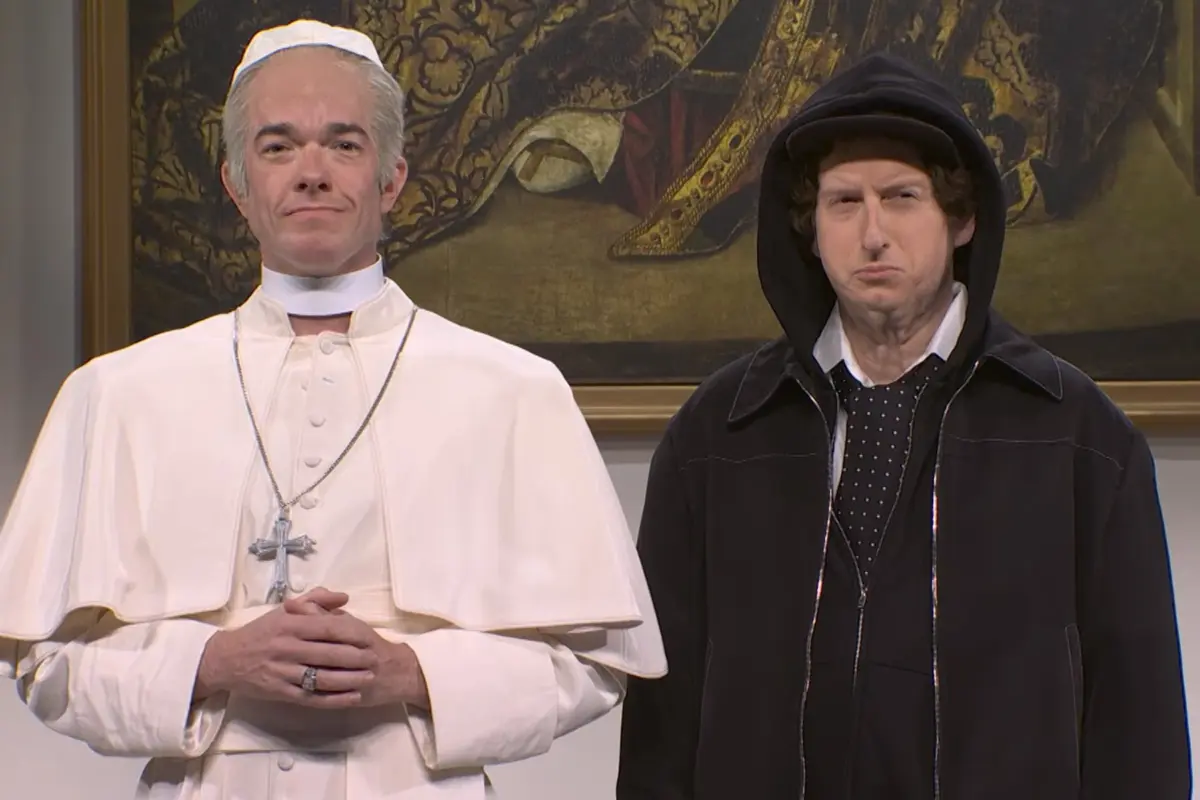
The private encounter between legendary musician Bob Dylan and His Holiness Pope Leo XIV earlier this month captivated global attention, largely due to the enigmatic nature of the figures involved and the scarcity of official details surrounding their conversation. While a photograph of the meeting quickly went viral across social media platforms, the specifics of what transpired behind Vatican walls remained largely unknown, fueling widespread curiosity and speculation. This vacuum of information provided fertile ground for satirical commentary, culminating in a highly anticipated, albeit initially unaired, sketch from NBC’s venerable late-night institution, Saturday Night Live. The parody, titled "Bob Dylan & The Pope," featuring host John Mulaney as Pope Leo XIV and cast member James Austin Johnson as Bob Dylan, meticulously lampooned the public’s perception of both personalities, attempting to "reveal" the imagined dialogue that captivated millions. Though it did not make the live broadcast on November 14, 2026, the sketch’s subsequent release on YouTube has ignited further discussion, highlighting the cultural appetite for interpreting the private moments of public icons.
The Real-Life Vatican Rendezvous: A Brief but Potent Encounter
The actual meeting between Bob Dylan and Pope Leo XIV took place in early November 2026, within the hallowed confines of the Vatican City. The event, reported by Vatican News, was officially described as "brief, consisting of greetings and a few lighthearted exchanges." This concise statement, while offering a glimpse into the formality of the occasion, did little to satisfy the fervent public interest in what two such profoundly influential, yet distinct, individuals might discuss. Dylan, a Nobel laureate in Literature and an icon of American folk music, has long maintained an intensely private and often inscrutable public persona. His music, rich with spiritual and philosophical undertones, has frequently engaged with themes of faith, morality, and societal change, making a meeting with the head of the Catholic Church symbolically resonant. Pope Leo XIV, in turn, as the spiritual leader of over a billion Catholics worldwide, embodies a commitment to global dialogue, interfaith understanding, and addressing contemporary social challenges. The intersection of these two worlds – secular artistic genius and spiritual leadership – was inherently compelling.
The Vatican’s decision to share a photograph of the meeting on its official Instagram account served as the primary, and perhaps only, tangible evidence of the encounter for the global public. The image, depicting the two men in conversation, immediately became a viral sensation. Social media users dissected every visual cue, attempting to decipher the body language, the expressions, and the implied tenor of their interaction. The lack of detailed accompanying text from the Vatican only amplified the mystery, transforming the photograph into a canvas for public imagination and conjecture. This phenomenon underscores the pervasive influence of digital media in shaping public discourse around high-profile events, where visual fragments often speak louder, or at least inspire more questions, than official communiqués. The public’s collective yearning for narrative, particularly when it involves figures of such magnitude, created an ideal environment for satirical intervention.
Saturday Night Live‘s Fictionalized Account: Filling the Informational Void
It was against this backdrop of widespread intrigue that Saturday Night Live conceptualized its parody, aiming to humorously fill the informational void left by the official Vatican report. The sketch, introduced by a familiar Star Wars-esque opening crawl, explicitly stated its premise: "The photos of their meeting went viral, but the conversation that followed has remained a mystery. Until now." This direct acknowledgment of the public’s curiosity set the stage for a comedic interpretation designed to resonate with those who had followed the real-life event.
John Mulaney, serving as host for the November 14 episode, embodied Pope Leo XIV with a blend of reverence and slightly awkward sincerity, a characteristic often associated with his comedic style. His Holiness, in Mulaney’s portrayal, earnestly attempts to engage Dylan in profound spiritual and artistic dialogue, reflecting the public’s expectation of such a meeting. However, the true comedic core of the sketch lay in James Austin Johnson’s uncanny impersonation of Bob Dylan. Johnson, renowned for his ability to capture the unique cadences and mannerisms of public figures, delivered a performance that perfectly encapsulated the enigmatic, often laconic, and occasionally dismissive public persona that Dylan has cultivated over decades.
The sketch’s dialogue brilliantly played on these established perceptions. Johnson’s Dylan candidly states that "Bob Dylan fans are my least favorite type of person," a line that drew laughter for its bluntness and its ironic detachment from the very audience that adores his work. He further quipped about having "complete Alzheimer’s about anything interesting that happened in my life," humorously addressing the musician’s well-documented reluctance to revisit or elaborate on his storied past. This portrayal of Dylan as an almost unwilling participant in his own legend, forcing the Pope to awkwardly attempt to keep the conversation afloat, provided the central comedic tension. Dylan’s sartorial choices in the sketch—a black hoodie under a black jacket—were also subject to a witty jab: "I told my stylist, ‘Make it look like I’m about to deejay my own funeral.’" This self-deprecating humor, delivered with Johnson’s signature Dylan drawl, served to further humanize and satirize the iconic musician, even as it reinforced his image as someone operating entirely on his own terms.
The "Cut-for-Time" Phenomenon: SNL’s Digital Strategy
Despite its comedic brilliance and topical relevance, the "Bob Dylan & The Pope" sketch did not make it to the live broadcast of the November 14 episode. This omission is a common occurrence in the fast-paced, time-constrained world of Saturday Night Live, where sketches are often trimmed or cut entirely due to various factors. In this instance, the article noted that Mulaney’s "pretty long monologue" and a "nine-minute Central Park horse-and-carriage musical skit" likely contributed to the time crunch. The episode also featured musical guest Phoebe Bridgers, who performed highlights from her Lost Weekend album, "Bobby" and "Still Standing," further occupying valuable airtime.
However, the modern media landscape offers a vital second life for such unaired content. SNL‘s strategic decision to upload "cut-for-time" sketches to its official YouTube channel late Sunday afternoon following the live broadcast has become a crucial component of its content distribution and audience engagement strategy. This practice not only allows viewers to access material that would otherwise be lost but also generates additional buzz and extends the show’s reach beyond its traditional linear television audience. For sketches like "Bob Dylan & The Pope," which tap into highly specific and current cultural conversations, the online release can sometimes garner even more attention than if they had aired live, given the ease of sharing and the dedicated online communities that follow such content. This digital strategy reflects a broader trend in television production, where supplementary online content is increasingly used to enhance the primary broadcast experience and cater to the viewing habits of a digitally native audience.

Broader Implications and Cultural Commentary: The Power of Parody
The SNL sketch, in its witty interpretation of the Dylan-Pope meeting, offered more than just laughs; it served as a form of cultural commentary, touching upon several significant themes.
Dylan’s Enigmatic Persona and Public Perception: The parody brilliantly capitalized on Bob Dylan’s well-established image as an artist who has consistently defied categorization and resisted public expectations. His reluctance to engage in conventional media interviews, his often cryptic pronouncements, and his general air of detached observation have created a mystique that the sketch both celebrated and gently mocked. By having Dylan express disinterest in his own fans and memory, SNL highlighted the disconnect that can sometimes exist between a revered artist and the consuming public, a dynamic that Dylan himself has often seemed to cultivate. The humor arises from the exaggeration of these traits, making the inscrutable musician relatable through caricature.
The Papacy in the Modern Age: While the sketch focused primarily on Dylan’s character, Mulaney’s portrayal of Pope Leo XIV, though earnest, subtly comments on the contemporary papacy’s efforts to engage with the secular world. The Pope’s willingness to meet with a figure like Dylan, a non-Catholic artist, speaks to a broader strategy of outreach and dialogue that has characterized many recent pontificates. The Vatican’s use of social media platforms like Instagram to share the initial viral photo also reflects an understanding of modern communication channels. The sketch implicitly, and humorously, suggests the challenges inherent in bridging these diverse worlds, even for figures as globally recognized as a Pope.
The Role of Satire in News Interpretation: In an era of rapid information dissemination and often shallow reporting, satire, particularly from platforms like Saturday Night Live, plays a crucial role in processing and interpreting current events. When official reports are sparse, as was the case with the Dylan-Pope meeting, parody steps in to offer a narrative, however fictionalized, that resonates with public sentiment. It allows for a collective processing of the news, transforming ambiguity into shared humor. The sketch didn’t just invent a conversation; it tapped into common assumptions and anxieties about celebrity interactions and the perceived solemnity of high-level meetings, providing a comedic release valve.
Media Consumption in the Digital Age: The entire trajectory of this story—from a viral Vatican Instagram photo to a cut-for-time SNL sketch finding massive viewership on YouTube—underscores the evolving landscape of media consumption. News breaks visually and quickly, generating immediate reactions and conversations online. Entertainment then responds to these conversations, often creating content specifically designed for digital platforms. The interconnectedness of these cycles means that a single event can spawn multiple layers of public engagement, each amplified by the digital infrastructure of the 21st century. The public’s immediate access to, and engagement with, both the initial photo and the subsequent parody illustrate a dynamic where news and entertainment are increasingly intertwined and mutually reinforcing.
Chronology of an Unlikely Encounter and its Parody
The timeline of events highlights the swift interplay between a real-world event and its comedic interpretation:
- Early November 2026: Bob Dylan has a private meeting with Pope Leo XIV at the Vatican.
- Soon After: The Vatican shares an official photograph of the meeting on its Instagram account. The image quickly goes viral, sparking global discussion due to the limited official details.
- November 14, 2026: Saturday Night Live airs its new episode, hosted by John Mulaney, with Phoebe Bridgers as the musical guest. The "Bob Dylan & The Pope" sketch, featuring Mulaney as the Pope and James Austin Johnson as Dylan, is filmed but ultimately cut from the live broadcast due to time constraints.
- Late Sunday Afternoon, November 15, 2026: SNL uploads the "Bob Dylan & The Pope" sketch to its official YouTube channel, making it available to a global online audience. The sketch rapidly gains traction, drawing significant views and commentary.
Inferred Public Reactions and Lasting Impact
While neither Bob Dylan nor the Vatican issued official statements regarding the SNL parody—which would be highly unusual given their respective institutional natures—the public reaction to the sketch has been overwhelmingly positive. Viewers praised James Austin Johnson’s impression of Dylan, noting its accuracy and comedic timing. John Mulaney’s portrayal of the earnest, slightly flustered Pope also resonated with audiences. The sketch quickly became a talking point online, with social media users sharing clips and debating its humor and its insights into both Dylan’s persona and the broader spectacle of celebrity-meets-dignitary encounters.
The enduring appeal of such an unlikely pairing, whether real or imagined, lies in the human fascination with the convergence of disparate worlds and the desire to understand the private moments of public figures. The SNL sketch, by offering a humorous, albeit fictional, glimpse into the conversation between Bob Dylan and Pope Leo XIV, provided a satisfying narrative for a public left wanting more by the official accounts. It reaffirmed Saturday Night Live‘s role as a cultural mirror, reflecting and refracting the events of the day through the lens of satire. In doing so, it not only entertained but also subtly reinforced the enigmatic legacy of Bob Dylan and the evolving public image of the modern papacy, all within the dynamic framework of digital media engagement. The sketch’s journey from a "cut-for-time" segment to a viral online sensation further cements the power of platforms like YouTube in shaping and extending the reach of comedic commentary in the contemporary news landscape.
