

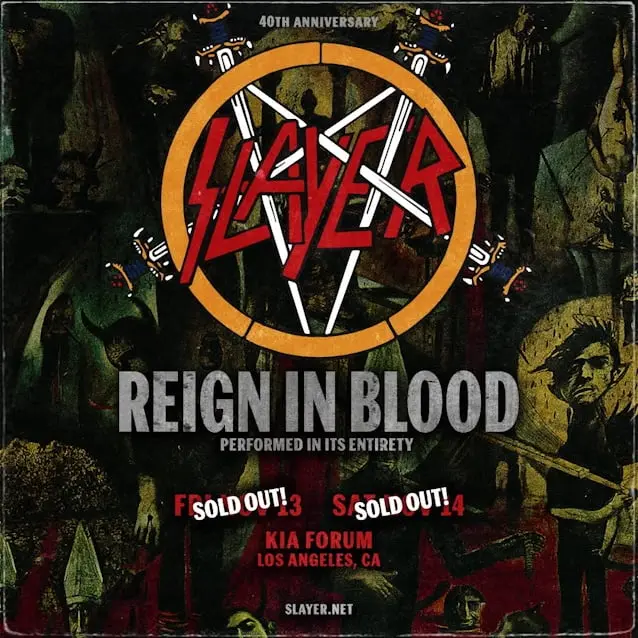
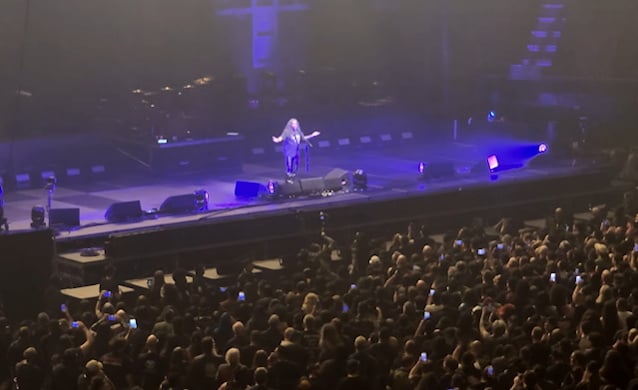
The highly anticipated November 14 concert by thrash metal legends SLAYER at the iconic Kia Forum in Los Angeles, California, was brought to a jarring halt for several minutes as safety concerns escalated due to disruptive behavior from a segment of the audience. The incident, which occurred seven songs into the band’s set, forced the veteran musicians to briefly leave the stage, leaving attendees in suspense and prompting a direct address from frontman Tom Araya regarding the necessity of maintaining order within the 17,500-capacity venue.
This pivotal moment unfolded during the second of two sold-out shows commemorating the 40th anniversary of SLAYER’s seminal 1986 album, "Reign In Blood." The band’s decision to pause the performance underscored the seriousness of the situation, as elements within the crowd engaged in actions that compromised the safety of fellow concertgoers and potentially endangered the venue itself. The interruption served as a stark reminder of the fine line between enthusiastic fandom and destructive behavior, a recurring theme in the history of intense live music events.
Araya’s Stern Address and Venue Safety Protocols
Upon returning to the stage alone, bassist and vocalist Tom Araya took the unprecedented step of directly addressing the audience, his voice amplified throughout the arena, conveying a message of disappointment and a plea for responsible conduct. Transcribed by BLABBERMOUTH.NET, Araya’s words painted a clear picture of the circumstances leading to the stoppage: "Quiet. You need to know why we stopped the show," he began, seeking the crowd’s attention. "All right? Quiet. I just need your attention, all right? I don’t know how many times I had this conversation when we first started playing in fucking huge places. I kept telling everybody, ‘Man, you gotta fucking maintain yourself. You can’t start destroying shit because they’ll shut this shit down.’"
Araya’s address highlighted the direct correlation between audience behavior and the venue’s operational integrity. He emphasized that while the band encourages a high-energy environment, this enthusiasm must be channeled responsibly. "No, I don’t wanna hear, ‘Oh.’ Listen, if you guys wanna have fun, you have fun right here in front of us in the middle of an area where there’s nothing you can destroy — except each other. When you start doing shit on the outside of that line right there, they’re gonna shut the place down. They don’t want anybody to get hurt."
The thrash metal icon stressed the venue’s commitment to attendee safety, a standard protocol in large-scale events. "There’s a lot of people that wanna come see the show. They don’t understand some of this stuff, and you guys get so fucking crazy, you start hurting each other." Araya acknowledged the inherent difficulty in controlling such passionate crowds, stating, "Look, you guys, I know it’s hard to fucking contain yourself. It’s hard to fucking maintain yourself. I know that. But you gotta fucking be respectful of the people around you, especially if you’re sitting in fucking seats."
The immediate cause for the halt was reportedly the intervention of the fire marshal, a critical authority in ensuring public safety at large gatherings. Araya relayed this to the audience: "The fire marshal said we’re gonna pause. We’re gonna pause until you guys get your shit and your act together, okay? And there’s no one to blame but you. And you know who I’m talking about. Not these people in the front. Not them. Not them. It’s you motherfuckers behind these people." This pointed finger underscored the specific areas of concern within the venue’s layout.
Araya’s impassioned plea also touched upon the broader implications of such behavior, referencing a perceived lack of accountability in contemporary society. "Now we’re in a time where there’s no consequences for the shit you fucking do. And we need consequences. If you guys keep that shit up, we’re gonna go home. And I hope you guys don’t do that next time we come." He further elaborated on the financial and professional repercussions the band faces when such incidents occur: "You think I should get away with shit and not get in trouble for it? We end up in trouble for it. We have to pay for that shit."
The gravity of his message was amplified by his sincerity: "I’m not joking, man. I’m not joking. Have you ever heard me talk to you like this?" He concluded his address with a final exhortation: "So you need to fucking get your heads on straight and behave like human fucking beings unless you’re in this fucking area right here in the front. Fire marshals are here, and they’re here for your safety. Your fucking safety. Do you hear what I’m saying? All right, let’s see how you act. We might come back."
Following Araya’s speech, SLAYER waited for several minutes, allowing time for the situation to de-escalate and for venue security and authorities to assess the environment. The band eventually returned to the stage to complete their performance, but the incident had undeniably cast a shadow over the anniversary celebration.
Chronology of the Incident and Setlist
The concert began as scheduled, with SLAYER delivering a powerful performance that delved into their extensive catalog. The setlist for the evening was meticulously crafted to honor the legacy of "Reign In Blood" while also showcasing other fan favorites. The initial seven songs, which preceded the halt, included:
- Disciple
- God Send Death (performed live for the first time since 2016)
- Bloodline (performed live for the first time since 2017)
- Payback
- War Ensemble
- The Antichrist (performed live for the first time since 2017)
- Jihad
It was during or immediately after the performance of "Jihad" that the disruptions reached a critical point, prompting the band’s exit from the stage. The subsequent pause lasted for an unspecified but significant duration, during which Araya delivered his address.
Upon their return, the band resumed their set, which included:
- Seasons In The Abyss (delayed by several minutes due to safety concerns)
- Born Of Fire
- Dead Skin Mask
- Hell Awaits
- South Of Heaven
The latter part of the concert was dedicated to a full playthrough of the "Reign In Blood" album, a centerpiece of the anniversary tour:
- Angel Of Death
- Piece By Piece
- Necrophobic
- Altar Of Sacrifice
- Jesus Saves
- Criminally Insane
- Reborn
- Epidemic
- Postmortem
- Raining Blood
The concert concluded with a final encore:
- Black Magic
The setlist demonstrates the band’s commitment to delivering a comprehensive experience for their fans, particularly in celebrating "Reign In Blood," an album widely considered a cornerstone of the thrash metal genre. The inclusion of songs performed live for the first time in years further highlighted the significance of this tour.
Historical Parallels: The "Seat Cushion Riot" and Palladium Incident
The recent disturbance at the Kia Forum is not an isolated incident in SLAYER’s storied career. The band has a documented history of encountering audience behavior that has tested the limits of venue capacity and security. Nearly four decades prior, in the summer of 1988, SLAYER experienced a legendary "seat cushion riot" during their "South Of Heaven" tour.
On August 31, 1988, at New York City’s Felt Forum, adjacent to Madison Square Garden, an overly enthusiastic crowd escalated their excitement to destructive levels. Toward the end of the main set, during the performance of "Ghosts Of War," fans began tearing up seat cushions and throwing them indiscriminately, with many projectiles reaching the stage. As the situation became increasingly dangerous, the band was forced to retreat backstage. The "seat cushion war" continued throughout the arena for several minutes. Subsequently, Tom Araya emerged to confront the crowd, delivering a stern reprimand: "You guys came here to have a good time, and you’re blowin’ it, big time! Why don’t you give us a break? We can probably never play here again."
Following this impassioned speech, SLAYER launched into the final song of the night, "Angel Of Death," while still navigating the barrage of flying cushions. A bootleg video later surfaced, capturing both Araya’s admonishment and the band’s performance of "Angel Of Death" under these chaotic circumstances. True to his prediction, SLAYER never returned to play the Felt Forum.
Another notable incident occurred in the same year, 1988, when SLAYER headlined a show at the Hollywood Palladium in Los Angeles. Approximately 200 fans were denied entry due to an oversold or scalped ticket situation, leading to significant unrest outside the venue. According to longtime manager Rick Sales, these disgruntled fans resorted to smashing through the venue’s front doors, throwing objects at security personnel, and initiating a mosh pit in front of the club.
Sales recounted the chaotic scene to Loudwire, describing witnessing a fan run through a plate glass door, only to refuse medical treatment and continue on. "When I followed the kid out the plate glass door, the police were organized into those little riot squads with batons," Sales added. "It was like a military exercise. Ten or twelve of them were together, jogging down the sidewalk and knocking everybody away. It was kind of like a war zone." Local media reported three injuries and three arrests stemming from the Hollywood Palladium incident, including fans arrested for throwing rocks and bottles at police and one individual allegedly attempting to run over a traffic control officer with a van.
These historical events provide crucial context for the recent disruption at the Kia Forum. They illustrate a recurring pattern where extreme fan enthusiasm, when unmanaged or misdirected, can lead to significant safety concerns and direct confrontations with the band and venue authorities.
Analysis and Broader Implications
The halting of the SLAYER concert at the Kia Forum carries several significant implications for the band, the venue, and the broader live music industry. Firstly, it highlights the ongoing challenge of managing the behavior of dedicated, often intensely passionate, fan bases at heavy music concerts. While SLAYER has always cultivated a devoted following that embraces the darker and more aggressive aspects of their music, this loyalty must be balanced with a collective responsibility for maintaining a safe environment.
Tom Araya’s direct intervention, while seemingly effective in this instance, is a rare and often last-resort measure. His words suggest a weariness with addressing such issues, particularly as the band approaches the twilight of its career. The fact that the fire marshal intervened underscores the critical role of venue safety protocols and the authority vested in these officials to suspend events when public safety is compromised. The Kia Forum, as a large-capacity entertainment venue, is obligated to adhere to stringent safety regulations, and the actions of a segment of the crowd directly triggered these emergency procedures.
The incident also raises questions about the evolving nature of concert security and crowd management in the digital age. While social media can amplify excitement and connect fans, it can also inadvertently contribute to the spread of misinformation or the coordination of disruptive activities, though no such intent was explicitly stated in this case. The band’s manager’s earlier accounts of the Hollywood Palladium incident also point to the persistent challenges of overselling, ticket scalping, and the resulting fan frustration that can spill into violence.
For SLAYER, these incidents, while infrequent in their later career, can still have professional repercussions. Araya’s comments about the band facing trouble and having to pay for damages are a testament to the financial and reputational risks associated with such events. The potential for future performances at certain venues to be jeopardized, as seen with the Felt Forum, remains a concern.
Ultimately, the Kia Forum incident serves as a cautionary tale for both artists and fans. It reinforces the understanding that while the energy and catharsis of a live SLAYER concert are unparalleled, this experience is contingent upon a shared commitment to respect, safety, and order. The band’s legacy, built on decades of relentless and uncompromising music, deserves to be celebrated in an environment that honors both their artistic vision and the well-being of all in attendance. The continued success of live music events hinges on the collective responsibility of everyone involved – from the performers and promoters to the venue staff and, crucially, the audience itself.
