

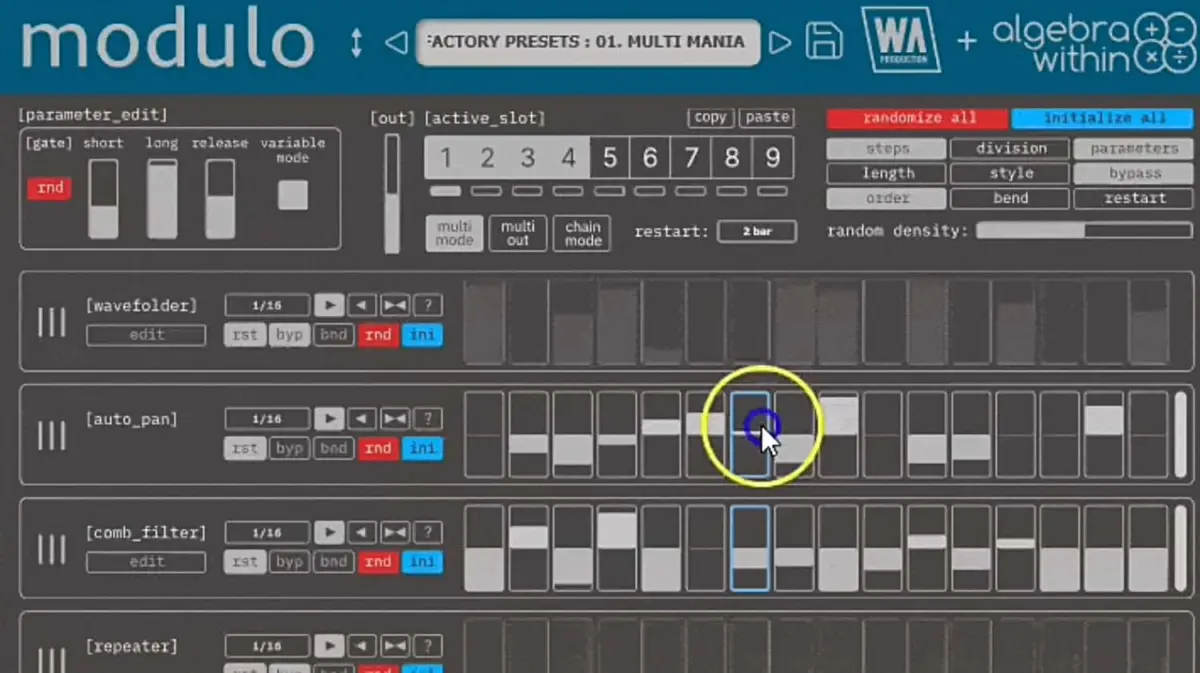
W. A. Production has officially expanded its software catalog with the launch of Modulo, a sequencer-driven multi-effects plugin designed to cater to the growing demand for rhythmic processing, glitch aesthetics, and evolving sonic textures. This new tool represents a significant step in the company’s efforts to provide high-level sound design capabilities to both professional producers and home-based creators. Modulo integrates ten independent effect lanes, each governed by its own 16-step sequencer, allowing for a level of rhythmic complexity that traditional static effect chains often struggle to achieve. By offering the ability to switch between eight distinct effect racks, the plugin serves as a comprehensive workstation for temporal and timbral manipulation.
The release of Modulo comes at a time when the electronic music production landscape is increasingly focused on "movement" and "non-static" sounds. Whether in the realm of industrial techno, ambient soundscapes, or modern pop, the ability to modulate parameters in sync with a project’s tempo has become a foundational requirement. Modulo addresses this by providing a centralized interface where multiple parameters can be sequenced simultaneously, effectively turning any audio input into a dynamic, rhythmic performance.
Technical Architecture and Sequencing Capabilities
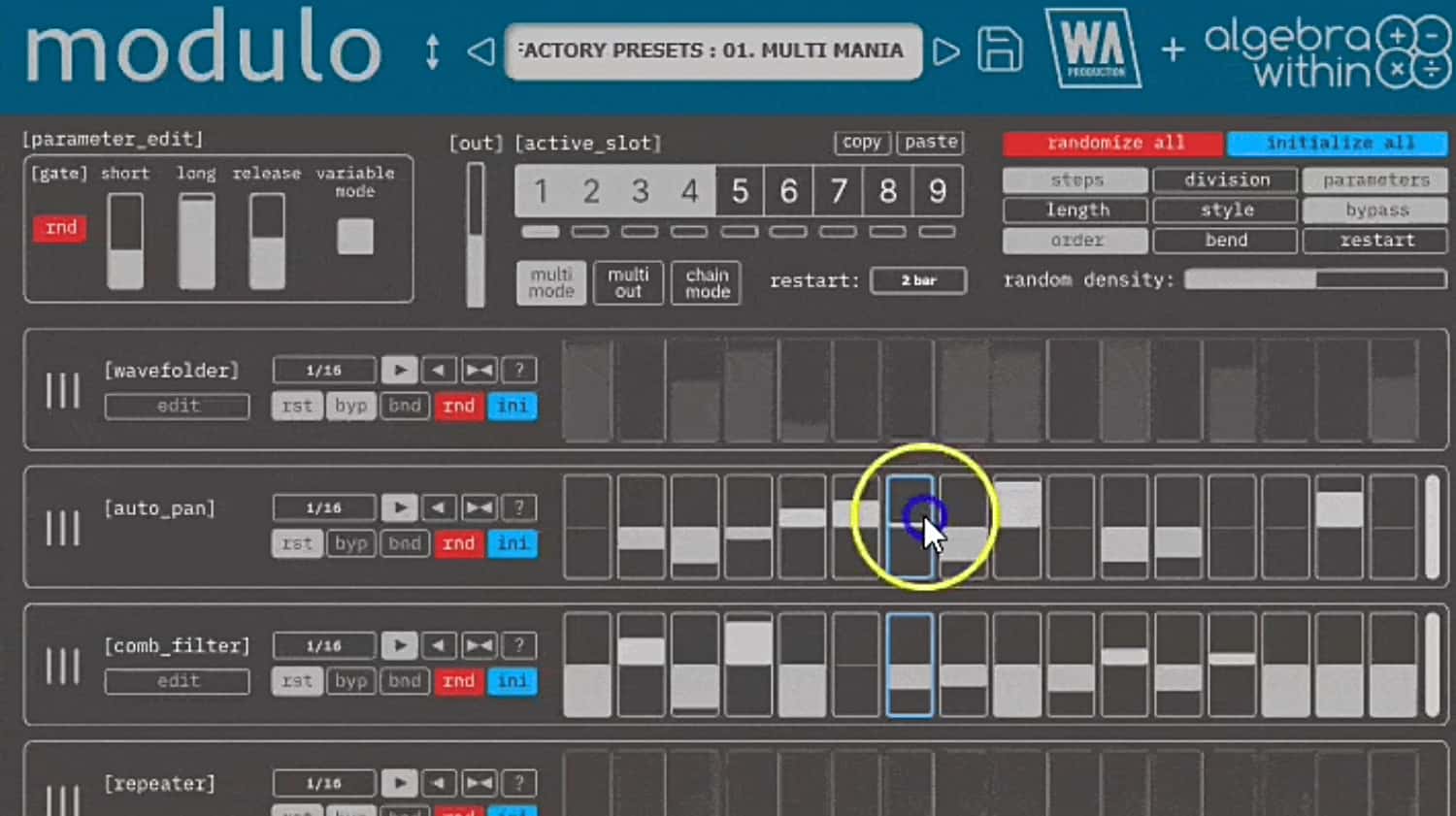
At the core of Modulo’s design is its sequencer-based architecture. Unlike standard multi-effects units that apply a uniform layer of processing to an audio signal, Modulo breaks the processing down into ten individual lanes. Each lane is dedicated to a specific effect type and is equipped with a 16-step sequencer. This allows users to program precisely when an effect is active and how its intensity fluctuates over the course of a musical measure.
The inclusion of ten independent lanes means that a producer can, for example, sequence a trance gate on lane one, a wavefolder on lane two, and a pitch shifter on lane three, each with a different rhythmic pattern. This multi-layered approach facilitates the creation of complex "glitch" patterns that would traditionally require hours of manual automation or destructive audio editing. Furthermore, the plugin allows users to build and switch between up to eight different effect racks. This "rack-switching" functionality is particularly useful for live performances or for creating dramatic transitions within a studio arrangement, as it enables the user to jump between entirely different processing configurations instantaneously.
To further enhance the generative potential of the software, W. A. Production has included global and individual randomization options. A standout feature in this regard is the "Density" control. This parameter allows users to determine the mathematical probability of sequencer steps triggering, providing a controlled way to introduce chaos and variation into a loop. This ensures that the resulting audio remains organic and less repetitive over long durations.
A Detailed Breakdown of the Ten Effect Modules
The versatility of Modulo is largely derived from its diverse selection of internal modules. Each module has been selected to provide a specific type of sonic transformation, ranging from traditional frequency filtering to more aggressive digital distortion and spatial manipulation.
- Trance Gate: This module provides the classic rhythmic volume-chopping effect synonymous with electronic dance music. By sequencing the gate, users can create intricate rhythmic pulses out of sustained pads or vocal drones.
- Filter: A versatile filtering module that allows for rhythmic frequency sweeps. Users can program the sequencer to open or close the filter at specific intervals, adding a sense of "breathing" to the audio.
- Phaser: This adds phase-based modulation, creating a sense of movement and swirling textures. When sequenced, the phaser can be used to highlight specific beats with metallic or liquid timbres.
- Repeater: A buffer-based effect that captures small segments of audio and repeats them. This is a staple for glitch music, allowing for the creation of "stutter" effects that are perfectly synced to the DAW’s tempo.
- Autopan: This module manipulates the stereo field. By sequencing the panning, producers can make sounds dance between the left and right speakers in complex patterns rather than simple back-and-forth oscillations.
- Spatial Processing: This lane focuses on width and depth, allowing for the rhythmic expansion of the stereo image or the sudden introduction of reverberant space.
- Comb Filter: Known for its metallic and resonant characteristics, the comb filter in Modulo can transform mundane sounds into industrial, harmonic textures.
- Wavefolder: A form of distortion that "folds" the peaks of a waveform back onto itself. This adds rich harmonic content and is particularly effective for beefing up basslines or giving synthesizers a "biting" edge.
- Pitch Shifter: This module allows for real-time frequency shifting. When applied via the sequencer, it can create melodic motifs out of non-tonal percussion or add "octave-jumping" artifacts to a lead line.
- Time Bender: A more experimental module that manipulates the temporal flow of the audio, allowing for granular-style time-stretching and time-compression effects.
Workflow Integration and Use Cases
Modulo is designed to be a "workhorse" plugin, suitable for a wide variety of audio sources. In modern drum programming, it can be used to add "micro-variations" to a standard 4/4 loop, ensuring that every bar sounds slightly different from the last. For synthesizers, Modulo can act as a secondary oscillator of sorts, adding rhythmic layers that complement the original melody.
The plugin’s interface is built to facilitate a fast workflow. The order of the effects can be rearranged via a simple drag-and-drop mechanism, which is crucial because the sequence of effects significantly alters the final output. For instance, placing a Pitch Shifter before a Reverb creates a vastly different sound than placing it after. This modular flexibility encourages experimentation, allowing sound designers to discover "happy accidents" that occur when disparate processing techniques collide.
The software is compatible with major Digital Audio Workstations (DAWs) including Ableton Live, FL Studio, Logic Pro, and Cubase, supporting VST3, AU, and AAX formats. This ensures that it can be integrated into almost any professional production environment, whether on macOS or Windows.
Market Context and Industry Positioning
The release of Modulo reflects a broader trend in the music software industry: the democratization of advanced sound design tools. Traditionally, sequencer-driven multi-effects were the domain of boutique developers and often carried high price tags or required steep learning curves. W. A. Production has positioned Modulo as an accessible alternative that does not sacrifice depth for ease of use.
The introductory pricing strategy is a clear indicator of the company’s intent to capture a large user base quickly. Priced at $12 during its launch period (extending through December 3, 2026), the plugin is positioned as an "impulse buy" that offers professional-grade utility. Even at its regular retail price of $39.90, Modulo remains highly competitive when compared to similar offerings from competitors like Sugar Bytes or Glitchmachines.
Industry analysts suggest that the rise of "intelligent" and "rhythmic" plugins is a response to the saturation of standard sample packs. As more producers use the same foundational sounds, the demand for tools that can uniquely "mangle" and "re-sequence" those sounds has skyrocketed. Modulo fits perfectly into this niche, providing a way for artists to stamp their own sonic identity onto their projects.
Chronology of Development and Availability
W. A. Production has a history of releasing utility-focused plugins that address specific pain points in the production process. Following the success of their previous releases such as the "Imprint" multiband enhancer and the "Heat" saturation series, Modulo represents a move toward more creative, "destructive" processing.
The development cycle for Modulo focused on optimizing the CPU efficiency of the ten simultaneous effect lanes. Given that multi-effects plugins can often be taxing on a computer’s processor, the engineering team at W. A. Production prioritized a streamlined codebase to ensure that Modulo could be used on multiple tracks within a single project without causing performance lags.
Availability Summary:
- Product Name: Modulo
- Developer: W. A. Production
- Formats: VST3, AU, AAX
- Compatibility: macOS (Intel and Silicon), Windows 10/11
- Introductory Price: $12.00 (Available until December 3, 2026)
- Standard Price: $39.90
Broader Implications for Music Production
The introduction of Modulo highlights the ongoing shift toward algorithmic and semi-generative composition. By allowing the software to handle the "density" and "randomization" of effects, the producer moves from the role of a manual editor to that of a curator. This allows for a more fluid creative process, where the focus is on selecting the best results from a range of computer-generated possibilities.
Furthermore, the "rack-switching" feature points toward a future where plugins are more "performative." As the line between studio production and live performance continues to blur, tools that allow for the instant reconfiguration of complex effect chains are becoming indispensable. Modulo provides this functionality in a stable, user-friendly package.
As the digital audio landscape continues to evolve, Modulo stands as a testament to the power of sequenced processing. It offers a bridge between the precision of traditional engineering and the unpredictability of modern glitch synthesis, making it a valuable addition to the toolkit of any contemporary audio professional. With its aggressive pricing and robust feature set, Modulo is expected to become a staple in the signal chains of electronic music producers worldwide over the coming years.
