

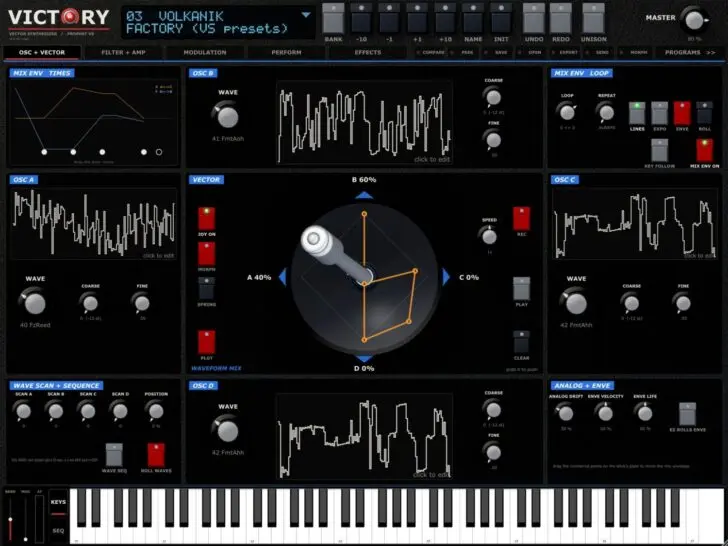
DenverSynthLabs has officially announced the release of VICTORY, a sophisticated software instrument designed to recreate and expand upon the legacy of the Sequential Prophet VS. By integrating the specific architectural nuances of 1980s vector synthesis with modern sequencing and modulation capabilities, the developer aims to provide a bridge between vintage digital grit and contemporary production workflows. The instrument arrives at a time of renewed interest in early digital synthesis, specifically the "hybrid" era where digital oscillators were paired with analog filters to create textures that were neither purely subtractive nor entirely FM-based.
Technical Foundation and Vector Synthesis Architecture
At the core of VICTORY is the four-oscillator vector synthesis engine, a technology pioneered by Sequential Circuits in 1986. Unlike traditional subtractive synthesis, which typically relies on mixing two or three static oscillators, vector synthesis allows the user to navigate between four distinct sound sources using a two-axis joystick. This creates dynamic, evolving timbres as the balance of the four waveforms shifts in real time.
DenverSynthLabs has prioritized authenticity in its digital reconstruction. The software utilizes the original 12-bit oscillator waveforms from the Prophet VS hardware. To maintain the specific "aliasing" and harmonic profile of the original unit, the developer modeled the 128-step Digital-to-Analog Converter (DAC) character. This ensures that the waveforms retain the slight digital imperfections that contributed to the "shimmer" and "air" of the 1980s hardware, avoiding the clinical cleanliness often associated with modern 24-bit or 32-bit software oscillators.
Furthering the customization options, VICTORY allows users to go beyond the factory waveforms. The interface includes a waveform editor where users can draw custom shapes, effectively allowing for the creation of unique additive or single-cycle digital textures. This data is then processed through a modeled signal path that includes a recreation of the CEM3389 integrated circuit. The CEM3389 was the "Curtis" chip responsible for the Prophet VS’s signature analog filter sound, known for its resonant character and ability to maintain low-frequency weight even at high resonance settings. DenverSynthLabs claims to have calibrated this software model against their own physical Prophet VS unit to ensure accurate key tracking and resonance response.
Historical Context: The Legacy of the Prophet VS
The release of VICTORY serves as a modern tribute to one of the most pivotal instruments in synthesizer history. The original Sequential Prophet VS was released in 1986, during a period of intense competition between American and Japanese synthesizer manufacturers. It was the final flagship instrument released by Sequential Circuits before the company was acquired by Yamaha.
The Prophet VS was a radical departure from the analog-only Prophet-5. Designed by a team that included synthesis pioneer Dave Smith and digital designer Chris Meyer, the VS introduced the concept of the "Vector" (the V in VS). When Sequential ceased operations, much of the engineering team transitioned to Korg, where they evolved the vector concept into the Korg Wavestation. Consequently, the Prophet VS is often cited as the "missing link" between the analog era and the workstation era of the 1990s.
By emulating this specific architecture, DenverSynthLabs is targeting a niche of sound designers who value the "lo-fi" digital aesthetic of the mid-80s. The Prophet VS was famously used by film composers such as John Carpenter and Vangelis, as well as pop icons like Depeche Mode and Brian Eno. Its ability to create "glassy" pads, metallic bells, and industrial textures made it a staple of science fiction and horror soundtracks—a sonic palette that VICTORY aims to replicate for modern DAWs.
Modern Enhancements and Sequencing Capabilities
While the foundation of VICTORY is rooted in 1986, the software introduces several features that were technologically impossible on the original hardware. These additions are designed to meet the demands of modern electronic music production and cinematic scoring.
Patch Morphing and Wave Sequencing
One of the most significant upgrades is the patch morphing system. This allows users to load up to four complete programs and use a secondary morphing interface to blend between them. This is distinct from the oscillator vector mixing; while the joystick mixes four waveforms, the patch morpher blends entire sets of parameters, including filter settings, envelopes, and modulation matrices.
Additionally, VICTORY incorporates wave sequencing, a feature that appeared in the Prophet VS’s successors but was absent from the original unit. Each of the four oscillators can be programmed to cycle through a sequence of up to eight different waveforms during a single note press. When combined with the vector joystick, this creates a multidimensional soundscape where the internal timbres of each "corner" of the vector are themselves in a state of constant flux.
Advanced Sequencing and Arpeggiation
The instrument includes a dedicated snapshot sequencer, which allows for the automation of sound changes at individual steps of a sequence. This is paired with a gate sequencer for rhythmic pulsing and a flexible arpeggiator. Notably, the joystick movements themselves can be sequenced, allowing for complex, rhythmic timbral shifts that are perfectly synced to the host DAW’s tempo—a task that required tedious MIDI CC automation or manual performance on the original hardware.
Sound Library and Professional Integration
To provide immediate utility for producers, VICTORY ships with a massive library of 5,200 programs. This collection includes:
- The original factory sound banks from the 1986 Prophet VS.
- Archived ROM banks that were sold as cartridges during the 1980s.
- 100 new patches specifically designed to showcase the software’s expanded modulation and effects features.
For owners of the original hardware or long-time enthusiasts, VICTORY supports the import of Prophet VS SysEx banks. This ensures that custom sounds created decades ago can be brought into the modern digital environment without the need for manual parameter matching.
The effects section has also been significantly expanded. While the original Prophet VS featured a basic chorus, VICTORY includes a full suite of studio-grade processors. This includes distortion and drive circuits for adding harmonic warmth, a phaser, a flanger, and two types of delay: a clean digital delay and a modeled Bucket Brigade Device (BBD) delay for darker, analog-style echoes. The reverb section offers multiple algorithms, ranging from tight rooms to expansive, ambient spaces.
Market Analysis and Industry Implications
The introduction of VICTORY at an introductory price of $25 (regularly $50) represents a strategic move by DenverSynthLabs to disrupt the boutique software synthesizer market. For comparison, other high-end Prophet VS emulations often retail for significantly higher prices or are bundled within expensive "collection" suites. By offering a high-fidelity, focused emulation at a lower price point, DenverSynthLabs is positioning VICTORY as an accessible entry point for producers interested in vector synthesis.
Industry analysts suggest that the "retro-digital" trend is currently at its peak. As the market for analog emulations (Moog, Juno, etc.) becomes saturated, developers are increasingly looking toward the 12-bit and 16-bit eras for inspiration. The popularity of "lo-fi" aesthetics in genres such as synthwave, vaporwave, and modern film scoring has created a high demand for instruments that can produce the specific grit of early digital converters.
Furthermore, the standalone format alongside VST3 and AU support indicates a push for versatility. By offering a standalone version, DenverSynthLabs allows performers to use VICTORY on stage without the overhead of a full DAW, potentially appealing to live electronic acts who require the specific textures of the Prophet VS without the fragility and maintenance costs associated with 40-year-old hardware.
Development and Official Statements
In documentation accompanying the release, DenverSynthLabs emphasized the "obsessive" nature of their modeling process. The developer stated that the goal was not just to create a synthesizer that sounded "like" the Prophet VS, but one that behaved like it. This included simulating the non-linearities of the summing stage where the four digital oscillators meet.
"The Prophet VS has a specific way of ‘breaking up’ when all four oscillators are pushed to their maximum in the vector mix," the developer noted. "By modeling the summing stage and the specific behavior of the CEM3389 filter under those conditions, we’ve managed to capture the aggressive, sometimes unpredictable nature of the original machine."
Early reactions from the synth community have highlighted the inclusion of the sequenceable joystick and the extensive preset library as standout features. Beta testers have reportedly praised the instrument’s ability to handle complex modulation without significant CPU strain, an important factor for modern producers running multiple instances of software instruments.
Availability and System Requirements
VICTORY is available for immediate download through the DenverSynthLabs online store. The software is compatible with both Windows and macOS systems. It supports VST3 and AU plugin formats, ensuring compatibility with major DAWs including Ableton Live, Logic Pro, FL Studio, and Cubase. The standalone version is included for users who prefer a dedicated environment for sound design or live performance.
The introductory pricing of $25 is expected to remain in place for a limited time before the instrument moves to its standard retail price of $50. This aggressive pricing strategy, combined with the depth of the emulation and the massive preset library, positions VICTORY as a significant new entry in the virtual instrument landscape, offering a specialized tool for those seeking the unique harmonic character of the vector synthesis era.
