

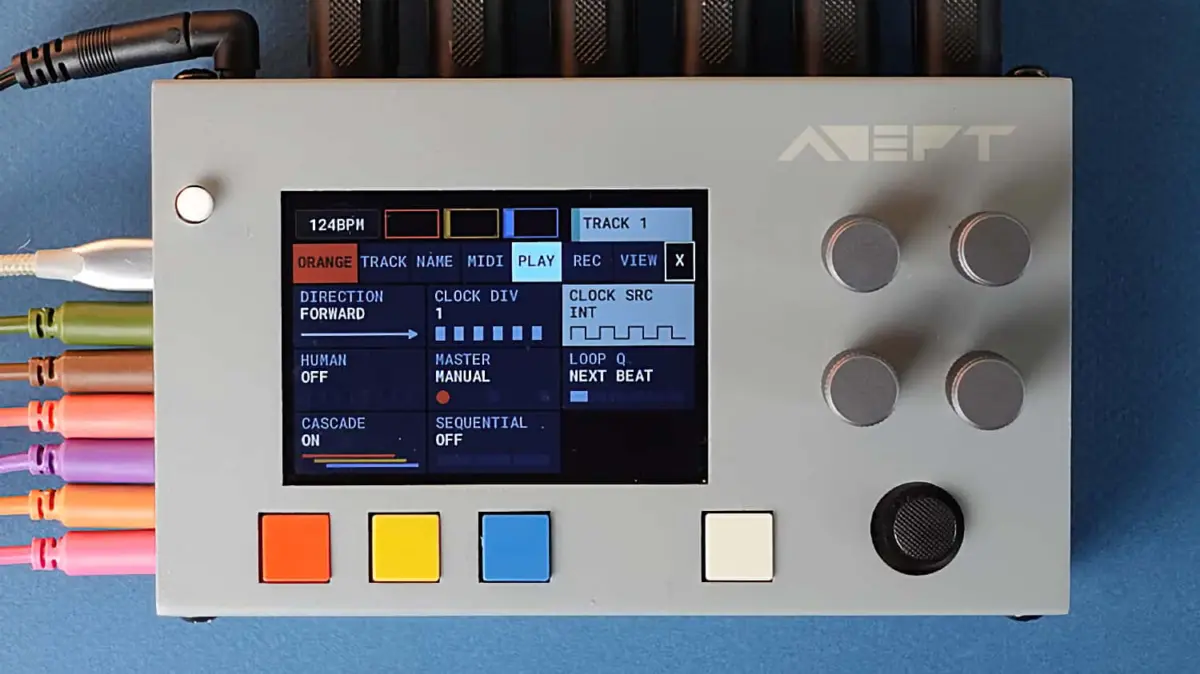
The landscape of electronic music production is witnessing a significant shift toward generative and non-linear sequencing, a trend further solidified by the recent launch of the ADEPT hardware sequencer by AARM. Debuting on the Kickstarter crowdfunding platform, ADEPT is a standalone MIDI and Control Voltage (CV) sequencer designed to challenge traditional step-sequencing paradigms through a unique multi-playhead architecture. By allowing multiple independent playheads to traverse a single musical pattern simultaneously, the device offers a degree of rhythmic and melodic complexity that typically requires extensive modular setups or complex software environments.
The ADEPT system is built around 12 tracks, each capable of hosting three independently configurable playheads. This approach allows a single set of musical data—whether a melody, a chord progression, or a drum pattern—to be interpreted in three different ways at once. This multi-playhead methodology serves as the core of AARM’s design philosophy, aimed at providing performers and composers with a tool that bridges the gap between intentional composition and algorithmic discovery.
The Architecture of Multi-Playhead Sequencing
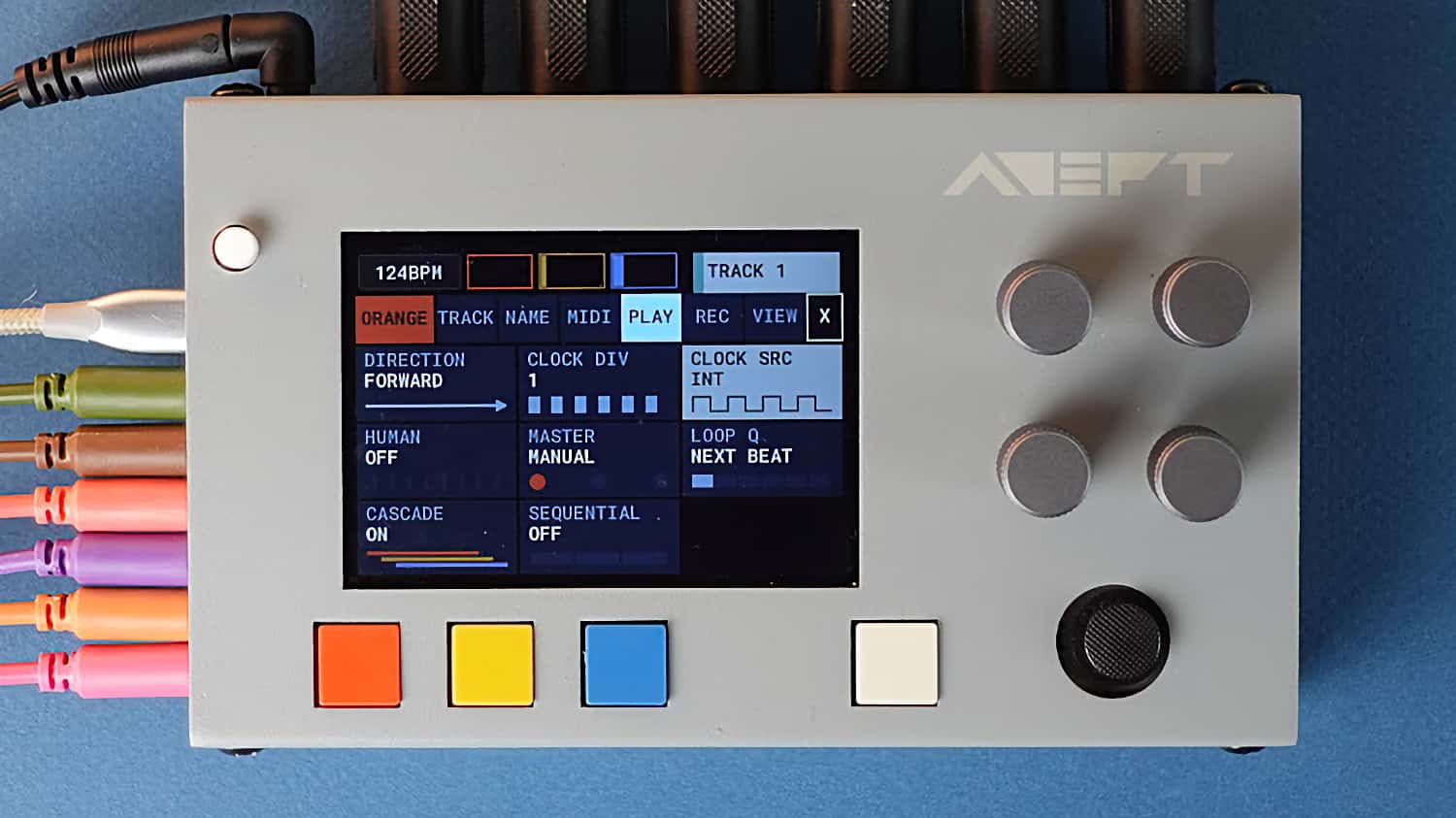
At the heart of the ADEPT hardware are its 12 tracks, which are not merely static containers for notes but dynamic environments for generative exploration. Each track is accessed by three distinct playheads, color-coded as Orange, Yellow, and Blue. These playheads are far more than simple mirrors of one another; each can be independently programmed with its own specific parameters, including sequence length, playback direction (forward, backward, pendulum, or random), clock division, and clock source.
Furthermore, each playhead can be routed to a specific output. This configuration enables a single track to function as three separate musical voices. For example, a user could program a 16-step melodic sequence where the Orange playhead plays the sequence forward at a standard 1/16th note clock to drive a lead synthesizer. Simultaneously, the Yellow playhead could read the same sequence in reverse at a half-speed clock division to create a counter-melody, while the Blue playhead could utilize a randomized direction and a different MIDI channel to trigger a percussive element.
This architectural flexibility allows for the effortless creation of polyrhythms and polymeters—musical structures that are often cumbersome to program in standard digital audio workstations (DAWs) or traditional hardware sequencers. By decoupling the playheads from the underlying data grid, AARM has provided a platform where complex musical evolution occurs as a byproduct of simple parameter adjustments.
Eleven Distinct Sequencer Engines
ADEPT distinguishes itself through a diverse library of 11 internal sequencer types. These engines provide the mathematical and logical frameworks through which the playheads interact with the musical data. The inclusion of these varied types ensures that the device can adapt to multiple genres, from rigid techno and ambient soundscapes to experimental avant-garde compositions.
The available sequencer types include:
- Note Grid and Drum Grid: These provide familiar interfaces for melodic and percussive programming, serving as the foundation for traditional sequencing.
- Euclid: Based on Euclidean algorithms, this engine distributes a set number of pulses across a specific time frame as evenly as possible, a technique widely used in world music and modern electronic production.
- Logic and Pachinko: These engines introduce stochastic and Boolean elements. The Pachinko mode, likely inspired by the "random walk" or "Bernoulli gate" concepts found in modular synthesis, allows for controlled unpredictability.
- Trapdoor, Pathways, and Cube: These modes focus on spatial and geometric movement, where notes are triggered based on the playhead’s journey through multi-dimensional or interconnected grids.
- Orbit and Deflector: These engines simulate physical or celestial movements to dictate note triggers, offering a more fluid, less grid-dependent approach to timing.
A critical feature of the ADEPT workflow is the ability to switch between these sequencer types on the fly without losing the underlying data. This "hot-swapping" of engines allows a composer to view the same musical idea through different algorithmic lenses, facilitating rapid iteration and creative breakthroughs. Moreover, the generative engines can be configured to trigger entire tracks rather than just individual notes, creating a nested hierarchy of sequencing where one pattern controls the behavior of another.
Integration and the ADEPT Link Ecosystem
Recognizing the modern producer’s need for hybrid workflows, AARM has developed the ADEPT Link companion software. This application serves as a bridge between the hardware unit and a computer-based environment. Available as a standalone application or as a plugin (supporting VST3 and AU on macOS and VST3 on Windows), ADEPT Link provides two-way control and communication.
One of the primary functions of ADEPT Link is its ability to host VST instruments. This allows the ADEPT hardware to control software synthesizers directly, effectively turning the hardware into a sophisticated controller for a user’s entire digital library. The software also simplifies the management of MIDI routing and provides a visual interface for complex configurations. To ensure longevity and ongoing refinement, AARM has committed to free firmware updates, which can be installed via a browser-based web application over a standard USB connection.
Development Timeline and Project Background
The launch of the ADEPT Kickstarter follows an intensive period of research and development by the AARM team. While the company is a relatively new entrant in the hardware market, the design of ADEPT suggests a deep understanding of the limitations inherent in current sequencing technology. The development timeline moved from initial conceptualization and software modeling of the playhead algorithms to the creation of multiple hardware prototypes.
The current Kickstarter campaign represents the transition from the "beta" phase to full-scale production. AARM has already released a beta version of the ADEPT Link software, signaling that the digital infrastructure supporting the hardware is already well-advanced. According to the project’s roadmap, the funds raised during the campaign will be allocated toward component procurement, final assembly, and the rigorous quality assurance testing required for hardware intended for professional studio and live use.
Market Analysis and Industry Context
The release of ADEPT occurs at a time when the "Dawless" movement—producing music without a computer—is at an all-time high. Musicians are increasingly seeking tactile, dedicated hardware that offers the depth of software without the distractions of a computer screen. ADEPT enters a competitive market currently occupied by established devices such as the Squarp Hapax, the Polyend Play, and the Torso T-1.
However, ADEPT’s specific focus on the "multi-playhead" concept provides it with a unique value proposition. While other sequencers offer generative features like probability and Euclidean rhythms, the ability to have three independent "readers" on a single track is a feature more commonly associated with high-end modular modules like the Monome Teletype or specialized Max/MSP patches. By packaging this capability in a standalone, portable unit with both MIDI and CV connectivity, AARM is targeting a niche of power users who prioritize complex rhythmic interplay.
Industry analysts suggest that the $325 early-bird pricing is highly competitive. For a device offering 12 tracks of CV and MIDI sequencing with high-level generative capabilities, the price point sits significantly lower than many of its direct competitors, which often retail between $600 and $1,000. This aggressive pricing strategy may be intended to build a large user base quickly, fostering a community that can contribute to the device’s evolution through feedback and shared sequences.
Official Positioning and Statements
In documentation associated with the launch, AARM emphasizes that ADEPT was designed to be "musical first," despite its mathematical underpinnings. The developers have stated that the goal was to create an interface where complex results could be achieved through intuitive physical interaction. By using color-coded playheads and a streamlined button layout, the design aims to reduce the "menu diving" that often plagues feature-rich hardware.
While official testimonials from high-profile artists are often reserved for post-launch marketing, early reactions from the synthesizer community and beta testers have highlighted the device’s ability to act as a "brain" for a larger studio. The inclusion of CV outputs makes it particularly attractive to the Eurorack modular community, who often struggle to find compact sequencers that can provide enough modulation and gate sources for complex patches.
Risks, Pricing, and Availability
As with all crowdfunded hardware projects, potential backers are reminded of the inherent risks involved in manufacturing. Supply chain fluctuations, particularly regarding specialized semiconductors and high-quality encoders, have affected numerous music tech startups in recent years. However, AARM has attempted to mitigate these concerns by demonstrating working hardware and a functional software companion at the time of the campaign’s launch.
The ADEPT Kickstarter campaign features an early-bird tier at US$325, with the subsequent tier set at US$350. These prices represent a significant discount over the projected final retail price. The package typically includes the ADEPT unit, a USB cable for power and data, and access to the ADEPT Link software suite.
Broader Implications for Music Technology
The ADEPT sequencer represents more than just a new piece of gear; it is an indicator of the maturing "generative" music market. As algorithms become more integrated into the creative process, the role of the musician is shifting from that of a note-by-note programmer to a "curator of systems." ADEPT facilitates this shift by providing the systems (the engines and playheads) and allowing the human operator to set the boundaries and directions of the musical flow.
If successful, ADEPT could influence future designs from larger manufacturers, pushing the industry toward more flexible, non-linear sequencing methods. For now, it stands as a testament to the innovation currently being driven by small, independent developers who are willing to experiment with unconventional musical interfaces. As the campaign progresses, the electronic music community will be watching closely to see if ADEPT can deliver on its promise of making complex, multi-layered composition accessible to a broader range of artists.
