

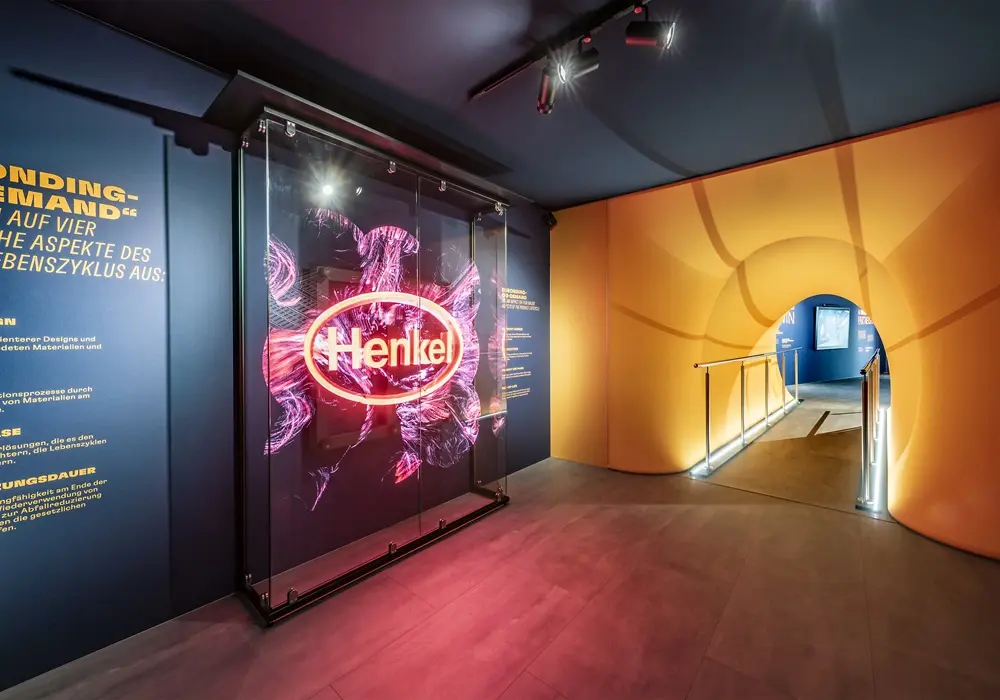
The global industrial and consumer goods giant Henkel marked its sesquicentennial anniversary on September 26, 2026, with a massive commemorative festival held at its landmark headquarters in Düsseldorf. While the event drew an estimated 17,000 employees and their families to the sprawling industrial site, the architectural highlight of the celebration was undoubtedly the "Bonding Space." This immersive brand environment, specifically designed for the Henkel Adhesive Technologies business unit, utilized cutting-edge textile engineering to transform the abstract concept of chemical adhesion into a tangible, walk-through experience. Developed through a high-level collaboration between lead agency Avantgarde, Artlife Messe- und Eventbau, and the textile specialists at hms design solutions, the installation served as a physical manifesto of Henkel’s 150-year legacy of "bonding" people, technologies, and markets.
A Vision of Adhesion: The Architectural Concept
The creative genesis of the Bonding Space originated with Avantgarde, a global agency known for experiential marketing. Their designers sought to create a structure that looked as though two separate entities had been glued together and then forcefully pulled apart, leaving behind long, elastic strands of adhesive. This visual metaphor was intended to represent the strength and flexibility of Henkel’s industrial adhesives—products that are often invisible in daily life but essential to the integrity of everything from smartphones to high-speed trains.
To bring this vision to life, the project required a sophisticated fusion of traditional event construction and avant-garde textile physics. The final layout consisted of two primary tent structures: a larger 10-by-10-meter pavilion and a smaller 5-by-5-meter satellite. These were linked by a central, weather-protected corridor. The "magic" of the installation lay in the external envelope, where oversized, three-dimensional "glue threads" made of specialized stretch textiles were tensioned between the two structures. Visitors walking through the connecting tunnel found themselves literally moving through the heart of a simulated adhesive bond, creating a powerful spatial narrative of connectivity.
Technical Engineering and the Challenge of Stretch Textiles
Translating a conceptual sketch into a structurally sound, outdoor-ready installation required the specialized expertise of hms design solutions. Unlike rigid architectural structures, working with stretch textiles involves managing complex variables such as elasticity, tension distribution, and environmental factors like wind load and moisture.
Steve Otto, Head of Exhibition Design at hms design solutions, noted that the project could not be finalized through digital modeling alone. "The complexity of the shapes meant that we couldn’t simply manufacture a finished product from a CAD file," Otto explained. "The material’s behavior in three-dimensional space is highly dynamic. We had to engage in a rigorous process of physical prototyping to understand how the tension points would interact with the tent frames and the central tunnel."
To ensure success, hms design solutions conducted several full-scale trial assemblies at their dedicated showroom. These rehearsals allowed the engineering team to:
- Optimize Geometry: Adjust the cutting patterns of the stretch fabrics to ensure the "glue threads" maintained their organic, fluid appearance without sagging or over-tensioning.
- Refine Connection Points: Develop bespoke keder and zipper systems that allowed the textiles to integrate seamlessly with the structural frames provided by Fetscher Zelte.
- Test Durability: Evaluate the resilience of the blockout textiles and printed surfaces against the mechanical stresses of assembly and the potential for late-September weather in the Rhine region.
This iterative process was crucial for the integration of the "Bonding Space" into the wider festival infrastructure. By the time the components arrived at the Düsseldorf plant, the assembly team had a proven blueprint for a construction that was as safe as it was visually striking.
Inside the Bonding Space: Showcasing High-Tech Innovation
While the exterior of the Bonding Space captured the imagination of passersby, the interior was designed to educate and inspire. Henkel Adhesive Technologies is the global market leader in the adhesives sector, and the pavilion served as a high-tech showroom for its latest breakthroughs.
One of the central exhibits featured Henkel’s partnership with Formula E racing. Adhesives play a critical role in the manufacturing of electric vehicle (EV) batteries, providing thermal management, structural integrity, and lightweighting solutions that are vital for high-performance racing. By showcasing a Formula E car within the textile-walled environment, Henkel demonstrated how its 150 years of experience are currently driving the future of sustainable mobility.
The interior design mirrored the high-quality finish of the exterior. hms design solutions utilized their proprietary frame systems to create seamless, printed wall surfaces and elegant textile ceilings. These elements ensured that the brand’s visual identity was consistent throughout the space, using blockout fabrics to prevent external light from interfering with the immersive lighting and digital displays inside.
A 150-Year Chronology: From Laundry Detergent to Global Leader
The 150th-anniversary festival was more than just a corporate party; it was a celebration of a journey that began in 1876. To understand the significance of the "Bonding Space," one must look at the timeline of Henkel’s evolution:
- 1876: Fritz Henkel founds Henkel & Cie in Aachen, launching a "Universal Detergent" based on silicate.
- 1878: The company moves to Düsseldorf and introduces Henkel’s Bleaching Soda, its first major commercial success.
- 1907: Launch of Persil, the world’s first self-acting laundry detergent, which revolutionizes housework.
- 1922: Henkel begins producing its own adhesives for packaging its products, marking the birth of the Adhesive Technologies business unit.
- 1969: The invention of the Pritt stick—the world’s first glue stick—inspired by the mechanism of a lipstick.
- 1997: Acquisition of Loctite, significantly expanding the company’s industrial adhesive portfolio.
- 2020s: A strategic pivot toward sustainability and digitalization, focusing on circular economy solutions and CO2-neutral production.
The Bonding Space at the 2026 festival represented the culmination of this history. It highlighted how a company that started with a simple cleaning product became a vital partner for nearly every major industrial supply chain in the world.
Logistics and Collaborative Execution
Executing an event for 17,000 people on an active industrial site presents significant logistical hurdles. The Düsseldorf plant, often referred to as a "city within a city," continued its operations while the festival took place. This required the construction teams—led by Artlife Messe- und Eventbau—to adhere to strict safety protocols and precise timelines.

Artlife, acting as the general contractor for the brand spaces, coordinated the various specialist partners. While Fetscher Zelte provided the heavy structural shells, hms design solutions acted as the "aesthetic and functional skin" of the project. This division of labor allowed for a high degree of specialization:
- Artlife: Oversight of construction, interior fit-out, and overall project management.
- hms design solutions: Textile engineering, large-format printing, custom confection of stretch elements, and on-site assembly of the specialized facades.
- Avantgarde: Creative direction and brand storytelling.
The successful delivery of the Bonding Space demonstrated the strength of the German event industry’s collaborative ecosystem, where medium-sized specialized firms come together to execute world-class brand experiences for DAX-listed corporations.
Broader Impact: The Future of Brand Architecture
The Henkel "Bonding Space" is indicative of a broader trend in corporate communications where temporary architecture is used to foster emotional connections with employees and stakeholders. In an era dominated by digital interaction, the physical "touchpoint" of a brand has gained renewed importance.
For Henkel, the anniversary was a strategic opportunity to reinforce its corporate culture during a period of global economic transformation. By focusing on the concept of "Bonding," the company sent a dual message: one of technical superiority in its products and one of social cohesion within its workforce. The use of textiles—a material that is inherently flexible yet strong when properly engineered—served as an ideal medium for this message.
Furthermore, the project highlighted the growing role of "Textile Architecture" in sustainable event design. Stretch fabrics and modular frame systems are often more efficient to transport and quicker to assemble than traditional wood or steel constructions, offering a lower carbon footprint for temporary installations.
Conclusion: A Milestone in Corporate Storytelling
As the sun set over the Düsseldorf Rhine district on September 26, 2026, the illuminated "Bonding Space" stood as a testament to Henkel’s enduring spirit of innovation. The 150-year anniversary was not merely a look back at the past, but a showcase of the technical and creative capabilities that will define the company’s next chapter.
Through the expert application of textile engineering by hms design solutions and the visionary design of Avantgarde, Henkel succeeded in making the invisible world of adhesives visible. The "Bonding Space" was more than a tent; it was a physical manifestation of the ties that have held the company together for a century and a half, and the new connections it continues to build in the modern industrial landscape. For the 17,000 attendees, the experience provided a memorable insight into the "glue" that binds one of Germany’s most storied companies to the global future.
