

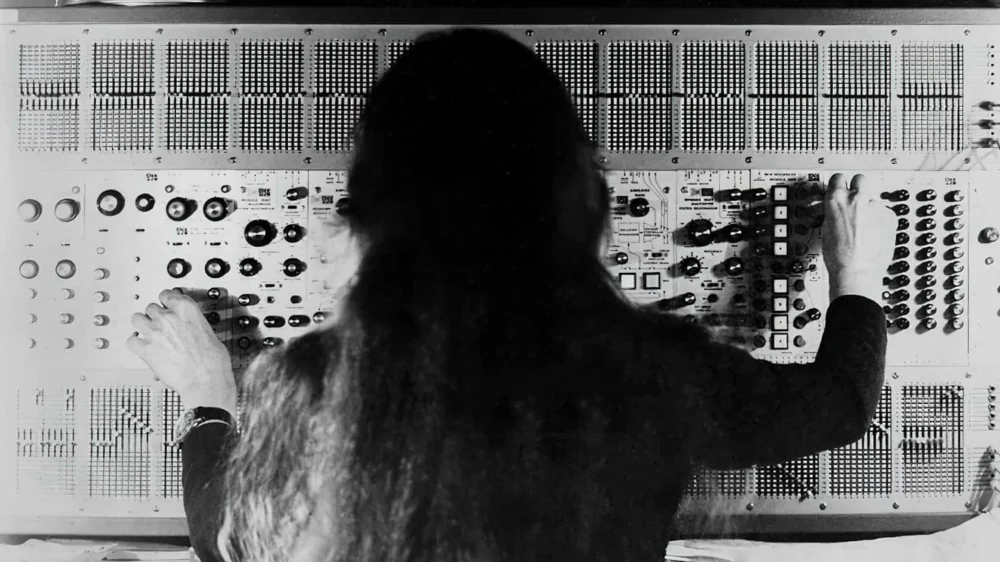
The international music community is mourning the loss of Éliane Radigue, the French composer and electronic music visionary who redefined the boundaries of sound, time, and perception. Radigue, whose career spanned more than seven decades, passed away on February 23, 2026, at the age of 94. Known for her profound contributions to drone music and her mastery of the ARP 2500 modular synthesizer, Radigue’s work served as a bridge between the mid-century avant-garde and the contemporary ambient movement. Her death marks the end of an era for experimental music, leaving behind a legacy characterized by what she described as "the radical power of slowness."
Born in Paris on January 24, 1932, Radigue’s journey into the world of sound began not with traditional instrumentation, but with the raw materials of the industrial age. Her evolution from a student of the French musique concrète pioneers to a global icon of minimalist synthesis reflects a lifelong commitment to the exploration of the "inner life" of sound.
The Formative Years: Musique Concrète and the Studio d’Essai
In the mid-1950s, Radigue became a student of Pierre Schaeffer and Pierre Henry at the Studio d’Essai in Paris. Schaeffer and Henry were the architects of musique concrète, a revolutionary approach to composition that utilized recorded sounds—train whistles, footsteps, and kitchen utensils—as musical objects. Under their tutelage, Radigue learned the rigorous art of tape manipulation, cutting and splicing magnetic tape to create complex sonic collages.
However, while Radigue respected the technical foundations laid by her mentors, she eventually found herself at odds with the "chopped and changed" aesthetic of the Parisian school. Where Schaeffer and Henry sought contrast and rhythmic disruption, Radigue was drawn to continuity and the slow unfolding of frequencies. This philosophical divergence led her to move away from the GRM (Groupe de Recherches Musicales) to forge her own path, one that would prioritize the microscopic shifts within a single tone over the dramatic juxtaposition of varied sounds.
The Arrival of ‘Jules’ and the ARP 2500 Era
The 1970s marked a pivotal shift in Radigue’s career. During a residency at New York University’s electronic music studio in 1970, she was introduced to a new generation of American minimalist composers, including Terry Riley, Morton Subotnick, and Laurie Spiegel. It was in this environment that she discovered the ARP 2500, a massive modular synthesizer known for its unique matrix switch system, which allowed for complex routing without the clutter of patch cables.
Radigue formed an intimate bond with the instrument, which she affectionately named "Jules." For the next 25 years, Jules would be her primary vehicle for creative expression. Unlike many of her contemporaries who used synthesizers to create aggressive or percussive sounds, Radigue treated the ARP 2500 as a source of living, breathing drones. She mastered the art of "tuning" the machine to produce beating frequencies—subtle oscillations that occur when two notes are played very close to one another in pitch.

Her process was notoriously slow and deliberate. She would spend weeks, sometimes months, refining a single patch on the ARP 2500, recording the output to tape and then layering the results to create vast, shimmering soundscapes. This period produced some of her most celebrated works, including the "Adnos" trilogy (1973–1980) and "Λ dnos" (1973).
The Masterwork: Trilogie de la Mort
Radigue’s electronic period culminated in the monumental "Trilogie de la Mort" (1988). Composed over a decade, the trilogy was deeply influenced by her conversion to Tibetan Buddhism and her study of the "Bardo Thodol" (The Tibetan Book of the Dead). The three movements—"Kyema," "Kailasha," and "Koumé"—explore the intermediate states of existence between life and death.
The "Trilogie de la Mort" is considered a cornerstone of the drone genre. It features the ARP 2500 in its most refined state, producing sounds that shift almost imperceptibly from one harmonic cluster to another. Listeners often describe the experience as a "musical bath," a term Radigue herself used to describe the immersive, non-directional nature of her work. The piece does not demand attention through sudden changes but rather invites the listener to sink into a state of deep meditative focus.
A Late-Career Transition to Acoustic Minimalism
In 2001, at the age of 69, Radigue made a decision that surprised the electronic music world: she stopped using synthesizers entirely. Believing she had exhausted the possibilities of "Jules," she turned her attention to acoustic instruments. This transition did not signify a change in her musical philosophy, but rather a change in medium. She sought to replicate the microscopic fluctuations of her electronic music using traditional instruments like the cello, bassoon, and organ.
This era was defined by her "Occam Ocean" series, a vast collection of collaborative works with soloists and ensembles. The process for "Occam" was unique; Radigue did not use traditional musical scores. Instead, she worked one-on-one with musicians, using oral transmission and poetic imagery to describe the sounds she wanted them to produce. She encouraged performers to find the "partial" and "overtone" frequencies of their instruments, resulting in acoustic music that possessed the same ghostly, shimmering quality as her modular synth compositions.
One notable late-career highlight was "Occam XXV," performed by organist Frédéric Blondy. Utilizing an organ built in 1877, the piece demonstrated that Radigue’s vision of time and space was universal, transcending the technology used to realize it.
Chronology of a Sonic Pioneer
- 1932: Born Éliane Radigue in Paris, France.
- 1955–1958: Studies with Pierre Schaeffer and Pierre Henry at the Studio d’Essai.
- 1967–1968: Returns to the GRM and begins experimenting with feedback and tape loops.
- 1970–1971: Residency at NYU; discovers the ARP 2500 and begins her lifelong work with "Jules."
- 1974: Formally converts to Tibetan Buddhism, which profoundly influences her compositional philosophy.
- 1988: Premieres "Trilogie de la Mort," a definitive work of electronic minimalism.
- 1998: Completes "L’Île re-sonante," which wins the Golden Nica at Ars Electronica.
- 2001: Transitions from electronic to acoustic composition.
- 2011–2026: Continues the "Occam Ocean" series, collaborating with a new generation of virtuoso performers.
- 2026: Dies in Paris at the age of 94.
Technical Legacy and Analysis
Radigue’s technical contribution to music lies in her treatment of the synthesizer as a delicate, organic entity rather than a machine. In an era where many viewed electronic music as cold or clinical, Radigue proved that synthesis could be used to achieve a profound sense of spirituality and human warmth. Her mastery of the ARP 2500’s oscillators allowed her to play with the physical properties of sound waves in a way that prefigured the modern "glitch" and "ambient" movements.

Her rejection of the score in her later years also challenged the traditional hierarchy of the composer-performer relationship. By treating her collaborators as "partners in sound," she fostered a method of creation that was as much about listening as it was about playing.
Global Impact and Reactions
The news of Radigue’s passing has prompted a wave of tributes from the world of experimental and ambient music. Composer and sound artist Robin Rimbaud, known as Scanner, noted her impact on the perception of time in art: "In an era often seemingly obsessed with velocity and spectacle, she taught us the radical power of slowness, of patience, and attention stretched to the threshold of perception."
Musicologists have frequently compared her work to the "ambient" definitions set forth by Brian Eno. While Eno’s ambient music was often designed to be "ignorable as it is interesting," Radigue’s music functioned more as an environment—a sonic space that the listener inhabited rather than merely observed.
Her influence is visible today in the works of artists across genres, from the drone-metal of Sunn O))) to the minimalist compositions of Max Richter and Sarah Davachi. Radigue’s ability to find majesty in a single, sustained note remains a guiding light for those seeking depth in an increasingly distracted digital world.
Final Implications
Éliane Radigue’s departure leaves a void in the avant-garde, yet her influence is more pervasive than ever. As modular synthesis experiences a massive resurgence in the 21st century, a new generation of "patchers" looks to her techniques for inspiration. Her life’s work serves as a reminder that the most powerful musical statements do not always require volume or speed. Instead, they require the courage to be still, the patience to listen, and the vision to see the infinite within the infinitesimal.
Radigue’s career was a testament to the idea that "Time, silence and space are the main factors constituting my music." In her passing, she leaves behind a body of work that continues to offer listeners a sanctuary—a "musical bath" where time stands still and sound becomes a gateway to the sublime.
