

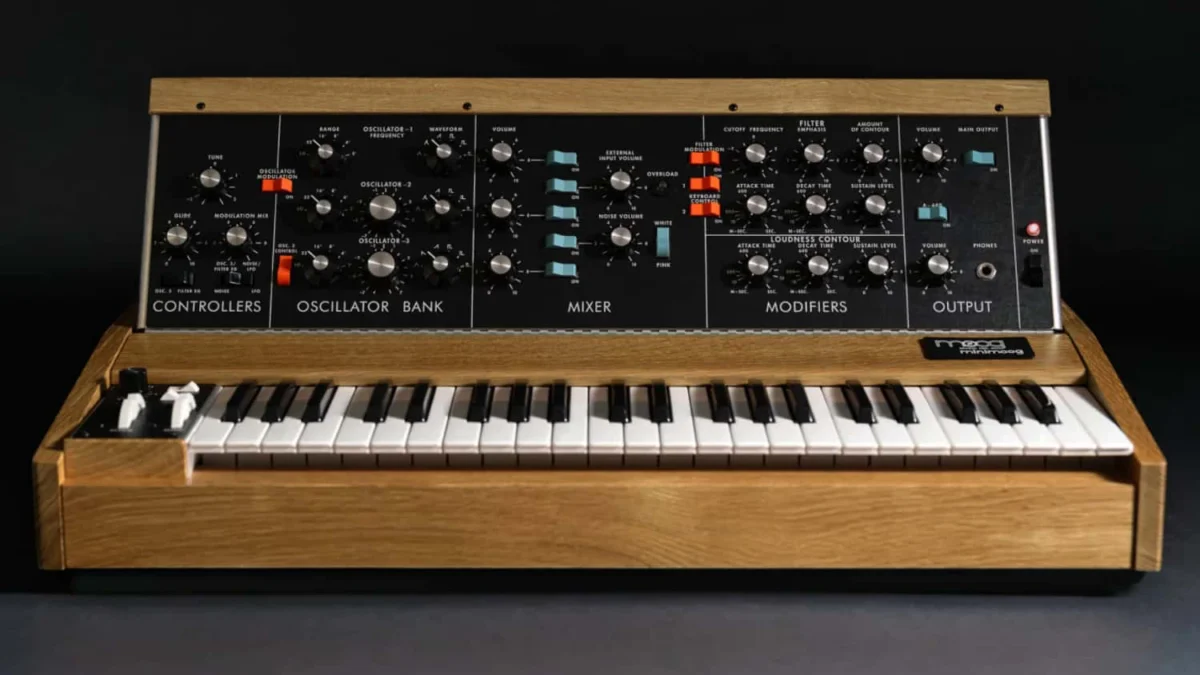
Moog Music has officially announced the release of the Minimoog Model D Bob Moog Tribute Edition, a limited-production run of the world’s most iconic synthesizer designed to celebrate the life of its creator and provide substantial financial support to his namesake foundation. This new iteration of the Minimoog Model D serves as both a high-end musical instrument and a philanthropic vehicle, with a portion of every sale dedicated to the Bob Moog Foundation, an independent 501(c)(3) non-profit organization. Priced at $3,999 USD, the Tribute Edition is limited to just 500 units worldwide, positioning it as a significant collector’s item for musicians, historians, and synthesizer enthusiasts alike.
The release marks a continuation of Moog Music’s commitment to the legacy of Dr. Robert “Bob” Moog, whose work in the 1960s and 70s fundamentally altered the landscape of modern music. While Moog Music Inc. and the Bob Moog Foundation are separate entities, this collaboration bridges the commercial and educational sectors of the synthesizer industry. Each unit sold will generate a $500 donation directly to the foundation, resulting in a potential $250,000 total contribution to support initiatives such as the Moogseum, Dr. Bob’s Sound School, and the preservation of the Bob Moog Foundation Archives.
A Legacy of Sound: The Historical Context of the Model D
To understand the significance of the Tribute Edition, one must look back to the inception of the original Minimoog Model D in 1970. Before its release, synthesizers were massive, wall-sized modular systems found only in specialized laboratories and university music departments. They were expensive, difficult to tune, and required complex patch cables to generate sound. Bob Moog, along with engineers Bill Hemsath, Clyde Scott, and Jim Scott, sought to distill the power of the Moog modular systems into a portable, hard-wired instrument that could be played by musicians on stage.
The result was the Minimoog Model D, the first synthesizer to feature a built-in keyboard and a pre-set signal path. It became the blueprint for every synthesizer that followed. Its three-oscillator design and the patented Moog Ladder Filter created a rich, thick, and "creamy" sound that defined the music of the 1970s and beyond. From the progressive rock of Rick Wakeman and Keith Emerson to the jazz fusion of Herbie Hancock and the funk of Bernie Worrell, the Model D was the sonic engine behind some of the most influential recordings in history.
The Tribute Edition arrives during a period of renewed interest in analog synthesis. After the original production run ended in 1981, the Model D remained a sought-after vintage item for decades. Moog Music first reissued the instrument in 2016, followed by another production run in 2022. This 2026 Tribute Edition represents the most refined version of these reissues, combining the raw power of the 1970s circuit with modern reliability and aesthetic upgrades that pay homage to the brand’s heritage.
Technical Specifications and Modern Enhancements
The Minimoog Model D Bob Moog Tribute Edition maintains the 100% analog signal path that made the original famous. At its core are three ultra-stable voltage-controlled oscillators (VCOs) and the classic 24dB/octave low-pass Ladder Filter. However, the Tribute Edition is not a mere carbon copy of the 1970 unit; it incorporates several functional enhancements developed for the modern era of music production.
Key technical features include:
- Analog Circuitry: The instrument utilizes the same component placement and through-hole design as the 1970s models, ensuring the harmonic complexity and "grit" of the original VCA and VCF.
- Modern Modulation: Unlike the original, the reissue includes a dedicated analog Low Frequency Oscillator (LFO) with square and triangle waves, freeing up the third oscillator for audio use rather than just modulation.
- Premium Keybed: The unit features a premium Fatar keybed, which provides a tactile response far superior to the original 1970s keys. Crucially, the keybed supports velocity and aftertouch, which can be routed via CV (Control Voltage) to affect the filter or pitch, offering a level of expressivity unavailable to early synth pioneers.
- Connectivity: The back panel includes MIDI In, Out, and Thru, allowing for seamless integration with modern Digital Audio Workstations (DAWs) and sequencers. It also retains the classic CV and Gate inputs and outputs for interfacing with modular gear.
- Feedback Loop: The Tribute Edition includes the "overload" modification, a famous trick where the output is fed back into the external audio input to create thick, distorted bass tones.
Aesthetic Craftsmanship and Exclusive Features
Distinguishing itself from standard reissues, the Bob Moog Tribute Edition features bespoke materials and design elements. Each unit is hand-built in the Moog Music factory in Asheville, North Carolina. The most striking visual change is the custom cabinet made from quartersawn white oak. Quartersawn wood is prized for its stability and distinctive grain patterns, providing a rugged yet elegant housing for the instrument’s electronics.

The front panel features a custom badge created through a metal photo-anodization process. This specific technique was chosen to mirror the aesthetic of early R.A. Moog Co. modular systems, such as the System 55 and Model 10. This nod to the 1960s modular era connects the portable Minimoog to its larger-than-life ancestors. Additionally, each instrument comes with a custom-fitted Moog SR Series travel case, ensuring the limited-edition synthesizer is protected during transport.
Philanthropic Impact: Supporting the Bob Moog Foundation
The primary driver behind this release is the support of the Bob Moog Foundation (BMF). Since its inception following Bob Moog’s passing in 2005, the BMF has operated independently of Moog Music Inc. This independence allows the foundation to focus strictly on education and historical preservation.
The $500-per-unit donation will be allocated to three core pillars of the foundation:
- Dr. Bob’s Sound School: This innovative 10-week curriculum teaches the physics of sound to second-grade students. By using synthesizers and theremins to demonstrate waves, frequency, and amplitude, the program has reached over 30,000 children, fostering an early interest in STEM (Science, Technology, Engineering, and Math).
- The Moogseum: Located in Asheville, North Carolina, the Moogseum is an interactive facility that brings Bob Moog’s legacy to life. It houses rare prototypes, interactive exhibits, and an extensive timeline of electronic music history.
- The Bob Moog Foundation Archives: The foundation maintains a massive collection of blueprints, circuit diagrams, personal correspondence, and vintage instruments. These archives are vital for researchers and historians looking to document the evolution of electronic synthesis.
Executive Director of the Bob Moog Foundation, Michelle Moog-Koussa, has frequently emphasized the importance of such partnerships in ensuring the sustainability of these programs. The Tribute Edition represents one of the largest corporate-nonprofit collaborations in the foundation’s history.
Chronology of the Minimoog Model D
The journey of the Model D is one of the most storied in the history of technology:
- 1970: The first Minimoog Model D is produced in Trumansburg, New York.
- 1971-1981: Over 12,000 units are produced as the instrument becomes a staple of global music production.
- 1981: Production ceases as digital synthesizers and polyphonic instruments begin to dominate the market.
- 2002: Moog Music (then Big Briar) releases the Minimoog Voyager, a modern spiritual successor.
- 2016: Moog Music announces the first official reissue of the Model D, featuring a dedicated LFO and MIDI.
- 2022: A second production run of the reissue is launched, featuring improved pitch tracking and a modified power supply.
- 2026: The Bob Moog Tribute Edition is unveiled at Moogfest, celebrating the legacy of the inventor with a limited 500-unit run.
Market Analysis and Industry Implications
The release of the Tribute Edition reflects a broader trend in the music hardware industry: the "boutique" reissue. As software synthesizers (VSTs) become more powerful and accessible, many professional musicians and collectors are moving toward high-end, tangible hardware that offers a "lifetime" value.
At $3,999, the Minimoog Model D is positioned as a luxury professional tool. However, market data suggests that limited edition Moog instruments often retain or increase in value on the secondary market. By limiting the run to 500 units, Moog Music is catering to a niche of "super-collectors" while simultaneously funding a charitable cause. This model of "conscious capitalism" within the music industry is increasingly popular, as brands look for ways to support the culture that sustains them.
Furthermore, the choice of quartersawn white oak and the photo-anodized badge signals a move toward artisanal manufacturing. In an era of mass-produced plastic electronics, the Tribute Edition emphasizes the "instrument" aspect of the synthesizer—something intended to be passed down through generations, much like a Steinway piano or a Stradivarius violin.
Conclusion
The Minimoog Model D Bob Moog Tribute Edition is more than a piece of hardware; it is a tribute to a man who changed how the world hears music. By blending the historical authenticity of the 1970s design with modern performance features and a commitment to philanthropy, Moog Music has created an instrument that honors the past while funding the future of music education. As the 500 units find their way into studios and collections around the world, the legacy of Bob Moog continues to vibrate through the circuits of his most famous invention, ensuring that the sound that shaped music will continue to be heard for decades to come.
