

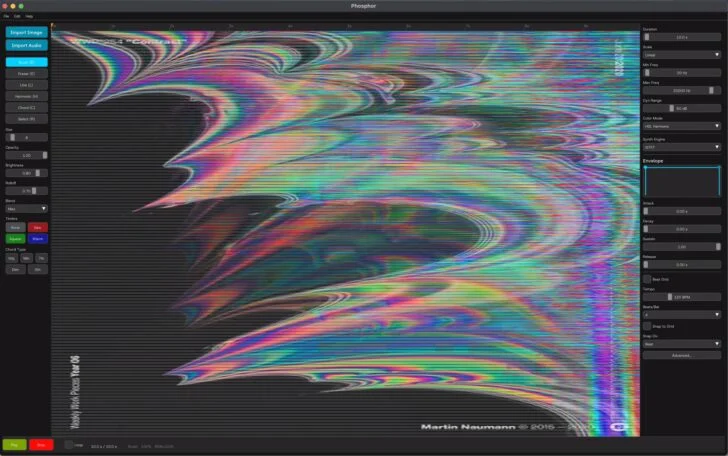
RoEx Audio, a company increasingly recognized for its innovative applications of artificial intelligence and advanced signal processing in the music technology sector, has officially released Phosphor. This new software instrument for macOS represents a significant entry into the niche but powerful field of spectral synthesis, offering creators a streamlined method for converting visual data into complex auditory textures. By utilizing the fundamental principles of the spectrogram—a visual representation of the spectrum of frequencies in a signal as it varies with time—Phosphor allows users to "paint" sound or import existing images to generate unique audio outputs. This release marks a notable shift toward making experimental sound design tools more accessible to the broader producer community, particularly through its distribution as a free, standalone utility.
The core mechanism of Phosphor is rooted in the inversion of traditional audio analysis. In standard digital audio workstations (DAWs) and spectral analysis tools, a sound file is processed through a Fast Fourier Transform (FFT) to create a visual spectrogram. In this visual domain, the horizontal axis represents time, the vertical axis represents frequency, and the brightness or color intensity represents amplitude or loudness. Phosphor reverses this workflow, treating the visual canvas as the primary data source. When a user draws a line at the bottom of the canvas, the engine interprets it as a low-frequency bass tone. A vertical line becomes a burst of noise or a transient "click," and complex textures or photographs are translated into intricate, evolving soundscapes that would be nearly impossible to program using traditional subtractive or frequency modulation (FM) synthesis.
The Evolution and Mechanics of Spectral Synthesis
To understand the significance of Phosphor, one must look at the technical lineage of spectral synthesis. This method of sound generation differs fundamentally from the oscillator-based approaches that have dominated electronic music since the mid-20th century. While subtractive synthesis begins with a harmonically rich waveform and removes frequencies via filters, and FM synthesis uses oscillators to modulate one another, spectral synthesis treats sound as a collection of individual "bins" of frequency.
Historically, the concept of turning images into sound dates back to early optical soundtracks in cinema and experimental instruments like the ANS synthesizer, developed by Soviet engineer Evgeny Murzin between 1937 and 1957. The ANS used a system of rotating glass disks with etched patterns to modulate light, which was then converted into sound. In the digital era, software like MetaSynth, developed by U&I Software in the late 1990s, pioneered the "Image Synth" concept, allowing composers to manipulate sound as if it were a digital photograph.
Phosphor enters this lineage by modernizing the interface and focusing on a high-resolution spectral engine. When a user imports a JPEG or PNG file into Phosphor, the software scans the pixels and assigns frequency values to the vertical positions and amplitude values to the pixel brightness. Because digital images often contain millions of pixels, the resulting audio is characterized by a high degree of harmonic density. This makes the tool particularly effective for creating "cinematic" drones, granular textures, and non-linear Foley effects that are essential in modern film scoring and sound design for video games.
Technical Specifications and User Experience
RoEx Audio has optimized Phosphor for the macOS environment, ensuring compatibility with the latest iterations of the operating system and taking advantage of the processing power found in Apple Silicon (M1, M2, and M3 chips). The software provides a dedicated workspace where the canvas serves as the primary interface. Users are provided with a variety of "painting" tools that allow for the manual creation of spectral data. These tools include brushes of varying sizes and opacities, enabling the creation of soft, blurred harmonic clouds or sharp, staccato rhythmic elements.
One of the standout features of Phosphor is its ability to handle external image imports with minimal latency. Producers can take photographs of natural textures—such as wood grain, stone marble, or urban landscapes—and hear how those physical patterns translate into the frequency domain. This "sonification" of the visual world offers a bridge between photography and music production, providing a new source of inspiration for artists who may feel constrained by the traditional piano roll or step sequencer.
The workflow encouraged by RoEx Audio involves using Phosphor as a laboratory for sound creation rather than a traditional playable instrument. Once a sound has been "painted" or synthesized from an image, the user can export the resulting audio as a high-quality WAV file. This file can then be dragged into a DAW like Ableton Live, Logic Pro, or FL Studio for further processing, such as time-stretching, pitch-shifting, or the application of spatial effects like reverb and delay.
Strategic Market Positioning and Accessibility
The decision by RoEx Audio to release Phosphor as a free download, requiring no user account or registration, is a strategic move that reflects a growing trend in the music software industry. By lowering the barrier to entry, RoEx is positioning itself as a developer focused on community growth and the democratization of high-end synthesis tools. This approach mirrors the "freemium" models seen in other tech sectors, where providing a high-value utility for free builds brand loyalty and serves as a proof-of-concept for the company’s more advanced, paid offerings, such as their AI-driven mixing and mastering services.
Industry analysts suggest that Phosphor serves as an effective showcase for RoEx’s underlying spectral processing algorithms. By demonstrating their ability to handle complex FFT-based synthesis with stability and ease of use, the company strengthens its reputation among professional sound designers who are increasingly looking for tools that offer "happy accidents"—those unexpected sonic results that emerge from non-traditional workflows.
Historical Timeline of Optical and Spectral Audio Innovation
The development of Phosphor is the latest milestone in a century-long timeline of innovations that seek to unify the visual and auditory senses:
- 1920s-1930s: Early experiments in "drawn sound" on film strips by innovators like Oskar Fischinger and Rudolf Pfenninger.
- 1958: Completion of the ANS Synthesizer, the first functional instrument to use a large-scale spectral-visual interface.
- 1979: The Fairlight CMI introduces the "Page R" sequencer and basic spectral manipulation, though limited by the computing power of the era.
- 1997: The release of MetaSynth 1.0, which established the standard for image-to-sound conversion in the digital studio.
- 2012: iZotope releases Iris, a "spectral sampling" synthesizer that allows users to select specific frequencies within a sample using visual tools.
- 2024: RoEx Audio releases Phosphor, bringing high-resolution spectral synthesis to a streamlined, free-to-use macOS application.
Broader Implications for Music Production and Sound Design
The release of Phosphor arrives at a time when the boundaries between different forms of digital media are increasingly blurred. As AI-generated imagery becomes more prevalent, the ability to turn those generated images into unique, copyright-free audio textures offers a new frontier for content creators. A designer could, for instance, use an AI image generator to create a "nebula," import that image into Phosphor to generate a space-themed ambient pad, and then use that audio in a multimedia installation.
Furthermore, Phosphor addresses a specific need in the sound design community for tools that bypass the "blank slate" problem. By starting with an image, a composer has a structural foundation for a sound before they even touch a keyboard. The mathematical relationship between the symmetry of an image and the consonance of the resulting sound provides a logical framework for experimentation. Symmetrical images often yield harmonic, chord-like structures, while chaotic or "noisy" images produce dissonant, metallic, or percussive sounds.
From an educational perspective, Phosphor also serves as a powerful pedagogical tool. For students of acoustics and music technology, seeing a sound as they draw it provides an immediate, visceral understanding of how frequency and amplitude interact. It demystifies the Fourier transform, turning an abstract mathematical concept into a creative playground.
Official Responses and Community Reception
Initial reactions from the electronic music community have been overwhelmingly positive, with many praising the software’s "clean" interface and its departure from the cluttered, "skeuomorphic" designs of many modern plugins. While some users have noted that the software is currently limited to macOS, there is a strong demand for a Windows version, highlighting the widespread interest in spectral tools.
RoEx Audio has indicated that Phosphor is part of a broader vision to integrate advanced audio processing into intuitive interfaces. While the company has not officially announced a roadmap for Phosphor updates, the "standalone" nature of the current release suggests that it may eventually see integration as a plugin (VST/AU) or receive expanded features such as real-time MIDI control over spectral parameters.
In a market often saturated with "me-too" products—clones of vintage synthesizers or standard compressor models—Phosphor stands out by offering a different way of thinking about sound. It challenges the user to stop thinking in terms of notes and scales and start thinking in terms of shapes and textures. As digital art and music continue to converge, tools like Phosphor will likely become essential components of the modern artist’s toolkit, providing the bridge between what we see and what we hear.
Phosphor is currently available for download directly from the RoEx Audio website. The company’s commitment to a "no-strings-attached" release model ensures that this sophisticated piece of technology is accessible to everyone from hobbyists to professional film composers, further cementing RoEx’s role as a key player in the next generation of audio innovation.
