

The innovative audio software developer MNTRA has officially expanded its portfolio of specialized sound tools with the launch of Nagual, a virtual instrument library that bridges the gap between ancient Mesoamerican history and modern digital synthesis. Developed in close partnership with renowned Mexican musician and ethnomusicologist Ramiro Ramírez, the library provides composers, sound designers, and producers with a meticulously sampled collection of clay flutes, conch trumpets, wooden drums, and ritual whistles. Unlike traditional sample libraries that focus solely on archival preservation, Nagual utilizes MNTRA’s proprietary MNDALA engine to "transmute" these ancient sound sources into dynamic, morphing textures that respond to real-time performance controls.
The Intersection of Ethnomusicology and Modern Synthesis
The development of Nagual represents a significant undertaking in the field of digital archaeology and sound design. At the heart of the project is the collection of Ramiro Ramírez, a specialist in the reconstruction and performance of Pre-Hispanic instruments. For decades, Ramírez has studied the acoustic properties of artifacts found in archaeological sites across Mexico, recreating them using traditional materials such as specific clays, hardwoods, and organic resonators. By collaborating with MNTRA, these physical reconstructions have been captured using high-fidelity recording techniques, ensuring that the unique harmonic overtones and non-linear behaviors of the instruments are preserved in the digital realm.
The concept of "Nagual" itself is rooted in Mesoamerican mythology, referring to a human being who has the power to transform or "shape-shift" into an animal or another form. This philosophical underpinning serves as the guiding principle for the software’s architecture. While the raw samples are historically accurate, the MNDALA engine allows users to morph these sounds into otherworldly pads, aggressive cinematic textures, and evolving rhythmic patterns. This dual nature makes the library suitable for both authentic historical scoring and avant-garde electronic production.
Detailed Instrument Inventory and Acoustic Characteristics
Nagual features a diverse array of instruments that played central roles in the social, military, and spiritual lives of the Aztec, Mayan, and other Pre-Hispanic civilizations. The library is categorized into several distinct sonic families:
- Clay Flutes and Ocarinas: These instruments are celebrated for their "breathiness" and complex pitch fluctuations. In the Pre-Hispanic world, flutes were often shaped like animals or deities, with the internal chambers designed to produce microtonal intervals and "warbling" effects that mimic bird calls or the wind.
- Conch Trumpets (Tecciztli): Traditionally used as signaling devices in warfare and as ceremonial calls to prayer, the conch shell produces a powerful, resonant drone. In Nagual, these have been sampled to capture the raw power of the initial attack as well as the long, vibrating decays.
- Wooden Percussion (Teponaztli): These slit drums were carved from hollowed logs and were essential for keeping time during ritual dances. The sampling process for Nagual captures the distinct tonal differences between the two tongues of the drum, providing a melodic quality to the percussion.
- Ritual Whistles: Perhaps the most famous of these is the "Death Whistle," known for its terrifying, scream-like timbre. Nagual includes various iterations of these whistles, providing a range of high-frequency textures that are frequently sought after for horror and suspense soundtracks.
Each instrument was recorded at multiple velocity layers and with various articulations, including staccato hits, long sustains, and experimental techniques like overblowing or flutter-tonguing.
Technical Infrastructure: The MNDALA 2 Engine
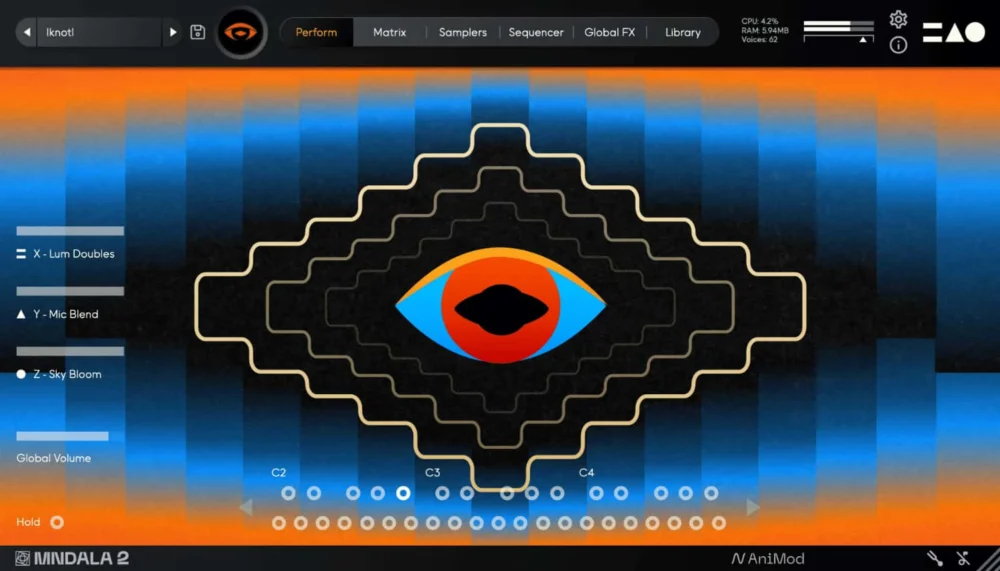
The functionality of Nagual is powered by the MNDALA 2 engine, MNTRA’s custom-built synthesis platform. One of the defining technical features of this engine is its support for ultrasonic sampling. While the human ear typically hears up to 20 kHz, MNTRA records its sources at 96 kHz or higher to capture ultrasonic frequencies. When these samples are pitched down or processed through the engine’s granular and FM (Frequency Modulation) modules, these high-frequency harmonics are brought into the audible range, creating rich, complex textures that are impossible to achieve with standard 44.1 kHz samples.
The user interface of Nagual is designed around an intuitive XYZ axis system. This allows performers to map multiple parameters—such as filter cutoff, distortion, reverb mix, and sample morphing—to a single point of control. By moving a cursor across the 3D space, a user can seamlessly transition from the sound of a dry clay flute to a massive, distorted synth pad. This "transmutation" process is what differentiates Nagual from a static sample player, turning it into a living instrument that rewards performative interaction.
Chronology of Development and Collaborative Philosophy
The journey toward Nagual’s release began several years ago when the team at MNTRA, led by founder and composer Brian D’Oliveira, sought to explore the sonic heritage of Mexico. D’Oliveira, known for his work on high-profile video game soundtracks such as Shadow of the Tomb Raider, has long been an advocate for using authentic cultural instruments in modern media.
The collaboration with Ramiro Ramírez was essential to ensuring cultural sensitivity and technical accuracy. Throughout the recording sessions, Ramírez provided context on how each instrument was traditionally played and the specific spiritual significance of their sounds. This data informed the creation of the library’s presets, which are often named after Aztec concepts or natural elements. The development timeline involved months of field and studio recordings, followed by an extensive period of "sonic sculpting" where the raw files were integrated into the MNDALA environment.
Market Context and Industry Implications
The release of Nagual comes at a time of increasing demand for "organic" and "boutique" sound libraries in the film and gaming industries. As audiences become more sophisticated, composers are moving away from generic orchestral palettes in favor of unique, culturally specific sounds that provide a sense of place and history.
From a competitive standpoint, Nagual occupies a unique niche. While other companies offer "world music" libraries, MNTRA’s focus on the "transmutation" of these sounds appeals to a broader demographic, including techno producers and industrial sound designers. By pricing the library at an introductory rate of $39 USD (regularly $59), MNTRA has made these rare sounds accessible to independent creators, further democratizing the use of high-end ethnomusicological tools.
Preservation Through Innovation
Beyond its utility as a creative tool, Nagual serves a secondary purpose as a digital archive. Many of the instruments sampled are rare, and the knowledge of how to construct and play them is held by a dwindling number of specialists. By encoding these sounds into a virtual instrument, MNTRA and Ramiro Ramírez are ensuring that the acoustic signatures of Pre-Hispanic Mexico remain part of the global musical conversation.
The library also highlights the potential for "speculative musicology"—the practice of using modern technology to imagine how ancient instruments might have evolved if their musical traditions had not been interrupted. By applying modern synthesis techniques to these ancient tones, Nagual creates a continuum between the past and the future.
Official Response and Performance Demonstrations
Upon the library’s release, MNTRA provided several demonstrations showcasing Nagual’s versatility. In the "Nagual Jam" demo composed by Brian D’Oliveira, the library is shown handling everything from rhythmic pulses to atmospheric leads. Early feedback from the professional scoring community has highlighted the "visceral" and "unfiltered" quality of the samples, noting that they retain an organic grit often lost in over-processed commercial libraries.
Ramiro Ramírez expressed satisfaction with the project, noting that the digital medium allows these instruments to "speak" to a global audience in a way that physical performances cannot reach alone. The collaboration emphasizes a respectful exchange of knowledge, where the technical expertise of the software developers is used to amplify the cultural expertise of the musician.
Pricing, Availability, and System Compatibility
Nagual is currently available for purchase through the official MNTRA website. The introductory price of $39 USD is set to remain in place for a limited time before returning to the standard MSRP of $59 USD.
In terms of technical requirements, the library is compatible with all major Digital Audio Workstations (DAWs) on both Windows and macOS, including VST3 and AU formats. Because Nagual runs within the MNDALA 2 engine—which is a free download—users do not need to own any additional third-party software like Kontakt to use the library. The engine is optimized for modern multi-core processors, ensuring smooth performance even when utilizing the complex XYZ mapping and high-resolution sample playback.
As the music industry continues to seek out sounds that offer both authenticity and innovation, Nagual stands as a testament to the power of cross-disciplinary collaboration. It is more than just a collection of samples; it is a bridge between the ceremonial traditions of the past and the limitless possibilities of the digital future.
