

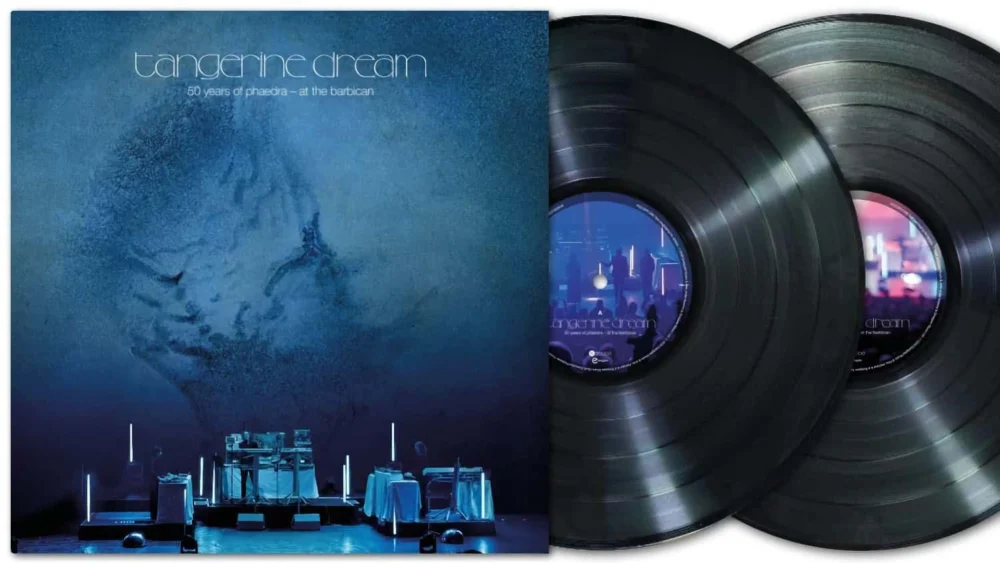
The release of the live album documenting the 50th-anniversary celebration of Tangerine Dream’s seminal work, Phaedra, marks a significant milestone in the history of electronic music. Recorded during a sold-out performance at London’s prestigious Barbican Centre, the album serves as both a retrospective tribute and a forward-looking reinterpretation of the 1974 masterpiece that defined the "Berlin School" of electronic composition. This new live recording, titled 50 Years of Phaedra: At The Barbican, is now available in multiple physical and digital formats, capturing the current trio of Thorsten Quaeschning, Hoshiko Yamane, and Paul Frick as they navigate the complex sonic landscapes originally forged by the group’s classic lineup.
The Historical Significance of Phaedra
To understand the weight of this live release, one must look back to 1974, when Tangerine Dream—then consisting of Edgar Froese, Christopher Franke, and Peter Baumann—released Phaedra. It was the group’s fifth studio album and their first for Virgin Records, a label then in its infancy. Before Phaedra, electronic music was largely the province of academic avant-garde composers or novelty pop acts. Tangerine Dream bridged this gap by utilizing the Moog modular synthesizer and the Mellotron to create immersive, atmospheric textures that felt both ancient and futuristic.
Phaedra was a commercial anomaly. Despite its lack of traditional melodies, lyrics, or rhythmic structures typical of the era’s rock music, it climbed to number 15 on the UK Albums Chart. Its success was fueled in part by the championing of BBC Radio 1 DJ John Peel, who recognized the album’s revolutionary use of sequencers. The title track, a nearly 18-minute epic, was famously recorded after the band’s Moog synthesizer drifted out of tune due to temperature fluctuations in the studio—a technical glitch that resulted in the haunting, otherworldly drones that became the album’s signature.
The Barbican Performance: A Multi-Generational Dialogue
Five decades later, the current incarnation of Tangerine Dream returned to the Barbican to honor this legacy. The performance was structured into two distinct segments, designed to show the evolution of the band’s sound from the analog experimentation of the 1970s to the precise, "Quantum Years" aesthetic of the 2020s.
The first half of the concert was dedicated entirely to the Phaedra anniversary. The arrangement of the material required a delicate balance between reverence for the original recordings and the necessity of live performance in a modern context. Thorsten Quaeschning, who joined the band in 2005 and was designated by the late Edgar Froese as his successor, led the arrangement process. The set opened with "Sequent C," a solo flute-patch piece originally composed by Peter Baumann. Performed by Quaeschning, this minimalist introduction set a contemplative tone before the full trio joined for "Mysterious Semblance at the Strand of Nightmares," a track originally defined by Froese’s sweeping Mellotron work.
A highlight of the first act was the integration of "Hippolytos," an improvised session named after the Greek mythological figure associated with the Phaedra narrative. This improvisation served as a bridge into "Phaedra 2024," a modernized version of the title track. While the original 1974 recording relied on the unpredictability of early voltage-controlled oscillators, the 2024 version utilized high-precision digital and analog hardware to deliver a more driving, rhythmically assertive take on the classic sequence.
The Evolution of the "Quantum Years"
The second half of the Barbican performance shifted focus toward the contemporary era of Tangerine Dream. Following the death of founding member Edgar Froese in 2015, the band entered what is known as the "Quantum Years." This period is characterized by the use of Froese’s archived musical sketches and a renewed focus on the "real-time composition" techniques that the band pioneered in the 1970s.
The setlist for this portion of the evening showcased the breadth of the band’s catalog, including:

- Sorcerer Theme: A tribute to the group’s prolific work in film scoring, originally composed for William Friedkin’s 1977 thriller.
- Dolphin Dance and White Eagle: Selections from the 1980s "Blue Years," demonstrating the group’s transition toward more melodic, structured synth-pop and new age influences.
- Los Santos City Map: A nod to the band’s modern relevance, taken from their extensive soundtrack work for the video game Grand Theft Auto V.
- Continuum and Raum: Tracks from their critically acclaimed 2022 album, Raum, which many critics hailed as a return to the band’s peak creative form.
The performance concluded with an encore of "Phaedra 2022," providing a final thematic bookend to the evening’s celebration.
Technical Execution and Audio Engineering
Capturing a live electronic performance of this magnitude presents unique challenges for audio engineers. Unlike a traditional rock band, where sound is projected from amplifiers on stage, Tangerine Dream’s sound is largely generated "in the box" or via complex signal paths of synthesizers and effects units. The recording at the Barbican emphasizes clarity and spatial depth, ensuring that the intricate layers of sequencers and Hoshiko Yamane’s electric violin are balanced against the deep, resonant bass frequencies that are a hallmark of the group’s sound.
Audience noise on the album is kept to a minimum, appearing primarily during transitions between movements and at the conclusion of the sets. This production choice allows the listener to experience the concert as a continuous sonic journey, mirroring the long-form compositional style for which the group is famous.
Physical Formats and Archival Material
The release of 50 Years of Phaedra: At The Barbican is available in two primary physical formats, catering to the band’s dedicated audiophile and collector fan base:
- Vinyl Edition: A three-LP set housed in a gatefold sleeve. This version includes an 8-page printed booklet containing rare photographs and extensive liner notes.
- CD Edition: A two-disc set in a tri-fold sleeve, featuring a scaled-down version of the booklet.
The inclusion of detailed liner notes provides essential context for the release. The booklet features archival reflections from Edgar Froese regarding the original 1974 recording sessions at The Manor Studio in Oxfordshire. It also includes modern commentary from Bianca Froese-Acquaye, the group’s manager and Edgar’s widow, who discusses the enduring relevance of the album’s themes. Furthermore, Thorsten Quaeschning offers a technical breakdown of the challenges involved in translating studio-bound 1970s compositions into a cohesive live performance using 21st-century technology.
Broader Impact and the Future of the Berlin School
The success of the Barbican concert and the subsequent release of this live album underscore the lasting influence of the Berlin School of electronic music. Tangerine Dream, alongside contemporaries like Klaus Schulze and Ash Ra Tempel, created a blueprint for genres ranging from ambient and trance to film scoring and industrial music.
In the current musical landscape, where software-based production is the norm, Tangerine Dream’s commitment to hardware-based improvisation and modular synthesis remains a point of distinction. The "Quantum Years" lineup has successfully navigated the transition from being a legacy act to becoming a vital, contemporary force in electronic music. By revisiting Phaedra, the band is not merely engaging in nostalgia; they are demonstrating how the fundamental principles of their sound—repetition, texture, and sonic exploration—remain adaptable and resonant.
The 50th anniversary of Phaedra serves as a reminder of a pivotal moment when synthesizers moved from being sound-effect machines to legitimate instruments capable of conveying deep emotional and atmospheric narratives. As Tangerine Dream continues to tour and record, 50 Years of Phaedra: At The Barbican stands as a definitive document of their ability to bridge the gap between their revolutionary past and an innovative future.
Conclusion
Tangerine Dream’s 50 Years of Phaedra: At The Barbican is more than a live recording; it is a testament to the durability of a musical vision that began in a divided Berlin and has since influenced generations of artists worldwide. By meticulously rearranging the sounds of 1974 for the audience of 2024, Quaeschning, Yamane, and Frick have ensured that the group’s most iconic work continues to evolve. The album is a vital addition to the Tangerine Dream discography, offering both a historical retrospective and a high-fidelity concert experience for long-time enthusiasts and new listeners alike.
