

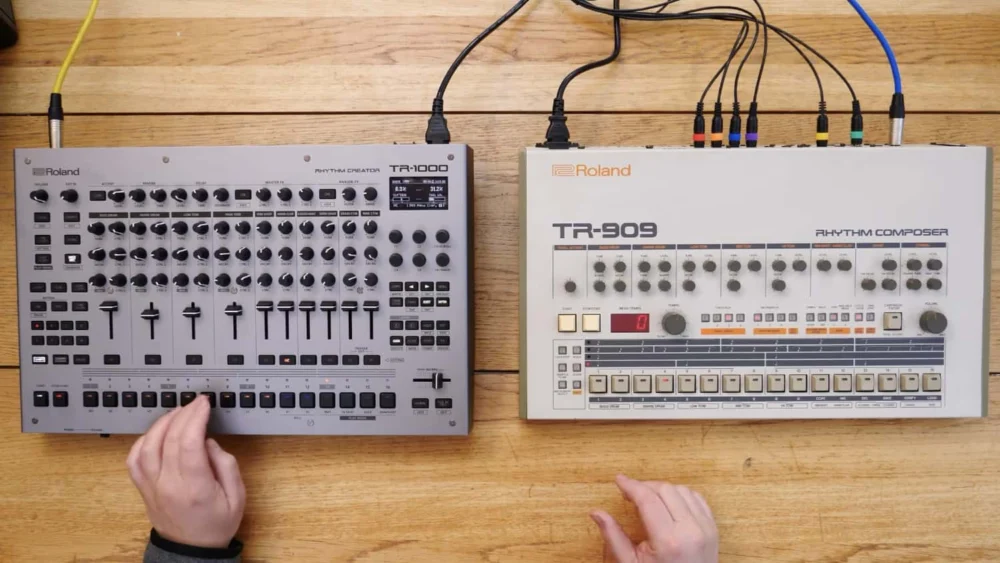
The release of the Roland TR-1000 Rhythm Creator has sparked a significant debate within the electronic music production community regarding the necessity of vintage hardware in a modern digital landscape. Renowned synthesist and technical reviewer Starsky Carr recently conducted a comprehensive head-to-head comparison between the original 1983 Roland TR-909 and its 2025 successor, the TR-1000. This analysis focuses on the nuances of sound reproduction, the evolution of Analog Circuit Behavior (ACB) technology, and the technical reasons why modern recreations often sound "cleaner" than their vintage counterparts. By employing frequency analysis and matching techniques within Logic Pro, Carr demonstrated that the perceived differences between the two units are often less about the core synthesis and more about the output stages and frequency limitations inherent in 40-year-old hardware.
The Evolution of the Rhythm Composer: From 1983 to 2025
The Roland TR-909 holds a singular place in the history of music technology. Launched in 1983 as a successor to the fully analog TR-808, the 909 was a hybrid machine, utilizing analog synthesis for its kick, snare, toms, and rimshot, while employing 6-bit digital samples for its cymbals and hi-hats. Although it was initially a commercial failure, as musicians of the era preferred the more realistic digital sounds of the LinnDrum, it eventually became the backbone of house and techno music. The aggressive "thump" of its kick and the "snap" of its snare defined entire genres.
In contrast, the TR-1000, announced in late 2025, represents the pinnacle of Roland’s digital modeling efforts. Billed as the most advanced drum machine the company has ever produced, it utilizes a highly refined version of ACB technology. This system attempts to model the behavior of every individual component in the original analog circuits—including resistors, capacitors, and transistors—and how they interact with one another. While previous iterations like the TR-8 and TR-8S brought the 909 sound to a modern audience, the TR-1000 aims for a level of fidelity that challenges the need for original hardware, which now commands prices exceeding $5,000 on the secondary market.
Comparative Methodology: Analog Circuitry vs. Digital Modeling
In his technical assessment, Carr focused on the fundamental differences between the analog voices of the original 909 and the ACB models found in the TR-1000. A primary point of contention in the synthesis community is the "irony" of digital modeling: while modern units can perfectly replicate the mathematical ideal of a circuit, they often lack the "crustiness" or noise floor of the original physical units.
The comparison covered several key percussive elements:
- The Kick Drum: The TR-909 kick is famous for its weight and mid-range "knock." Carr noted that while the TR-1000 captures the transient response accurately, the sustain and decay often feel more "pristine" in the digital realm.
- The Snare and Clap: These voices rely heavily on noise generators. In the original 909, the noise source is subject to the aging of analog components, leading to slight variations between units. The TR-1000 provides a more consistent, wide-band response.
- Rimshot and Toms: These sounds were analyzed for their harmonic saturation. The TR-909’s internal components naturally compress these sounds as they pass through the mixer stage, a phenomenon the TR-1000 simulates through software-based gain staging.
The Impact of Output Stages and Signal Processing
One of the most critical findings in Carr’s analysis is the distinction between the "Main Outputs" and "Individual Outputs" of the TR-909. On the vintage hardware, the main stereo output passes through a series of summing amplifiers and filters that introduce a specific frequency curve. This signal path effectively "band-limits" the sound, rolling off the very high frequencies and creating a more cohesive, "glued" character.
The TR-1000, being a modern digital device, offers a much higher frequency ceiling. It produces a "hi-fi" sound that extends well beyond the range of the original 1983 hardware. Carr argued that this increased fidelity is often what makes users feel the modern version is "different" or "less authentic." When listeners describe the 909 as sounding "warmer" or "punchier," they are often reacting to the natural low-pass filtering and slight distortion introduced by the 909’s aging output stage.
Technical Deep Dive: Replicating Vintage Character Through Frequency Analysis
To bridge the gap between the two machines, Carr utilized Logic Pro’s Match EQ to perform a frequency analysis of the TR-909’s main output. By capturing the spectral fingerprint of the vintage unit and applying it to the TR-1000, he was able to demonstrate how much of the "classic sound" is simply a matter of equalization.
The analysis revealed a specific "crusty" character in the 909’s main outs—a combination of a roll-off starting around 15kHz and a slight bump in the low-mid frequencies. By applying this exact EQ curve to the TR-1000, the digital unit’s output became virtually indistinguishable from the analog original in a mix. This suggests that for most professional applications, the TR-1000’s synthesis engine is more than capable of 1:1 matching, provided the user understands how to replicate the hardware’s output limitations.
Supporting Data: The 909 vs. TR-1000 Specifications
| Feature | Roland TR-909 (1983) | Roland TR-1000 (2025) |
|---|---|---|
| Sound Generation | Hybrid (Analog/6-bit Sample) | Digital (ACB / Multi-core) |
| Sampling Rate | N/A (Internal analog paths) | 96kHz / 32-bit internal |
| Connectivity | MIDI (Early spec), DIN Sync | USB-C, MIDI, CV/Gate, Individual Outs |
| Storage | Internal RAM (Volatile) | SD Card / Internal Flash |
| Frequency Response | Approx. 20Hz – 16kHz (Main Out) | 20Hz – 40kHz+ (Digital Out) |
| User Interface | Fixed Step Sequencer | High-res OLED / Touch-sensitive pads |
The data highlights a significant leap in technical overhead. The TR-1000 offers a dynamic range and frequency response that far exceeds the original. However, in the context of electronic music, "better" technical specs do not always equate to "better" artistic results, leading to the continued demand for "lo-fi" processing tools.
Chronology of the Roland Rhythm Series
The path to the TR-1000 has been marked by several key milestones in Roland’s development of drum synthesis:
- 1980: TR-808 becomes the foundation of Hip-Hop and R&B.
- 1983: TR-909 introduces MIDI and hybrid sampling to the market.
- 2014: Roland launches the AIRA line, introducing the TR-8 and the first generation of ACB technology.
- 2018: The TR-8S is released, allowing users to load their own samples alongside ACB models.
- 2025: The TR-1000 is launched, featuring advanced "Component-Level Modeling" and a dedicated focus on recreating the specific nuances of vintage output stages.
Industry Implications and Community Response
The reaction from the professional audio community has been largely positive regarding the TR-1000’s capabilities, though a purist faction remains. Many producers have noted that the TR-1000’s ability to function as a high-end audio interface and its integration with modern DAWs make it a more practical tool for the modern studio.
Industry analysts suggest that the TR-1000 is not merely a "clone" but an attempt by Roland to reclaim the professional market that had recently been dominated by boutique analog manufacturers and high-end software emulations. By providing a unit that can sound "perfectly digital" or "perfectly vintage" through the use of internal processing, Roland is targeting both the modern pop producer and the techno traditionalist.
Carr’s video highlights a shift in the philosophy of music gear. He suggests that "obsessing over 1:1 matching might be missing the point." The TR-1000 offers a stable, versatile platform that can be shaped to sound like a 909, but it also offers possibilities that the original hardware never could, such as per-step automation of every parameter and advanced polyrhythmic sequencing.
Broader Impact on Music Production
The conclusion drawn by many experts, including Carr, is that the "magic" of vintage gear often lies in its imperfections—low-resolution samples, limited frequency range, and the specific way analog components age. However, as digital modeling becomes increasingly sophisticated, these imperfections are no longer the exclusive domain of hardware.
The TR-1000 represents a bridge between eras. For the working producer, it offers the reliability of a modern device with the sonic DNA of a legend. The realization that a simple Match EQ or a band-limiting filter can close the gap between a $500 digital unit (or a premium modern unit like the TR-1000) and a $5,000 vintage machine may continue to drive down the perceived necessity of owning original 80s hardware for studio work.
As the industry moves forward, the focus is shifting from "does it sound exactly like the original?" to "can it provide the same emotional impact in a track?" In this regard, the TR-1000 appears to have succeeded, providing a tool that respects its heritage while embracing the technical advantages of 2025 technology. The discussion initiated by Starsky Carr serves as a technical roadmap for producers looking to extract the most "crusty" and "authentic" sounds from modern digital instruments.
