

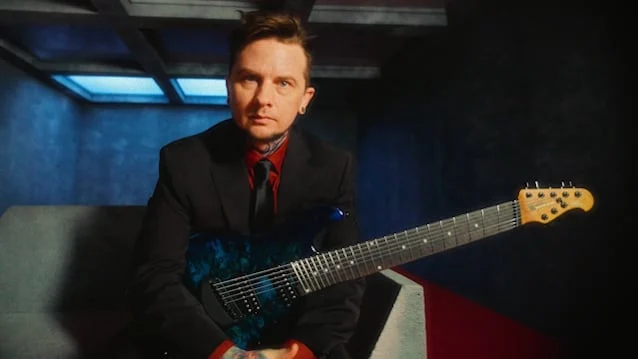
Guitar virtuoso Jason Richardson has broken his silence regarding his departure from the metalcore powerhouse All That Remains, a move that occurred in July of last year after a nearly seven-year tenure. In a candid interview with Guitar World, Richardson elaborated on the circumstances that led to his exit, emphasizing that the decision, while difficult, was primarily rooted in significant business and management shortcomings rather than interpersonal conflicts with his bandmates.
Richardson, known for his intricate and technically demanding guitar playing, joined All That Remains in late 2018, stepping into the lead guitar role following the tragic passing of founding member Oli Herbert. His integration into the band coincided with a period of significant creative output, culminating in the band’s tenth studio album, "Antifragile," released in 2025. However, it is the handling and promotion of this album, and the band’s subsequent inactivity, that Richardson cites as the primary catalysts for his departure.
"Kind of, but not, simultaneously," Richardson stated when asked about the difficulty of his decision. "I don’t want to get into the weeds of it publicly, but I’m still cool with all of the guys in the band. It was mostly just a business thing. And things just were not executed like they were promised to be, from management and the people tasked with putting the [tenth All That Remains] record out. I’m glad the record exists, but the fact that it’s already been out almost a year and there hasn’t been one show. So it’s, like, there’s just a lot of things on the business side in the back end that I was not happy with at all. It has nothing to do with anyone’s personality or anyone in the band at all. It just wasn’t, in my opinion – like, I could be doing other things than trying to make that work when it so clearly was not going to – from my perspective, at least."
This revelation sheds light on a period of uncertainty for fans who have noted the lack of live performances since the release of "Antifragile." The absence of touring, a cornerstone of any active band’s promotional strategy, particularly in the heavy music scene, raises questions about the operational efficacy of the band’s management and associated business entities. Richardson’s statement suggests a fundamental disconnect between the promises made regarding album rollout and the subsequent reality of its commercial and promotional lifecycle.
A Legacy of Technical Prowess and Musical Evolution
Jason Richardson’s journey to becoming a prominent figure in the progressive and technical metal scene is a testament to his dedication and innate musical talent. Born and raised in Manassas, Virginia, Richardson’s upbringing was steeped in music, with his father being a musician and instruments a constant presence in their home. His early musical explorations included piano lessons in the fourth grade, though he found himself more drawn to instruments that allowed for more immediate compositional freedom. After trying the violin and drums in fifth grade, the guitar eventually captured his full attention.
His father gifted him a gothic black Gibson Les Paul at the age of 12, igniting an obsession that fueled countless hours of practice. Heavily influenced by the intricate guitar work of Dream Theater, particularly the track "This Dying Soul," Richardson was driven to expand his sonic palette. He diligently saved money through odd jobs and lawn mowing to acquire a seven-string guitar, purchasing his first at the age of 14. This foundational period saw the nascent development of his unique and highly technical playing style, a characteristic that would define his future career.
Richardson’s early band experiences provided crucial learning opportunities. While playing in the local group Gallows Hill, alongside future Veil of Maya bassist Danny Hauser, he actively sought avenues to promote the band. This led him to audition for the deathcore band All Shall Perish through a trade advertisement, with the initial intention of using the opportunity to gain exposure for his own group. Instead, he secured the audition and, at the young age of 17, made the momentous decision to leave high school with just three months remaining until graduation to embark on a 10-month touring cycle with All Shall Perish.
Following his stint with All Shall Perish, Richardson’s career trajectory continued to ascend. He joined Born of Osiris, filling in for guitarist Tosin Abasi of Animals as Leaders during a period of scheduling conflicts. This led to a more permanent role, and he remained with Born of Osiris for over two years, contributing to their 2011 album, "The Discovery." His tenure with Born of Osiris ended somewhat abruptly in 2011 when he was dismissed from the band, a situation that coincided with the departure of guitarist Michael Stafford.
Almost immediately after his exit from Born of Osiris, Richardson joined the deathcore act Chelsea Grin, replacing guitarist Michael Stafford. He remained with Chelsea Grin until 2015, participating in the "Evolve" and "Lilith" EPs, and the full-length album "Ashes to Ashes" in 2014. His departure from Chelsea Grin was described as mutual and amicable, allowing him to pursue his burgeoning solo career.
The Genesis of a Solo Career and All That Remains
The launch of Richardson’s solo career marked a significant milestone. He initiated a crowdfunding campaign to finance his debut solo album, which quickly surpassed its financial goal. The resulting album, released in the summer of 2016, showcased his prodigious talent, with Richardson performing a majority of the instruments himself and collaborating with an impressive roster of guest musicians. This included drummer Luke Holland, vocalists Spencer Sotelo (Periphery) and Lukas Magyar (Veil of Maya), and esteemed guitarists such as Rick Graham, Jeff Loomis, Nick Johnston, Mark Holcomb (Periphery), and Jacky Vincent.
His second solo album, "II," released in the summer of 2022, further solidified his solo endeavors. This project once again featured Luke Holland on drums and included a notable guest appearance by Tim Henson of Polyphia, underscoring Richardson’s collaborative spirit and his ability to connect with a diverse range of contemporary guitarists.
Beyond his solo work, Richardson’s collaborative resume is extensive, featuring appearances and contributions with a wide array of notable artists. These include Falling In Reverse, Polyphia, August Burns Red, Veil of Maya, and Within Destruction, demonstrating his versatility and respected standing within the broader metal and progressive music communities.
The All That Remains Chapter and Its Unforeseen Conclusion
Richardson’s integration into All That Remains in late 2018 was a pivotal moment for both the guitarist and the band. The tragic passing of lead guitarist and co-founding member Oli Herbert left a significant void, and Richardson was chosen to fill that role. His arrival injected a fresh wave of technicality and modern flair into the band’s established sound.
During his time with All That Remains, Richardson contributed to the creation of their tenth studio album, "Antifragile." The album, released in 2025, was produced by the highly regarded Josh Wilbur, known for his work with numerous prominent metal acts. Richardson expressed his satisfaction with the album’s existence and his positive working relationship with Wilbur. "I still love the guys," Richardson stated. "I love the record. I loved working with [producer] Josh Wilbur, the guy who did the album. He’s phenomenal. And that’s probably one of the best things about that record, for me at least, is now I have a great relationship with him, and we’re gonna keep working together. But I am happy all those songs are real, so there’s that at least."
However, the enthusiasm surrounding the release of "Antifragile" was apparently tempered by significant operational challenges. Richardson’s assertion that nearly a year has passed since the album’s release without a single live performance points to a critical failure in the band’s promotional and touring strategy. In the realm of heavy music, consistent touring is not merely a revenue stream but an essential component of fan engagement, brand visibility, and artist development. The absence of such activity suggests a profound disconnect between the band’s creative output and its business execution.
The Business of Music: A Critical Disconnect
Richardson’s insistence that his departure was "mostly just a business thing" highlights a recurring challenge faced by many artists: the complexities of the music industry’s commercial infrastructure. Management, record labels, and promotional teams play a crucial role in translating artistic creation into tangible success. When these elements falter, it can lead to disillusionment and, ultimately, the dissolution of creative partnerships.
The financial implications of a stalled touring cycle are substantial. Bands rely on live performances for a significant portion of their income, covering not only artist compensation but also production costs, merchandise sales, and the upkeep of equipment and personnel. A prolonged period without touring, especially following a new album release, can have a detrimental impact on a band’s financial stability and its ability to maintain momentum.
Furthermore, the lack of live shows can alienate a dedicated fanbase. Concerts serve as vital touchpoints for artists to connect with their audience, build community, and foster loyalty. The inability to provide these experiences can lead to fan disengagement and a decline in overall interest.
A New Chapter for All That Remains and Jason Richardson
In January of this year, All That Remains announced the addition of Ken Susi to their lineup as Richardson’s replacement. Susi, a seasoned guitarist with prior experience in Unearth and As I Lay Dying, brings his own considerable pedigree to the band, suggesting an effort to revitalize their live presence. This transition, while signaling a new direction for All That Remains, also marks the end of an era for Richardson’s involvement.
For Jason Richardson, the departure from All That Remains appears to be a strategic pivot towards projects that align more closely with his professional expectations and his ongoing collaborative endeavors. His established relationship with producer Josh Wilbur, coupled with his continued success in his solo career and various guest appearances, suggests a future focused on projects where he can exercise greater influence over both the creative and operational aspects.
The circumstances surrounding Richardson’s exit serve as a stark reminder of the delicate balance between artistic vision and the pragmatic realities of the music business. While the specifics of the "business thing" remain undisclosed, his candid remarks underscore a frustration with unfulfilled promises and a commitment to his own professional standards, setting the stage for his continued contributions to the world of guitar-driven music. The future will undoubtedly see Richardson continue to push the boundaries of his craft, whether through his solo work or collaborations that leverage his exceptional talent and business acumen.
