

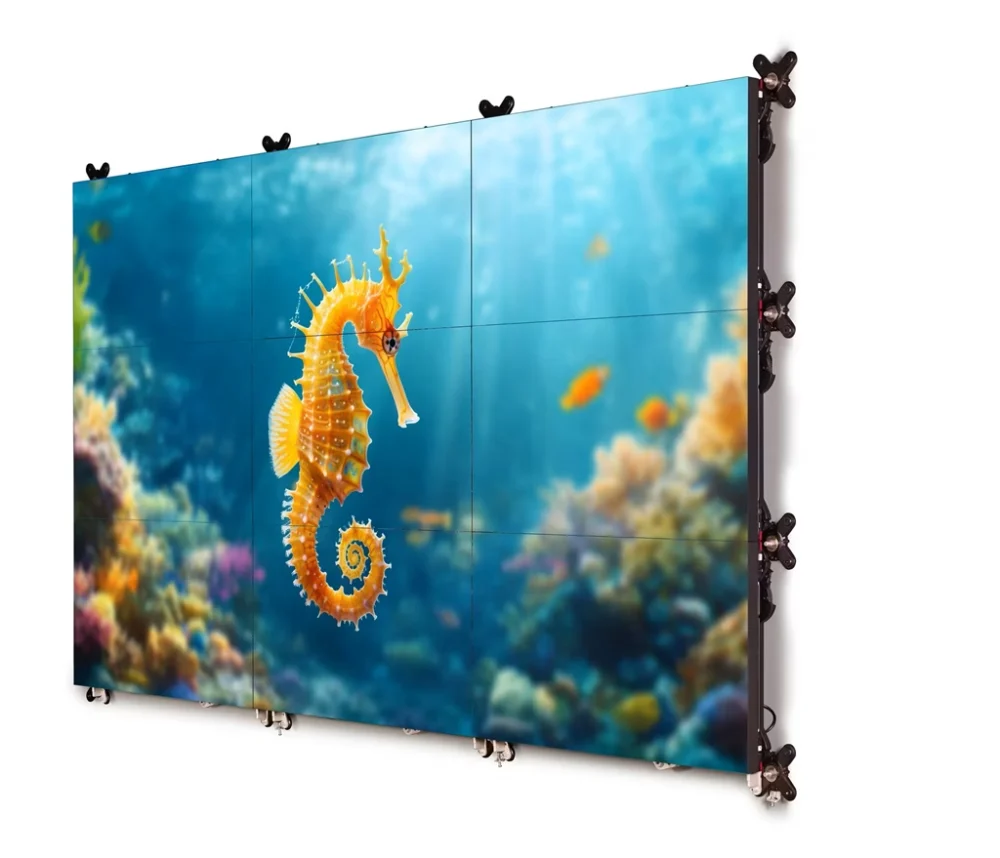
The global visual signaling and display market has reached a new milestone with the official introduction of the Barco UniSee 500+, a sophisticated evolution of the industry-standard UniSee platform designed to meet the rigorous demands of modern mission-critical environments. As the successor to the widely deployed UniSee 500, this new iteration focuses on three core pillars of professional display technology: visual homogeneity, operational ergonomics, and environmental sustainability. Scheduled for release at the end of the first quarter of 2026, the UniSee 500+ arrives at a time when corporate entities and government agencies are increasingly prioritizing long-term operational costs and energy efficiency alongside raw performance.
A New Standard in Visual Homogeneity
The UniSee platform has long been recognized for its "NoGap" technology, a mechanical engineering feat that allows multiple LCD panels to be mounted with virtually invisible seams. The UniSee 500+ builds upon this foundation by introducing intelligent local dimming technology to the 500-nit brightness segment—a first for the industry. Traditionally, local dimming has been reserved for high-brightness displays or consumer-grade HDR televisions. By integrating this into a professional 500-nit platform, Barco addresses the specific needs of control rooms where excessive brightness can lead to operator fatigue, yet high contrast is required to distinguish complex data sets.
The intelligent local dimming system works in tandem with an upgraded inter-panel communication protocol. This ensures that brightness, contrast, and color reproduction are synchronized across the entire video wall in real-time. In previous generations of LCD walls, "tiling" effects—where individual panels show slight variations in hue or luminance—remained a challenge for the most discerning eyes. The UniSee 500+ utilizes advanced sensing technology to perform continuous automated calibration. This process ensures that the image remains uniform not just at the moment of installation, but throughout the entire multi-year lifecycle of the display, effectively neutralizing the natural degradation of LEDs and liquid crystals over time.
Operational Efficiency and Environmental Impact
In an era where Environmental, Social, and Governance (ESG) criteria influence procurement decisions, the UniSee 500+ offers a significant leap in energy management. Barco has confirmed that the new model reduces power consumption by 25 percent compared to its predecessor. For a large-scale installation in a 24/7 operations center, this reduction translates into thousands of kilowatt-hours saved annually.
Beyond the direct reduction in electricity costs, the decrease in power consumption has a secondary benefit: reduced thermal output. Heat dissipation is a critical factor in the design of control rooms and server housing. Excessive heat can lead to hardware failure and requires more robust HVAC (Heating, Ventilation, and Air Conditioning) systems, further driving up operational costs. By running cooler, the UniSee 500+ extends the longevity of internal components and creates a more comfortable environment for human operators who must remain stationed near the display for extended shifts.
Ergonomics and Regulatory Compliance
The technical specifications of the UniSee 500+ highlight a strategic shift toward better integration within sensitive electronic environments. The platform now meets the Electromagnetic Compatibility (EMC) Class B standard. While the previous Class A standard was sufficient for most industrial applications, Class B represents a stricter level of regulation regarding electromagnetic emissions.
This improvement is particularly relevant for defense, aerospace, and emergency response sectors, where video walls are often located in close proximity to sensitive radio equipment, communication arrays, or high-precision sensors. By minimizing electromagnetic interference (EMI), Barco ensures that the UniSee 500+ can be deployed in a wider variety of specialized environments without the risk of disrupting critical signals.
Furthermore, the software architecture of the platform has been overhauled to provide deeper insights into the "health" of the display. The new lifecycle management tools allow IT and facility managers to monitor the status of individual panels remotely. These tools provide predictive maintenance alerts, identifying potential issues before they result in screen downtime. This proactive approach is essential for "mission-critical" applications where a blank screen is not merely an inconvenience but a potential security or safety risk.
The UniSee Ecosystem: Continuity and Integration
One of the primary concerns for existing Barco customers is the compatibility of new hardware with existing infrastructure. Barco has addressed this by ensuring the UniSee 500+ is fully compatible with the established UniSee ecosystem. This includes the UniSee Mount, a gravity-based mounting system that uses specialized hardware to align panels automatically, and the InvisiMount system for more streamlined aesthetic installations.
The mechanical precision of the UniSee Mount remains a key differentiator for the brand. Unlike traditional VESA mounts that require manual adjustment and can shift over time due to vibrations or temperature changes, the UniSee system uses a self-aligning mechanism that protects the glass edges of the panels. This modularity allows organizations to upgrade their existing UniSee 500 installations to the 500+ model without needing to replace the underlying mounting structure, significantly reducing the total cost of ownership (TCO) for long-term clients.
In addition to its mechanical advantages, the UniSee 500+ is fully compliant with the U.S. Trade Agreements Act (TAA). This compliance is a vital prerequisite for any technology intended for use by United States federal agencies and government contractors, ensuring that the product meets specific country-of-origin requirements and labor standards.
Market Context and Strategic Positioning
The launch of the UniSee 500+ comes at a pivotal moment in the display industry. While Direct-View LED (dvLED) technology has seen rapid growth in the "Experience Center" and high-end signage markets, LCD technology continues to hold a dominant position in control rooms and corporate boardrooms. The reasons for this are primarily rooted in pixel density and cost-efficiency.
At the viewing distances typical of a control room, LCDs offer a higher resolution per square meter than most affordable LED solutions. A standard 55-inch LCD panel provides a native 1920×1080 resolution; achieving that same pixel density with LED requires extremely fine pixel pitches (sub-0.9mm), which often come at a prohibitive price point. By refining the LCD platform with the 500+, Barco is reinforcing the value proposition of LCD as a high-resolution, reliable, and now more sustainable alternative to LED for 24/7 data-intensive applications.
Gerrit Vermeire, Vice President of Product Management and R&D Display at Barco, emphasized this strategic focus during the product’s unveiling. "Barco UniSee 500+ strengthens our position as a technology leader in the professional LCD video wall segment," Vermeire stated. "We have specifically listened to the requirements of control room operators and corporate environments to evolve the platform in terms of image quality, ergonomics, and sustainability."
Timeline and Global Availability
The development cycle of the UniSee 500+ reflects a multi-year effort to refine the supply chain and incorporate feedback from the original UniSee launch in 2017. Since its debut, the UniSee line has been installed in thousands of locations worldwide, from the command centers of major utility companies to the lobbies of Fortune 500 headquarters.

The chronology of the UniSee platform’s evolution demonstrates a consistent trend toward smarter, more autonomous hardware:
- 2017: The original Barco UniSee is launched, introducing the NoGap bezel-less design and the gravity-based mounting system.
- 2020: Enhancements in brightness and color calibration software are introduced to support HDR-like content.
- 2023: The UniSee 500 becomes a staple for mid-range brightness requirements, focusing on the 500-nit market.
- 2026 (Q1): The UniSee 500+ is set for commercial release, introducing local dimming, 25% energy savings, and EMC Class B compliance.
Global distribution is expected to begin in late March 2026, with initial shipments prioritized for certified Barco partners and existing contract holders in the EMEA and North American markets.
Implications for the Industry
The introduction of the UniSee 500+ is likely to trigger a shift in how professional displays are evaluated. Historically, the "best" display was defined simply by its brightness and bezel width. However, as the industry matures, the focus is shifting toward the "quiet" features: electromagnetic interference, thermal management, and long-term color stability.
For system integrators, the UniSee 500+ simplifies the installation process by reducing the need for complex external calibration tools. The "self-healing" nature of the inter-panel communication means that even if a single panel needs to be replaced years after the initial installation, the system can automatically adjust the new panel to match the aged characteristics of the surrounding wall.
For the end-user, particularly in the public sector and high-tech industries, the move to EMC Class B and TAA compliance makes the UniSee 500+ an easy choice for security-cleared environments. As digital transformation continues to push more data into the hands of operators, the need for a reliable, clear, and efficient "canvas" has never been greater.
In summary, the Barco UniSee 500+ represents more than just a incremental update; it is a comprehensive refinement of a platform that has come to define the high-end LCD video wall market. By balancing the technical requirements of visual performance with the practical realities of energy consumption and regulatory compliance, Barco has positioned the 500+ as the definitive solution for the next generation of professional display infrastructure. As the end of Q1 2026 approaches, the industry will be watching closely to see how this new standard influences the competitive landscape of professional visualization.
