

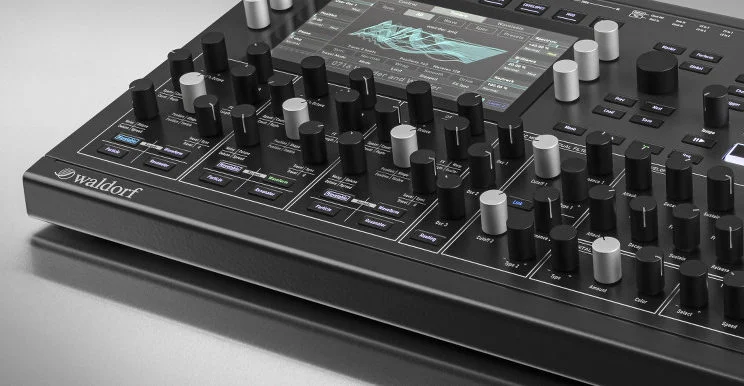
Waldorf Music, the venerable German manufacturer of high-end synthesis technology, has officially released a cryptic teaser video titled Coming Soon, sparking widespread speculation throughout the electronic music instrument industry. The brief audiovisual presentation, which appeared on the company’s official digital platforms, features a series of abstract visual cues and a sonic palette characteristic of the brand’s sophisticated wavetable and granular synthesis engines. While the teaser remains devoid of specific technical specifications or a formal product name, industry analysts and synthesizer enthusiasts have immediately begun drawing connections to the company’s recent roadmap, including whispers of a successor to the critically acclaimed Iridium platform.
The announcement comes at a pivotal moment for Waldorf, a company that has historically balanced boutique engineering with mass-market appeal. Based in Remagen, Germany, Waldorf has spent the last decade re-establishing its dominance in the flagship synthesizer market, moving away from the entry-level legacy of the Blofeld toward the high-powered architecture of the Quantum and Iridium series. The current teaser is being viewed not merely as a product launch, but as a strategic response to an evolving market that increasingly demands high-voice counts, multi-engine flexibility, and tactile control surfaces.
The Evolution of Waldorf Synthesis and the Path to the Current Teaser
To understand the significance of the "Coming Soon" announcement, one must examine the chronological trajectory of Waldorf’s hardware development over the last several years. The company’s modern era began in earnest with the 2018 release of the Quantum, a flagship hybrid synthesizer that combined digital wavetable synthesis with analog filters. This was followed by the Iridium in 2020, which transitioned the Quantum’s "Digital Heart" into a more compact, all-digital desktop format, later expanded into a 49-key version with polyphonic aftertouch.
In 2023, Waldorf further diversified the line with the Iridium Core, a streamlined version of the engine designed for portability and integration into smaller studio setups. The current teaser suggests a departure from this miniaturization trend, potentially signaling a return to a large-format flagship or a significant "Mark II" iteration of existing hardware. Speculation regarding an Iridium mkII has been circulating since a preview was reportedly discussed in the context of long-term development cycles at the NAMM (National Association of Music Merchants) Show. If the teased product is indeed a second-generation Iridium, it would likely address the few criticisms leveled at the original, such as the desire for integrated analog filtering or expanded processing power for more complex "Kernel" synthesis operations.
Technical Analysis of Potential Features and Architectures
While Waldorf has remained silent on the specifics, the technical requirements of modern synthesis provide a framework for what this new hardware might entail. The current Iridium and Quantum platforms utilize a sophisticated Linux-based architecture to manage five distinct synthesis types: Wavetable, Waveform (Virtual Analog), Particle (Granular/Sampling), Resonator, and Kernels (a modular FM-style engine).
An upgraded "mkII" or a new flagship model would logically focus on several key areas of technological advancement:
- Processing Power and Polyphony: As users move toward more complex multi-timbral patches, the demand for higher voice counts without aliasing or CPU throttling increases. A new Waldorf unit would likely utilize updated ARM-based processors or specialized FPGA (Field-Programmable Gate Array) chips to ensure smooth operation of its high-resolution touch interface alongside heavy synthesis loads.
- Analog Integration: One of the primary distinctions between the Quantum and the Iridium was the latter’s lack of analog filters. Industry insiders suggest that a "bridge" product—offering the Iridium’s compact form factor but incorporating the Quantum’s dual analog filters—would be a logical progression for the brand.
- Enhanced Connectivity: Modern studio environments require seamless integration with MPE (MIDI Polyphonic Expression) controllers and CV/Gate (Control Voltage) systems for modular synthesis. The teaser’s emphasis on "something new" could imply a hardware interface more deeply integrated with the Eurorack ecosystem or advanced DAW (Digital Audio Workstation) bidirectional communication.
- Interface Improvements: Waldorf has pioneered the use of large, high-resolution touchscreens in hardware synths. A new iteration might feature improved haptic feedback, higher refresh rates, or a redesigned encoder system to improve the "knob-per-function" workflow that professional sound designers prioritize.
Market Positioning and Competitive Landscape
The timing of Waldorf’s teaser is strategically significant. The high-end synthesizer market is currently experiencing a period of intense competition. Manufacturers such as Sequential, Arturia, and Novation have all recently refreshed their flagship offerings, pushing the boundaries of what is expected from a professional-grade instrument priced between $2,000 and $4,500.
Waldorf’s position in this landscape is unique due to its heritage in wavetable synthesis, a technology it pioneered alongside PPG in the 1980s. By teasing a new product now, Waldorf is asserting its relevance against competitors like the Arturia PolyBrute 12 or the Sequential 3rd Wave, the latter of which directly challenges Waldorf’s wavetable dominance. Data from retail analytics suggests that while the "budget" synth market has cooled slightly, the "luxury" or "pro-sumer" segment remains robust, with musicians willing to invest in deep, "evergreen" instruments that offer years of sonic exploration.
Chronology of Recent Waldorf Developments
To contextualize the current announcement, a timeline of Waldorf’s recent hardware releases provides insight into their development cycle:
- April 2018: Launch of the Quantum, establishing the new flagship platform.
- June 2020: Release of the Iridium Desktop, bringing the Quantum engine to a digital-only, more affordable format.
- September 2021: Introduction of the Waldorf M, a return to classic Microwave-style wavetable synthesis using authentic VCF and VCA components.
- May 2022: Release of the Iridium Keyboard, introducing a Fatar TP/8SK keybed with polyphonic aftertouch.
- October 2023: Launch of the Iridium Core, focusing on a ultra-compact 12-voice variant.
- Present Day: The "Coming Soon" teaser, which many believe represents the culmination of feedback gathered since the original Iridium release four years ago.
Industry Reactions and Professional Implications
The reaction from the professional audio community has been one of cautious optimism. Sound designers for film and television, who frequently utilize Waldorf instruments for their cinematic textures, have noted that a hardware refresh could solve existing bottlenecks in sample management and modulation routing.
"Waldorf has always been about depth," notes one industry consultant. "The challenge they face is making that depth accessible. If the new teaser points to a UI overhaul or a more powerful processing core, it could solidify the Iridium/Quantum ecosystem as the definitive workstation for the next decade."
Furthermore, the mention of a "2026 NAMM" preview in historical context suggests that Waldorf has been working on a long-term engineering cycle. This implies that the product being teased is not a minor firmware update, but a substantial hardware revision that has undergone several years of research and development. In an era where "planned obsolescence" is a common concern, Waldorf’s commitment to high-build quality and long-term support for its OS (Operating System) remains a key selling point for its user base.
Broader Impact on the Electronic Music Industry
Beyond the immediate excitement of a new piece of gear, Waldorf’s announcement reflects broader trends in the music technology industry. There is a growing movement toward "hybrid" workflows where digital flexibility meets analog warmth. Waldorf’s ability to navigate this line will likely influence how other manufacturers approach high-end digital synthesis.
The focus on a "Coming Soon" campaign also highlights the importance of "teaser culture" in modern marketing. By withholding details, Waldorf generates organic engagement and allows the community to voice their "wish lists," which can provide valuable last-minute market validation. Whether the new product is a "Mark II" Iridium, a new flagship "Quantum Pro," or an entirely new synthesis category, the impact will be felt across the industry, forcing competitors to respond to Waldorf’s unique blend of German engineering and avant-garde sound design.
As the industry awaits the official unveiling, the consensus among analysts is that Waldorf is preparing to reinforce its status as a leader in complex synthesis. The "Coming Soon" video serves as a reminder that in the world of professional audio, innovation is a continuous process of refinement and technological boundary-pushing. Detailed specifications, pricing, and shipping dates are expected to follow in the coming weeks, potentially aligning with major mid-year industry events. Until then, the electronic music community remains focused on the Remagen-based company, anticipating the next chapter in a legacy that began with the legendary PPG Wave and continues into the future of digital sound.
