

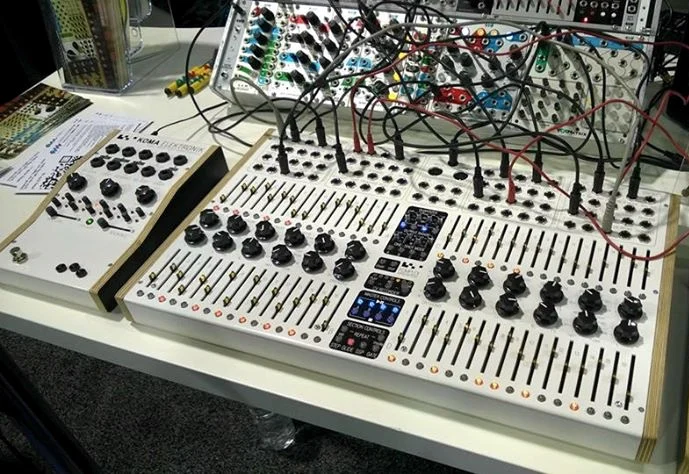
The Berlin-based hardware manufacturer KOMA Elektronik has recently released a comprehensive hands-on demonstration of its flagship Komplex Sequencer, a move that signals a renewed focus on one of the most ambitious hardware sequencers ever brought to the professional audio market. Originally unveiled to the public at the NAMM Show in 2015, the Komplex Sequencer represents a pinnacle of analog-style control logic, offering a sprawling, menu-free interface designed for the intricate manipulation of melodic patterns and modulation signals. Despite its decade-long presence in the industry, the device remains a rare sight in standard studio configurations due to its boutique production scale and its premium positioning within the synthesizer ecosystem. The latest video demonstration serves not only as a tutorial for prospective users but also as a testament to the enduring relevance of tactile, physical hardware in an increasingly digitized production landscape.
The Architecture of Complexity: Technical Specifications and Interface
At its core, the Komplex Sequencer is composed of four fully independent 16-step sequencers. While many modern sequencers utilize digital screens and multi-layered menus to manage complexity, KOMA Elektronik opted for a "one knob per function" philosophy. This design choice results in a massive physical footprint, populated by dozens of potentiometers, sliders, and patch points. Each of the four sequencers can operate on its own clock division, direction, and sequence length, allowing for the creation of polyrhythmic structures that far exceed the capabilities of standard linear sequencers.
The connectivity of the Komplex Sequencer is one of its most defining features. It boasts a comprehensive array of CV (Control Voltage) and Gate outputs, as well as MIDI In, Out, and Thru ports. This hybrid approach ensures that the device can serve as the central nervous system for a diverse rig, controlling vintage analog synthesizers, modern Eurorack modular systems, and digital MIDI-equipped workstations simultaneously. Each of the four sequencer blocks includes dedicated controls for Start Point, End Point, Play Mode (Forward, Backward, Ping-Pong, and Random), and Clock Division. This level of granular control is accessible instantly, without the need to "shift-click" or navigate sub-folders, facilitating a performance-oriented workflow that encourages improvisation.
A Historical Perspective: From NAMM 2015 to the Present
The journey of the Komplex Sequencer began during a transformative era for the music technology industry. In 2015, the "analog renaissance" was in full swing, with musicians moving away from purely software-based environments in favor of tactile hardware. KOMA Elektronik, founded by Wouter Jaspers and Christian Zollner, had already established a reputation for experimental and ruggedly built gear, such as the BD-101 Analog Gate/Delay and the FT-201 Voltage Controlled Filter/10-Step Sequencer.
When the Komplex Sequencer was first introduced, it was viewed as a bold architectural statement. It was one of the first modern sequencers to bridge the gap between the simplicity of a classic 16-step analog sequencer (like the Doepfer A-155) and the advanced logic of digital workstations. Over the last ten years, the product has maintained a cult-like status. Because it is produced in small batches at KOMA’s Berlin facility, the secondary market for these units has remained remarkably stable, with the device often being cited as a "holy grail" for modular synthesists who prioritize performance over pre-programmed sequences.
The Logic of Modulation: Internal Patching and Generative Capabilities
What elevates the Komplex from a standard step sequencer to a "complex" instrument is its internal modulation matrix. The device features a dedicated patch bay that allows the four sequencers to interact with one another. For example, Sequencer A can be patched to modulate the clock speed of Sequencer B, while Sequencer C can be set to determine the sequence length of Sequencer D. This internal feedback loop capability allows users to generate evolving, non-repeating patterns that mimic the behavior of generative software algorithms, but with the immediate tactile response of hardware.
Supporting data regarding the unit’s physical construction highlights its professional-grade intent. The chassis is constructed from heavy-duty metal, and the patch points are standard 3.5mm jacks, making it fully compatible with the Eurorack standard. The inclusion of a "Master Section" allows for global control over all four sequencers, including a master clock and global transposition. This is particularly useful for live performers who need to change the key or tempo of an entire multi-part composition with a single adjustment.
Pricing, Availability, and the Boutique Manufacturing Model
In an era where mass-produced digital sequencers often retail for between €300 and €700, the Komplex Sequencer’s price point of €1,998.00 positions it firmly in the luxury professional category. This pricing reflects the high cost of boutique manufacturing in Europe, the quality of the individual components, and the sheer scale of the hardware. Each unit is assembled with a focus on longevity, catering to a demographic of professional composers, sound designers, and high-end hobbyists who view their equipment as long-term investments.
The current pre-order phase indicated by KOMA Elektronik suggests that the company continues to operate on a low-volume, high-intent production model. By producing the Komplex Sequencer in limited runs, the company avoids the risks associated with overstocking while ensuring that each unit meets their stringent quality control standards. This model has become increasingly common among boutique synthesizer firms in Berlin, London, and Portland, who prioritize artisanal engineering over mass-market saturation.
Comparative Analysis: The Komplex Sequencer vs. Modern Alternatives
When analyzing the Komplex Sequencer’s place in the current market, it is necessary to compare it to other high-end sequencing solutions such as the Sequentix Cirklon, the Squarp Hapax, and the Erica Synths Black Sequencer.
- Sequentix Cirklon: Often considered the industry standard for MIDI sequencing, the Cirklon offers deep menu diving and immense connectivity. In contrast, the Komplex Sequencer trades the Cirklon’s deep digital memory for immediate, physical access to every parameter.
- Squarp Hapax: The Hapax is a modern, screen-heavy sequencer that excels at polyphonic MIDI sequencing and MPE (MIDI Polyphonic Expression). The Komplex, however, remains focused on the CV/Gate workflow and the "happy accidents" that occur when physically patching modulation sources.
- Erica Synths Black Sequencer: While the Black Sequencer provides a powerful 4-track CV/Gate experience within a Eurorack format, it lacks the expansive, standalone physical interface that defines the Komplex.
The primary implication of the Komplex Sequencer’s design is that it treats sequencing as an act of performance rather than an act of programming. For many artists, the lack of a screen is a feature rather than a limitation, as it forces the user to rely on their ears and their physical intuition rather than visual feedback.
Official Positioning and Industry Impact
While KOMA Elektronik has not issued a formal press release regarding a "version 2.0," the re-emergence of high-quality demonstration materials suggests a strategic effort to re-educate a new generation of synthesists on the benefits of their design philosophy. Industry analysts suggest that as the Eurorack market matures, there is a growing demand for "out-of-the-box" controllers that can unify disparate modules into a cohesive instrument.
The reaction from the synthesizer community to the latest demonstration has been largely positive, with many highlighting the unit’s unique ability to bridge the gap between experimental noise and structured melodic composition. The "Komplex" name is often described by users as an understatement; the device is essentially four instruments in one, capable of acting as a drum sequencer, a lead melody generator, a bassline driver, and a complex modulation source simultaneously.
Broader Implications for the Future of Music Technology
The continued production of the Komplex Sequencer after ten years highlights a significant trend in the music technology industry: the "long tail" of boutique hardware. Unlike software, which can become obsolete due to operating system updates, or mass-produced digital gear that may suffer from planned obsolescence, high-quality analog-style hardware like the Komplex tends to retain its value and utility over decades.
Furthermore, the Komplex Sequencer’s existence challenges the prevailing trend of miniaturization. While many companies are focused on making gear smaller and more portable, KOMA Elektronik embraces a large-format design that prioritizes ergonomic comfort and "playable" controls. This approach suggests that there will always be a market for substantial, desktop-based command centers that serve as the focal point of a studio.
As KOMA Elektronik opens pre-orders for the next batch of Komplex Sequencers, the device stands as a bridge between the historical traditions of voltage-controlled music and the modern requirements of the electronic music producer. For those willing to invest in its high entry price, the Komplex offers a level of interaction that few other devices can match, ensuring its place in the pantheon of classic hardware for years to come. The return of this boutique powerhouse serves as a reminder that in the world of synthesis, the interface is often just as important as the sound itself.
