

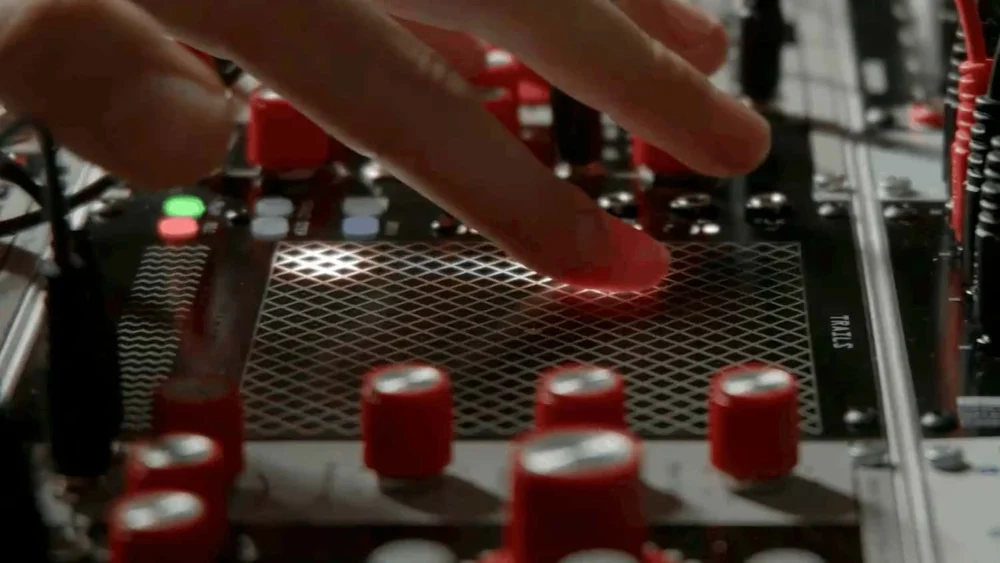
Bela, the London-based hardware manufacturer renowned for its ultra-low-latency audio processing technology, has officially unveiled Trails, a four-channel touch recorder designed for the Eurorack modular synthesizer format. This new module represents a significant leap in gestural control, allowing performers to capture intricate finger movements and translate them into a diverse array of musical outputs, including melody, harmony, and complex rhythmic patterns. By bridging the gap between tactile human expression and digital precision, Trails offers a versatile solution for musicians seeking to inject more "human" feel into their modular patches.
The module is engineered to generate both control voltage (CV) and MIDI information simultaneously, ensuring compatibility with a wide range of hardware and software instruments. This dual-output capability allows Trails to serve as a central hub for performance, controlling analog oscillators and filters alongside digital workstations or external synthesizers. With the ability to save recorded gestures into 16 distinct scenes, the module is positioned as a powerful tool for live performance, enabling artists to recall complex modulations and sequences instantaneously.
Technical Specifications and Core Functionality
At its core, Trails is a multi-channel recording interface that prioritizes the nuances of physical interaction. The module features a touch-sensitive interface that tracks the movement and pressure of the user’s fingers across four independent channels. These gestures are captured with high resolution, ensuring that even the most subtle tremors or speed changes are preserved in the recorded data.
The recorded signals can be utilized in two primary ways: continuous shaping or quantized generation. In continuous mode, the module outputs smooth, flowing CV signals ideal for parameter automation, such as filter sweeps, VCA levels, or effects modulation. Alternatively, the quantization engine allows these gestures to be snapped to specific musical scales or synchronized with an external clock. This turns a free-form finger movement into a perfectly timed melodic sequence or a tempo-synced rhythmic trigger, providing a bridge between improvisational performance and structured composition.
The 16-scene memory architecture is a critical feature for professional workflows. Each scene can hold a unique set of four-channel recordings, allowing the user to build up layers of movement throughout a performance. These scenes can be switched manually or triggered via external CV, facilitating the creation of evolving song structures within a single module.
A Chronology of Innovation: From Research to Eurorack
The development of Trails is the latest chapter in a decade-long journey for the Bela team. The project originated within the Augmented Instruments Laboratory at Queen Mary University of London, led by Dr. Andrew McPherson. The primary goal was to address the latency issues inherent in standard digital audio processing, which often create a perceptible disconnect between a musician’s action and the resulting sound.
In 2016, the Bela platform was launched via a successful Kickstarter campaign, introducing an embedded hardware system based on the BeagleBone Black. This system utilized a custom Linux environment (Xenomai) to achieve sub-millisecond latency, making it a favorite among instrument designers and researchers. Following the success of the standalone board, the company moved into the Eurorack market with "Salt," a programmable module that allowed users to run Bela code directly within a modular system.
The transition from Salt to Trails marks a shift from a purely programmable "open-canvas" module to a more focused, purpose-built instrument. While Salt required coding knowledge (C++, Pure Data, or SuperCollider), Trails is designed as a plug-and-play device that retains the high-performance DNA of the Bela platform while offering a streamlined, intuitive user interface for the broader modular community.
Supporting Data: The Importance of Low Latency in Gestural Control
The effectiveness of a touch recorder like Trails is heavily dependent on its responsiveness. Standard MIDI controllers often operate with latencies ranging from 5 to 10 milliseconds, which can be further exacerbated by software processing. In the context of modular synthesis, where timing is often measured in microseconds, high latency can result in "jitter" or a loss of phase coherence.
Bela’s proprietary technology allows for high-speed sensor sampling, often exceeding standard audio rates. By sampling the touch interface at several thousand times per second, Trails ensures that the recorded "trail" of a finger movement is a faithful reproduction of the physical act. This high-resolution data is particularly important when the module is used to generate pitch CV, where even a slight delay or rounding error can result in audible tuning issues.

Furthermore, the module’s ability to output MIDI via a dedicated jack allows it to bypass the traditional USB-MIDI bottlenecks found in many controllers. This direct-to-hardware communication is essential for maintaining the tight timing required for complex polyphonic sequences.
Official Design Philosophy and Industry Response
While the company has maintained a focus on technical excellence, the design philosophy behind Trails is rooted in the "tactile turn" of modern electronic music. In statements regarding the module’s development, the Bela team has emphasized the importance of muscle memory in electronic performance. By allowing a musician to "play" their modulation rather than programming it into a grid, Trails encourages a more physical relationship with the instrument.
Industry experts have noted that the Eurorack market has seen a growing demand for "performative sequencers"—modules that prioritize live interaction over static programming. Early reactions from the modular community suggest that Trails fills a specific niche by combining the fluidity of a touch-plate controller (similar to those found on Buchla systems) with the recording and playback capabilities of a digital sequencer.
The inclusion of 16 scenes has been highlighted as a particularly useful feature for "laptop-less" performers. By pre-recording complex modulations and switching between them during a set, artists can achieve a level of sonic complexity that would normally require a significant amount of manual knob-turning, freeing their hands to interact with other parts of the system.
Broader Impact on the Modular Ecosystem
The release of Trails is expected to influence how modular users approach the concept of "automation." Historically, automation in a modular system was achieved through Low-Frequency Oscillators (LFOs), envelope generators, or step sequencers. While effective, these methods are often cyclical and mathematically rigid. Trails introduces a method of "organic automation," where the movement is as unique as the person who performed it.
This has significant implications for sound design in film and game audio, where "natural" sounding variation is often preferred over repetitive cycles. By recording a human gesture and then looping or quantizing it, sound designers can create textures that feel alive and responsive.
Moreover, the dual CV/MIDI nature of the module addresses the increasing trend of hybrid setups. As more musicians integrate Eurorack with Ableton Live, Bitwig Studio, or hardware samplers, the need for controllers that speak both "languages" fluently has become paramount. Trails allows a single gesture to modulate an analog filter while simultaneously controlling a software parameter or triggering a polyphonic synth patch via MIDI.
Pricing, Availability, and Market Positioning
The Bela Trails is currently available for pre-order through the official Bela webshop at a price of $449 USD. This puts it in the mid-to-high price bracket for Eurorack modules, reflecting the specialized hardware and high-speed processing capabilities integrated into the unit.
In terms of market competition, Trails sits alongside devices like the Make Noise René or the Monome Teletype, though its focus on direct gestural recording sets it apart. While other modules offer touch-sensitive plates, few offer the specific combination of four-channel polyphonic recording, scene memory, and integrated quantization found in Trails.
As the modular synthesizer market continues to expand beyond hobbyists and into the realms of professional composition and live performance, tools that emphasize reliability and expressive potential are becoming increasingly vital. Bela’s background in academic research and high-performance embedded systems provides a strong foundation for Trails, suggesting that the module will become a staple for performers who demand the highest level of responsiveness from their gear.
The module is expected to begin shipping in the coming months, with a full rollout to international retailers to follow the initial pre-order phase. As musicians begin to integrate Trails into their rigs, the industry will likely see a new wave of gestural-based performances that move away from the "grid" and toward a more fluid, human-centric approach to electronic music.
