

Hardware Evolution and Internal Architecture Upgrades
The core of the Iridium MK2’s advancement lies in its redesigned internal architecture. Waldorf has implemented a completely new CPU board, which serves as the foundation for the instrument’s expanded capabilities. This hardware refresh includes a substantial increase in both RAM and flash storage. While the original Iridium was already lauded for its ability to handle complex wavetables and large sample libraries, the MK2 doubles down on these strengths.
The increased RAM is not merely for storage efficiency; it directly impacts the real-time performance of the synthesizer. It allows for smoother handling of high-resolution samples and more complex modulation routing without the risk of processing bottlenecks. Furthermore, the expanded flash storage provides users with significantly more space for factory content and user-created samples, making the Iridium MK2 a more formidable workstation for those who rely heavily on the "Particle" (granular) and "Resonator" synthesis engines.
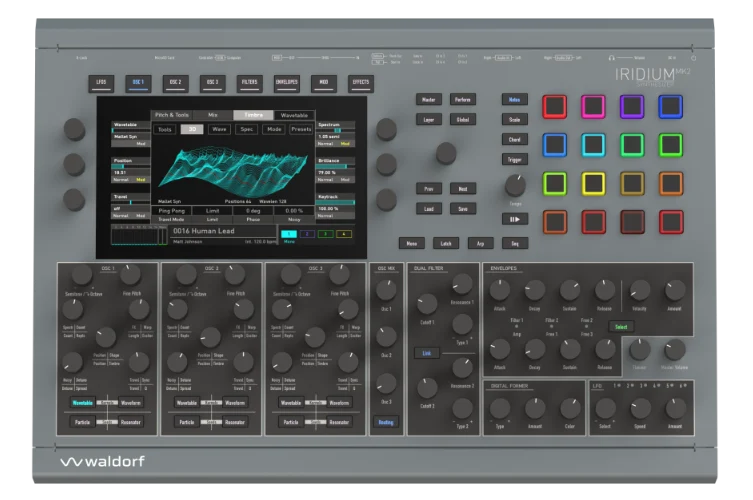
Visually, the MK2 retains the industrial aesthetic that has become a hallmark of Waldorf’s high-end line, featuring the familiar silver-and-black color scheme and the high-resolution multi-touch display. However, the internal hardware changes have necessitated a slight refinement in the physical layout to accommodate the new processing components and cooling requirements, ensuring long-term reliability in both studio and stage environments.
Per-Note-Parameter-Locks: The Aphex Twin Collaboration
One of the most talked-about features of the Iridium MK2 is the introduction of Per-Note-Parameter-Locks. This feature was developed in direct collaboration with Richard D. James, better known as Aphex Twin. James, a long-term user of the original Iridium Desktop, has a storied history of pushing electronic musical instruments to their absolute limits, often requesting specific modifications or features from manufacturers to facilitate his intricate approach to micro-composition.
Per-Note-Parameter-Locks allow a level of granularity previously reserved for high-end sequencers or software environments. With this system, each of the 128 MIDI notes can be assigned up to 16 individual parameter variations. By simply holding a note on the interface or an external controller and turning a knob, the user can lock a specific parameter value to that individual note.
This functionality transcends traditional automation. It allows for a single patch to sound entirely different depending on which note is played. For example, a user could program a percussive patch where C3 triggers a standard kick drum sound, while C#3 triggers the same patch but with a different oscillator type, a higher filter resonance, and a longer delay time. The ability to change synthesis modes or effect parameters on a per-note basis transforms the Iridium MK2 from a traditional polyphonic synthesizer into a complex multi-engine performance tool. These "locks" are saved within the patch metadata and can be viewed or edited via a dedicated software page on the touch screen, providing a visual representation of the micro-variations.
Expanded Multi-Timbrality and Layering Modes
The original Iridium featured a dual-timbral architecture, allowing users to layer or split two different sounds. Thanks to the upgraded CPU and RAM in the MK2, Waldorf has doubled this capacity. The Iridium MK2 now supports four multi-timbral layers. This expansion effectively allows the device to function as four independent synthesizers simultaneously, all controllable via different MIDI channels or mapped across a keyboard.

To complement this increase in layers, Waldorf has introduced advanced voice management modes:
- Round-Robin: This mode cycles through the four layers sequentially with each new note played. This is particularly useful for creating evolving textures or simulating the slight variations found in vintage analog hardware or orchestral sections.
- Random-Robin: This mode selects one of the four layers at random for each note strike, providing an unpredictable and organic feel to sequences and live playing.
The shift to four layers significantly enhances the Iridium’s utility in a live setting, where a performer might need a bass sound, a lead, and two atmospheric pads available at once without having to switch patches and interrupt the audio flow.
The Sixth Synthesis Sense: "Seeds"
The Iridium platform was already famous for its five synthesis engines: Wavetable, Waveform (Virtual Analog), Particle (Granular), Resonator, and Kernels (FM). The MK2 introduces a sixth method titled "Seeds."
The "Seeds" engine is a proprietary Waldorf technology that builds upon the principles of wavetable synthesis but adds a dynamic, generative element. It utilizes "waypoints" synthesized from sub-oscillators. These waypoints act as structural markers that the engine can move between, but unlike a static wavetable, these markers can be dynamically altered and recombined in real-time.
Techniques such as ring modulation and frequency modulation (FM) can be applied to these Seeds, and the engine allows for the injection of noise and non-pitched material to add grit and texture. This engine is designed for creating sounds that feel "alive," moving away from the static nature of traditional digital synthesis and toward a more fluid, evolving sonic palette.
Protein’s "Flavour" Knob and Micro-Variations
In addition to the new synthesis engine, Waldorf has ported a concept from their "Protein" synthesizer project: the "Flavour" knob. This control is designed to address one of the common criticisms of digital synthesis—that it can sometimes sound too precise or "sterile."
The Flavour knob introduces micro-variations across a wide array of parameters, including timing, timbre, and pitch. By turning the knob, users can dial in a specific amount of "instability." At lower settings, it adds a subtle warmth and movement reminiscent of high-quality analog circuitry. At higher settings, the variations become more pronounced, leading to experimental textures and lo-fi aesthetics. This feature is integrated into the Iridium MK2’s modulation matrix, meaning the amount of "flavour" can be modulated by LFOs, envelopes, or the Per-Note-Parameter-Locks mentioned previously.
Chronology of the Iridium Lineage
The release of the Iridium MK2 is the latest step in a timeline that began with the release of the Waldorf Quantum in 2018. To understand the significance of the MK2, it is helpful to view it within the context of Waldorf’s recent history:

- 2018: Waldorf releases the Quantum, a high-end hybrid synthesizer combining digital engines with analog filters.
- 2020: The Iridium Desktop is launched. It removes the analog filters in favor of digital models, doubles the polyphony to 16 voices, and introduces a more compact form factor.
- 2022: The Iridium Keyboard is released, adding a 49-key Fatar TP/8SK polyphonic aftertouch keybed and expanding the physical control surface.
- 2023: Waldorf introduces the Iridium Core, a streamlined, even more compact version of the Iridium engine for mobile setups.
- 2024: The Iridium MK2 is officially introduced, bringing the flagship desktop unit up to modern hardware standards with expanded memory and the Aphex Twin-inspired feature set.
Market Context and Professional Implications
The Iridium MK2 enters a market that is increasingly focused on "super-synths"—instruments that attempt to be all-in-one solutions for sound design. Its primary competitors include the ASM Hydrasynth Deluxe, the Polyend Sentinel, and various high-end software suites. However, Waldorf’s pedigree in wavetable synthesis (stretching back to the Microwave and the Wave in the 1980s and 90s) gives the Iridium a unique prestige.
For professional sound designers working in film and gaming, the addition of Per-Note-Parameter-Locks and four-layer multi-timbrality is a game-changer. These features allow for the creation of complex, non-repetitive environments and sound effects within a single hardware unit. In the electronic music world, the collaboration with Aphex Twin serves as a powerful endorsement, signaling that the MK2 is a tool for those who prioritize deep experimentation.
Pricing and Availability
At the time of its introduction, the Waldorf Iridium MK2 is priced at €2,399.00. While this places it in the premium category of electronic instruments, the price reflects the significant hardware upgrades and the proprietary nature of its synthesis engines.
Currently, the Waldorf website lists the Iridium MK2 as out of stock, a common occurrence for high-end boutique synthesizers shortly after announcement due to high demand and the complexity of the manufacturing process. Industry analysts expect shipping to stabilize as production ramps up at Waldorf’s German facilities.
Conclusion and Analysis
The Waldorf Iridium MK2 is more than a simple iterative update. By addressing the hardware limitations of the original unit and introducing features like "Seeds" and Per-Note-Parameter-Locks, Waldorf has ensured that the Iridium remains at the forefront of digital synthesis for the foreseeable future. The collaboration with Aphex Twin is particularly noteworthy, as it represents a bridge between instrument manufacturing and avant-garde artistry, resulting in a feature set that encourages users to think about synthesis in a nonlinear fashion.
As digital processing continues to advance, the Iridium MK2 stands as a testament to the idea that hardware synthesizers can offer an experience that is distinct from, and in many ways superior to, software plugins—offering a tactile, deep-dive environment for sonic exploration that is unmatched in its class. For the professional musician and the dedicated hobbyist alike, the MK2 represents the current pinnacle of Waldorf’s engineering prowess.
