

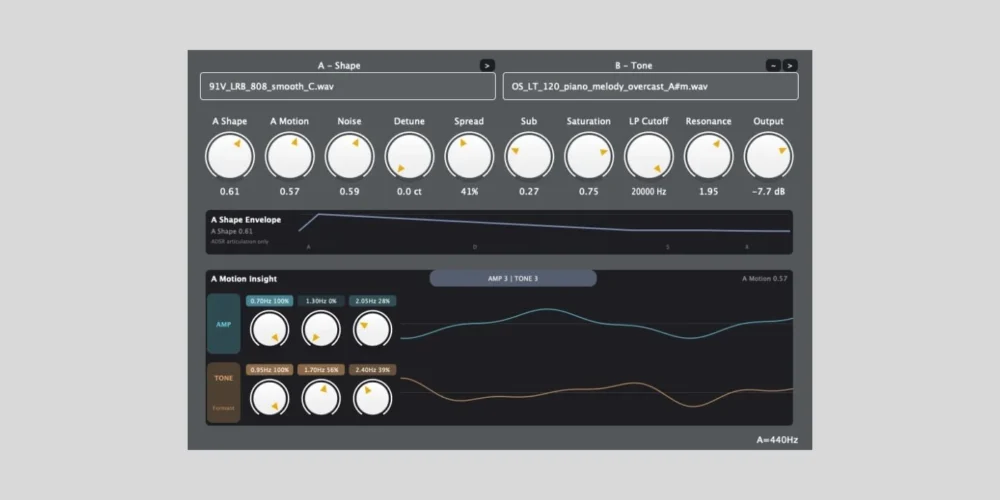
Kobito, an emerging developer in the realm of audio software, has released GrabTone, an experimental synthesizer plugin designed to transform any arbitrary sound into a playable, MIDI-controllable instrument. This innovative tool is currently available for free for a limited duration, utilizing a promotional code, positioning it as a significant offering for music producers and sound designers seeking novel sonic textures. The plugin’s core functionality revolves around a distinctive cross-synthesis approach, merging the rhythmic and articulative qualities of one audio file with the harmonic and timbral characteristics of another, thereby generating entirely new and often unpredictable synthesizer voices.
Understanding GrabTone’s Core Mechanism: A Deep Dive into Cross-Synthesis
At the heart of GrabTone’s operation lies a sophisticated audio processing engine that combines two distinct audio inputs, designated as Sound A (Shape) and Sound B (Tone). This dual-input architecture is fundamental to its creative potential. Sound A is primarily responsible for dictating the "movement," "articulation," and "rhythm" of the resulting synthesized sound. This implies that the transient information, envelope contours, and periodic fluctuations present in Sound A are extracted and impressed upon the output. Conversely, Sound B contributes the "harmonic and timbral information," meaning its spectral content, overtone structure, and overall sonic color are the dominant elements drawn upon.
The fusion of these two disparate sonic profiles represents a form of advanced cross-synthesis, a technique that has been explored in various forms within digital audio synthesis for decades. Unlike traditional additive or subtractive synthesis, which builds sounds from basic waveforms or filters complex ones, GrabTone’s method leverages existing audio recordings as its foundational elements. This approach opens up an almost infinite palette of possibilities, as users are not limited to predefined waveforms or oscillators but can draw from their entire audio library – be it field recordings, vocal snippets, drum loops, or even entire musical phrases. The plugin’s algorithm intelligently processes these inputs, identifying key characteristics from each and seamlessly blending them to create a coherent, yet often surprising, new sound. This process is akin to spectral morphing or granular synthesis in its capacity to dissect and reassemble audio, but with a specific focus on separating and recombining distinct sonic attributes.
Expansive Creative Applications in Music Production and Sound Design
The immediate implications of GrabTone’s unique synthesis method for music production and sound design are profound and multifaceted. Its capacity to morph disparate elements into cohesive new sounds presents an obvious avenue for experimental sonic exploration. Imagine feeding a recording of a creaking door (Shape) with the harmonic content of a lush synthesizer pad (Tone) to create a pad that breathes with the eerie, rhythmic texture of the door. Or, combining the sharp transients of a hi-hat (Shape) with the vocalizations of a human voice (Tone) to generate percussive elements that speak. This ability to generate "plain weird sounds" can lead to groundbreaking textures for film scores, game audio, experimental electronic music, or ambient soundscapes.
However, GrabTone’s utility extends beyond the creation of overtly abstract or alien sounds. Its true versatility also lies in its potential for subtle integration into existing mixes, offering a sophisticated layer of sound refinement and augmentation. Producers could, for instance, feed a lead vocal track or an entire FX-bus into GrabTone as either the Shape or Tone input. By doing so, they could generate new dimensions of familiar-sounding elements – perhaps creating a synth pad that subtly inherits the rhythmic cadence of a vocal, or a percussive layer that carries the spectral characteristics of an effects-laden reverb tail. This technique allows for the creation of sonic relationships and cohesive textures that might be challenging to achieve through conventional synthesis or layering methods, fostering a deeper sense of unity within a composition.
Furthermore, the synthesized outputs from GrabTone can be strategically employed to develop the compositional structure of a piece or to reinforce already existing sounds. A unique sound generated by GrabTone could serve as a foundational element for a new melodic motif or rhythmic pattern, guiding the evolution of a track. Alternatively, it could be used to double existing sounds, imparting a unique flair or an added layer of complexity. For example, a bassline could be subtly enhanced by a GrabTone-generated sound that shares its rhythmic backbone but possesses a distinct, otherworldly timbre, giving the bass an unprecedented sonic character.
For advanced sound designers, the plugin offers an iterative workflow with immense potential: resampling and bouncing several iterations of GrabTone’s output and subsequently feeding them back into each other. This recursive process allows for the progressive transformation of sounds, leading to increasingly complex, evolving, and "outlandish results." Each cycle of feedback introduces new layers of spectral and temporal manipulation, enabling the creation of deeply textured, dynamic, and intricate soundscapes that would be difficult, if not impossible, to achieve through a single pass. This method exemplifies the plugin’s depth as a tool for detailed sonic sculpting.
Navigating the Interface: Simplicity Meets Sonic Depth
Despite its sophisticated underlying algorithms, GrabTone features a remarkably simple and intuitive user interface. The primary interaction involves the selection of the two audio files – Sound A (Shape) and Sound B (Tone). According to initial user feedback and developer descriptions, much of the plugin’s "magic" is immediately apparent once these files are loaded, allowing users to play their MIDI keyboard and instantly hear the resulting "sonic Frankenstein monster," as one early user humorously described it. This "plug-and-play" ethos ensures a low barrier to entry, enabling rapid experimentation without requiring extensive technical knowledge.
However, this simplicity does not come at the expense of control. Kobito has thoughtfully integrated a comprehensive row of knobs, providing users with additional tweaking options to fine-tune their generated sounds. These controls include:
- Saturation: Adds harmonic richness and warmth, allowing users to dial in varying degrees of analog-style grit or intensity to the blended sound.
- Filter Cutoff and Resonance: Standard synthesizer controls that enable shaping the spectral contour of the sound. The cutoff determines the frequency point at which the filter begins to attenuate or boost, while resonance emphasizes frequencies around the cutoff, creating distinctive tonal qualities.
- Spread: Likely controls the stereo width or spatial distribution of the sound, enhancing its presence in the mix.
- Detune: Introduces slight pitch variations, often used to create a thicker, more ‘chorused’ sound or to add subtle instabilities and organic movement.
- Noise: Integrates a noise component into the sound, which can be used for adding texture, grit, or to emulate percussive elements.
- Intensity Controls for Shape and Tone: These are crucial for balancing the influence of the two input files. Users can adjust how prominently the rhythmic and articulative characteristics of Sound A (Shape) manifest, and similarly, control the dominance of the harmonic and timbral information from Sound B (Tone). This allows for a precise blend or a more pronounced emphasis on one input over the other.
To further aid the user in understanding the ongoing audio processing, GrabTone incorporates two dedicated sections with visual feedback for both the Shape and Tone inputs. These visualizers offer a basic representation of what is happening to the audio files in real-time, providing immediate insight into the plugin’s internal workings and helping users to correlate their knob adjustments with the resulting sonic changes. This visual aid is particularly valuable for experimental tools where the relationship between input and output might not always be intuitively predictable.
The Significance of "Plug-and-Play" Tools in Modern Workflows
In the contemporary landscape of music production, where complex digital audio workstations (DAWs) and intricate plugin chains are commonplace, the value of "plug-and-play" tools like GrabTone cannot be overstated. While they may appear simple and unassuming on the surface, their true power lies in their ability to serve as immediate sources of sound design inspiration or to break through creative impasses. Many producers and sound designers periodically encounter creative blocks, where conventional methods fail to yield fresh ideas. In such scenarios, a tool that offers immediate, unexpected, and high-quality sonic results can be invaluable.
GrabTone’s ability to quickly generate unique sounds from existing audio libraries provides an antidote to creative stagnation. Instead of spending hours meticulously designing a sound from scratch or sifting through endless presets, users can simply load two files and begin experimenting. This rapid prototyping capability allows for quicker iteration and exploration of sonic concepts, fostering a more fluid and intuitive creative process. For both seasoned professionals under tight deadlines and bedroom producers exploring new sonic territories, such tools are not merely conveniences but essential catalysts for innovation. They democratize advanced sound design techniques, making complex processes accessible and enjoyable for a wider audience, thereby expanding the creative horizons of the entire audio community.
Strategic Release: The Limited-Time Free Offer and its Industry Implications
Kobito’s decision to offer GrabTone for free for a limited time, using the promo code "GRABTONEPROMO100," is a well-established marketing strategy within the software industry, particularly for independent developers. This approach serves multiple objectives. Primarily, it aims to rapidly expand the user base and generate significant brand awareness for Kobito. By making a powerful and innovative tool freely accessible, the developer encourages widespread adoption and, critically, word-of-mouth marketing within the audio production community. Users who might be hesitant to purchase an experimental plugin from a lesser-known developer are more likely to try it when the financial barrier is removed.
This strategy also functions as a form of accelerated beta testing. A larger user base trying the plugin across various systems and workflows can provide invaluable feedback on performance, compatibility, and potential bugs, which can then inform future updates and improvements. Furthermore, it fosters goodwill within the community, positioning Kobito as a developer committed to providing value and innovation. The "pay-what-you-want" model, where users can enter "0" for a free download, is also a common practice among indie developers, allowing those who appreciate the product to contribute financially while ensuring accessibility for all.
The urgency created by the "limited time" offer, even without a specified end date, is a deliberate psychological tactic. It encourages immediate download and engagement, preventing potential users from deferring their trial. This immediate action helps Kobito build an email list of interested users, which can be leveraged for future product announcements and marketing campaigns. Such promotional strategies have proven highly effective in the competitive plugin market, often leading to a loyal user base and sustained interest in the developer’s subsequent releases.
Kobito and the Indie Plugin Landscape
Kobito’s entry into the market with GrabTone is emblematic of a vibrant and increasingly influential segment of the audio software industry: the independent developer community. Small teams and individual developers are often at the forefront of innovation, pushing boundaries and exploring niche areas that larger companies might overlook due to market considerations. These developers, often driven by passion and a deep understanding of specific sound design challenges, frequently produce highly creative and specialized tools.
The rise of platforms like Gumroad, through which GrabTone is distributed, has significantly lowered the barrier to entry for these indie developers, enabling them to reach a global audience directly. This ecosystem fosters a healthy competition that benefits users, as it leads to a diverse array of unique plugins like GrabTone, which challenge conventional approaches to synthesis and sound manipulation. The mention of other "unusual free VST plugins" in the original article underscores this trend, highlighting a growing appetite among producers for tools that offer novel creative pathways rather than simply replicating existing functionalities. Kobito’s GrabTone contributes significantly to this landscape by offering a distinct and powerful method for sound creation that is both accessible and deeply capable.
Broader Impact and Future Outlook
The introduction of tools like GrabTone represents a continued evolution in the democratization of sound design. Techniques that once required complex modular synthesis setups, advanced programming knowledge, or prohibitively expensive hardware are now becoming accessible through intuitive software plugins. This trend empowers a broader spectrum of artists, from aspiring bedroom producers to established professionals, to experiment with sophisticated sound manipulation techniques, potentially leading to new genres, sonic signatures, and creative expressions within music and audio art.
The ongoing development of such experimental plugins suggests a future where the lines between traditional instruments, found sounds, and digital synthesis become increasingly blurred. As computational power grows and algorithms become more refined, we can anticipate even more advanced and intuitive tools for audio transformation. GrabTone, with its elegant solution for fusing disparate sonic elements, serves as a compelling example of this trajectory, offering a glimpse into a future where the only limit to sound creation is the imagination of the artist.
Acquiring GrabTone: A Step-by-Step Guide
For those interested in exploring the capabilities of GrabTone, the process of acquiring the plugin for free is straightforward. Users should navigate to the official download page provided by Kobito. Upon reaching the purchase interface, it is necessary to enter "0" in the "pay-what-you-want" column to set the price to zero. The promotional code, "GRABTONEPROMO100," is typically applied automatically or needs to be entered manually in a designated field. Following this, users will be prompted to provide an email address. Once the email is submitted, the plugin installer and the corresponding license key will be made available for download. Given the unspecified end date of the limited-time offer, prospective users are advised to secure their copy promptly to avoid missing this opportunity.
GrabTone by Kobito stands as a testament to the innovative spirit within the audio software development community. Its unique cross-synthesis engine, combined with an intuitive interface and a powerful set of controls, positions it as an invaluable tool for generating new sonic textures, breaking creative barriers, and enriching musical compositions. As a free, limited-time offering, it provides an accessible entry point into advanced sound design, promising to inspire a new wave of sonic exploration across various audio disciplines.
