

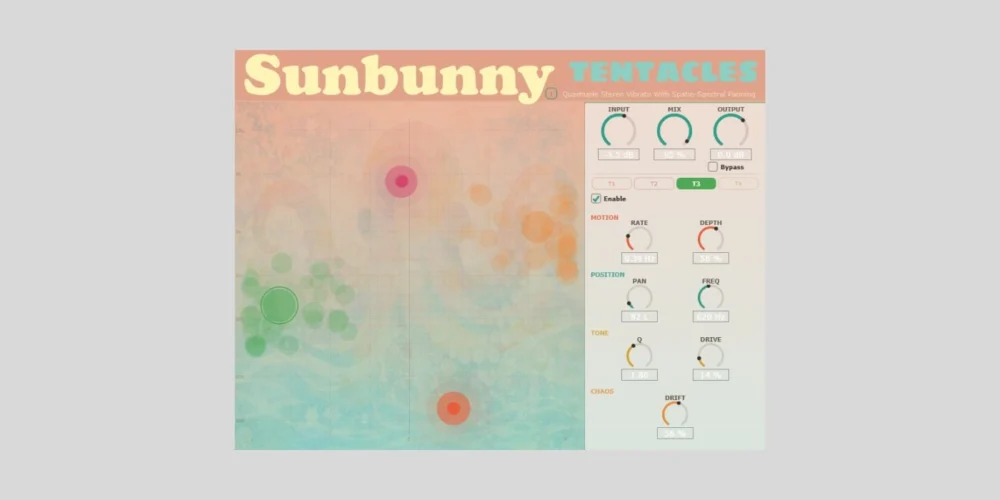
The independent developer Sunbunny has introduced "Tentacles," a sophisticated audio plugin designed to offer extensive spatio-spectral manipulation through a unique quadruple-stereo vibrato architecture. Released as a VST3, this innovative tool is now available for free, operating on Windows, macOS, and Linux platforms, marking a significant contribution to the freeware plugin ecosystem. Its launch underscores a growing trend within the audio software industry towards accessible, high-quality instruments and effects that empower a wider range of music producers and sound designers.
Architectural Innovation: Deconstructing the Quadruple-Stereo Vibrato
At its core, Tentacles distinguishes itself through a complex processing engine that splits an incoming audio signal into four discrete, parallel processing chains. Each chain is independently configurable, featuring its own dedicated band-pass filtering, saturation module, vibrato unit, and stereo-position controls. This parallel processing paradigm is crucial for achieving the plugin’s stated "quadruple-stereo vibrato" effect, allowing for an unprecedented degree of sonic sculpting and spatialization.
The vibrato component, a fundamental modulation effect, introduces subtle to extreme pitch variations, historically used to add warmth, movement, and character to sounds. In Tentacles, the application of four distinct vibrato instances across filtered and spatially separated signal paths creates a rich, multi-layered modulation experience. This goes beyond traditional stereo vibrato, offering a broader and more intricate tapestry of movement within the stereo field. By enabling separate control over each vibrato unit’s parameters—such as rate, depth, and waveform—users can craft complex, evolving textures that would be challenging to achieve with conventional tools.
The integration of band-pass filtering within each chain is equally critical. This allows users to isolate specific frequency ranges for vibrato application, saturation, and spatial placement. For instance, one might apply a subtle, slow vibrato to the low-mid frequencies while simultaneously introducing a faster, more aggressive vibrato to the high-end, each then independently saturated and positioned in the stereo image. This granular control over the spectral domain before spatial and temporal modulation provides immense creative potential, enabling effects ranging from subtle harmonic shimmer to dramatic, phase-shifting sonic landscapes.
Saturation, another integral part of each chain, offers further tonal shaping. By introducing harmonic content and gentle compression, saturation can add warmth, grit, and perceived loudness. When applied independently to different frequency bands within the four parallel paths, it allows for a nuanced approach to harmonic enhancement, contributing to the overall character and impact of the processed sound without muddying the entire signal. The ability to fine-tune the saturation for each spectrally isolated component allows for meticulous sound design, ensuring that the harmonic richness complements the dynamic and spatial effects.
Finally, independent stereo-position controls for each chain allow for precise placement of the processed spectral components within the stereo field. This, combined with the spatio-spectral panning capabilities controlled by the X/Y pad, enables truly immersive and dynamic spatialization. Users can spread elements across the stereo image, creating a sense of width, depth, and movement that reacts dynamically to the input signal and the plugin’s internal modulation.
The Intuitive Core: X/Y Pad and Advanced Control
Central to the Tentacles user interface is a large X/Y pad, providing an intuitive and highly visual means of controlling the plugin’s complex parameters. Each of the four parallel processing chains is represented by a colored dot on this 2D plane. The X-axis of the pad governs a stereo pan function, allowing users to sweep the sound from left to right across the stereo spectrum. This is not merely a simple pan pot; rather, it’s a dynamic control that influences the spatial placement of the individual chains, contributing to the "spatio-spectral panning" capability.
The Y-axis, conversely, operates as a log-scaled frequency band control, ranging from 80Hz to 12kHz. This means that as users move a dot along the Y-axis, they are dynamically adjusting the center frequency of the band-pass filter for that specific chain. The logarithmic scaling provides finer control over lower frequencies, where human hearing is more sensitive to pitch changes, while still offering a broad range for higher frequencies. The simultaneous control over both panning and frequency via a single X/Y movement streamlines complex sound design tasks, allowing for expressive, real-time manipulation.
This interactive approach, where multiple parameters are linked to a single gestural input, is a hallmark of modern plugin design, aiming to make intricate processes more accessible and musically intuitive. The X/Y pad facilitates the creation of evolving, "spaced-out" sounds and dynamic movement within a mix, empowering users to transform static audio into vibrant, animated textures with minimal effort.
Beyond the X/Y pad, a standard control panel on the right provides granular access to the individual parameters of each parallel chain. This panel typically includes controls for vibrato rate, depth, waveform selection, filter cutoff/resonance, saturation intensity, and precise stereo positioning. This dual-interface approach—combining macro control via the X/Y pad with micro-level adjustments—caters to both real-time performance and detailed sound design, offering flexibility for various production workflows. Additionally, standard input and output knobs allow for level management, while a mix knob enables users to blend the processed signal with the dry input, providing essential control over the effect’s intensity and presence within a mix.
Versatility in Application: From Mono to Stereo to FX Tracks
Tentacles’ design philosophy extends to broad utility, making it suitable for a wide array of audio processing tasks. The plugin supports both stereo and mono-to-stereo configurations, a critical feature for contemporary music production. Many recordings, particularly older samples, vocal tracks, or individual instrument recordings, often originate in mono. Applying Tentacles in a mono-to-stereo mode allows producers to inject width, depth, and dynamic movement into these otherwise static mono sources. This capability is invaluable for enhancing the presence of a lead vocal, broadening a synth pad, or giving an old drum loop new life, effectively transforming "bland sounds" into rich, stereo soundscapes.
Furthermore, the plugin’s inherent complexity and modulation capabilities make it an ideal candidate for creating entirely new effects tracks. Instead of merely augmenting existing sounds, users can route a dry signal through Tentacles to generate complex, evolving textural layers. These layers can then be blended into a mix as standalone FX, serving as atmospheric backdrops, dynamic transitions, or unique sonic embellishments. This transforms Tentacles from a mere processing tool into a sound-generating instrument, expanding its utility beyond traditional mixing and into creative sound design for film, games, and experimental music.
The "Drift" Function: Organic Movement and Repeatable Randomness
A standout feature that enhances Tentacles’ organic and unpredictable character is the "Drift" function. This mechanism introduces subtle, continuous modulation to the rate, pan, and filter center parameters of each parallel channel simultaneously. The result is a dynamic, evolving sound that ranges from "subtle liveliness" to "very weird and obnoxious sounds," depending on the intensity and settings applied. This continuous modulation mimics the natural imperfections and subtle fluctuations found in analog hardware, contributing to a more organic and less static sonic output.
Crucially, the drift function is "seeded," meaning that while the modulation appears random and organic, its sequence is repeatable. This addresses a common challenge in working with randomized or highly modulated effects: ensuring consistency across different rendering passes or project recalls. In a professional production environment, repeatability is paramount. A seeded random function allows producers to experiment freely, knowing that if they discover a desirable sonic outcome, they can reliably recreate it during subsequent renders or when revisiting a project. This eliminates the frustration of losing a "modulation goldmine" due to unrepeatable randomness, providing a significant workflow advantage for sound designers and mixing engineers.
The seeded drift function also has implications for applying Tentacles to buses within a mix. Bus processing, where multiple tracks are routed through a single effect, often requires precise control and recallability. The ability to apply complex, modulated effects to an entire bus and confidently recall those settings ensures consistency and creative freedom. While the practical application of such a complex, modulated effect on a master bus might be niche, its utility on instrument group buses (e.g., drum bus, synth bus) or effects sends is considerable, offering a powerful tool for adding cohesive, evolving textures to entire sections of a mix.
The Freeware Phenomenon and Sunbunny’s Contribution
The release of Tentacles as a free plugin, operating on a "pay-what-you-want" model via Gumroad, exemplifies a growing trend in the audio software industry. This model allows users to acquire the software without upfront cost, with the option to donate voluntarily. This approach democratizes access to high-quality tools, lowering the barrier to entry for aspiring producers and providing established professionals with innovative options without financial commitment. The requirement of an email for download, rather than a full account registration, further streamlines the acquisition process, prioritizing user convenience.
This model not only benefits users but also fosters a sense of community and direct support for developers. For independent developers like Sunbunny, it can generate goodwill, provide direct feedback, and potentially create a sustainable revenue stream through voluntary donations, allowing them to continue innovating. It positions Tentacles as part of a vibrant freeware ecosystem that constantly pushes the boundaries of what’s available without cost, challenging the traditional commercial plugin market.
The availability across Windows, macOS, and Linux is another significant aspect of Tentacles’ accessibility. Linux, while a powerful operating system, often faces a scarcity of professional audio software. Sunbunny’s commitment to cross-platform compatibility ensures that a wider demographic of producers, including those who prefer open-source environments, can integrate Tentacles into their workflow. The VST3 format, a modern plugin standard, further enhances compatibility and performance, offering benefits such as improved CPU efficiency, dynamic I/O, and better host integration compared to older VST versions.
Broader Implications for Music Production and Sound Design
The introduction of Tentacles has several implications for the broader landscape of music production and sound design. Firstly, it provides an accessible, high-quality tool for complex spatial and spectral modulation, an area often dominated by more expensive, niche plugins. This democratizes sophisticated sound design techniques, allowing producers of all experience levels and budgets to experiment with advanced effects.
Secondly, its focus on "experimental" processing encourages creative exploration. By providing a tool that can transform "lame samples" into vibrant textures or generate entirely new FX layers, Tentacles can inspire new sonic directions and workflows. This aligns with the increasing demand for unique, characterful sounds in contemporary music genres, where sonic identity is often paramount. The plugin’s ability to imbue sounds with organic movement through its drift function further supports the trend towards dynamic and evolving soundscapes, moving away from static mixes.
Thirdly, Sunbunny’s release reinforces the value of the freeware and "pay-what-you-want" model within the audio industry. As the quality of free plugins continues to rise, they increasingly challenge the perceived necessity of expensive commercial alternatives, pushing all developers to innovate and provide exceptional value. This competitive pressure ultimately benefits the end-user, fostering an environment of continuous improvement and diverse offerings.
In conclusion, Sunbunny’s Tentacles plugin represents a notable advancement in the realm of free audio effects. Its intricate quadruple-stereo vibrato architecture, coupled with spatio-spectral panning and an intuitive X/Y interface, offers powerful tools for dynamic sound design and mixing. The inclusion of a seeded drift function addresses critical workflow concerns regarding repeatability, while its cross-platform VST3 compatibility and "pay-what-you-want" model ensure broad accessibility. As producers and sound designers continue to seek innovative methods for sculpting audio, Tentacles stands out as a versatile and inspiring addition to any digital audio workstation.
