

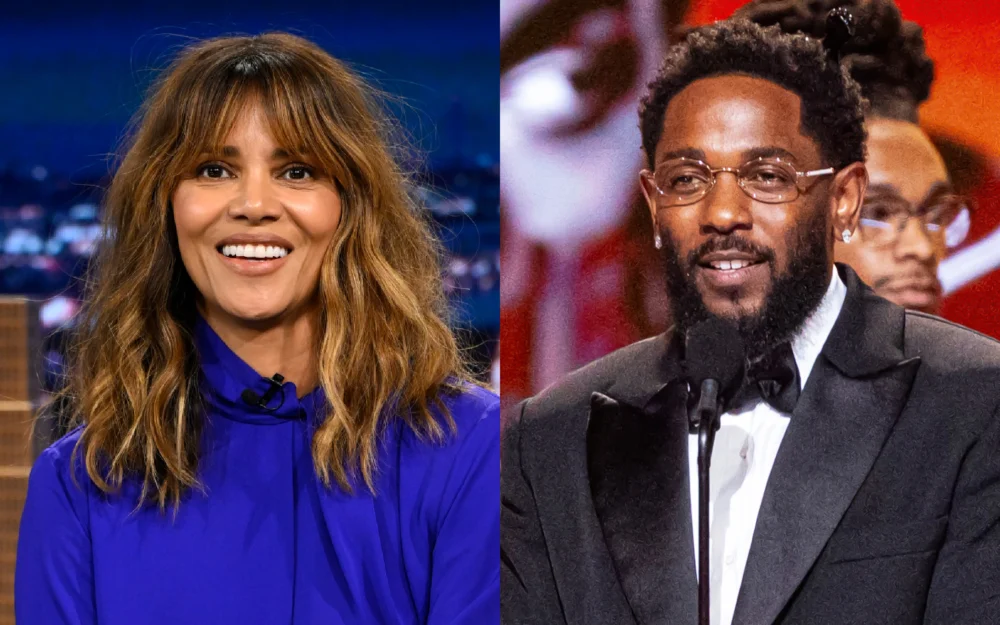
Academy Award-winning actress Halle Berry has publicly declared her fervent admiration for Compton rapper Kendrick Lamar, even going so far as to name his song “Not Like Us” as her go-to track for navigating Los Angeles traffic. This declaration, made during a promotional appearance for her upcoming film Crime 101, carries significant weight, especially given the ongoing, highly publicized lyrical feud between Lamar and fellow Canadian artist Drake. Berry’s pointed reference to Lamar’s diss track, delivered with a playful yet knowing laugh, effectively signals her allegiance and implicitly distances her from any potential endorsement of Drake, whose recent use of her image without consent has created a palpable rift.
The revelation occurred during an episode of UPROXX’s That Tracks series, a segment designed to gauge celebrity music preferences through hypothetical scenarios. Berry, alongside her Crime 101 co-stars Chris Hemsworth and Mark Ruffalo, was presented with a variety of musical prompts. The scenario that ignited Berry’s enthusiastic response centered on a common L.A. experience: being stuck in traffic on the 101 Freeway. Hemsworth posed the question, “If I’m stuck in traffic in the 101, I’m listening to my favorite L.A. based artist, Kendrick Lamar. Does that track?”
Berry’s immediate and unequivocal affirmation, “Absolutely, hell yes!” underscored her deep appreciation for Lamar’s artistry. However, she elevated her response beyond a simple endorsement by revealing the specific track she would choose to soundtrack such a frustrating situation. With a mischievous grin and a direct imitation of Lamar’s distinctive vocal cue, she quipped, “Say Drake!” before clarifying, “That’s all I’m gonna say.” This playful jab at Drake, referencing the iconic opening of “Not Like Us,” left little room for misinterpretation. The song, released in May 2024, became an anthem of the cultural moment, with its biting lyrics and infectious beat solidifying Lamar’s dominance in the rap discourse. The track’s rapid ascent on global music charts, including reaching number one on the Billboard Hot 100, further cemented its significance.
Further solidifying her position, Berry championed Lamar’s impact by asserting that his performance at the 2025 Super Bowl halftime show—a hypothetical event, as the Super Bowl LIX halftime show performer has not yet been announced—remains “the number one-performing halftime show ever.” While this statement appears to be a forward-looking projection rather than a retrospective fact, it speaks to Berry’s perception of Lamar’s unparalleled ability to captivate a massive audience and deliver a historically significant performance. Ruffalo, appearing to be caught slightly off guard but clearly swayed by Berry’s conviction, sheepishly agreed, stating, “Crazy! … Yeah, let’s go with that – just because.” Hemsworth also acknowledged his appreciation for Lamar, conceding, “On certain days, for sure,” indicating a more nuanced but still positive reception to the artist’s music.
A Timeline of Artistic and Personal Intersections
The mutual respect between Halle Berry and Kendrick Lamar is not a recent development. Their artistic connection dates back to 2012 when Lamar prominently featured Berry’s name in the chorus of his critically acclaimed track “Money Trees,” a song from his debut studio album good kid, m.A.A.d city. The lyric, "Bitch, all you can do is make money for us / I ain’t saying we gon’ make it, all depends on the hustle / I’m saying that all of us have a chance to make it / Bitch, all you can do is make money for us," served as a cultural nod, embedding Berry into the narrative of aspiration and ambition that permeated Lamar’s work. This early acknowledgment established a positive rapport, laying the groundwork for Berry’s current enthusiastic support.
Conversely, Berry’s relationship with Drake has taken a decidedly negative turn, primarily stemming from an incident in September 2023. Drake utilized an image of Halle Berry, specifically from her appearance at the 2012 Nickelodeon Kids’ Choice Awards where she was famously covered in green slime, as the cover art for his single “Slime You Out,” featuring SZA. This decision was made without Berry’s explicit permission, a fact that deeply agitated the actress.
Following the single’s release, Berry took to Instagram to express her displeasure. Her initial post, a cryptic yet pointed message, read, “Sometimes you have to be the bigger guy… even if you’re a woman!” accompanied by a middle finger emoji, signaling her strong disapproval. In subsequent comments on the same post, Berry elaborated on her grievances, directly stating, “Didn’t get my permission. That’s not cool I thought better of him!” She further articulated her disappointment in a reply to another fan, asserting, “When people you admire disappoint you you have to be the bigger person and move on!” This public airing of grievances highlighted a clear breach of trust and professional courtesy, significantly impacting her perception of Drake.
The "Not Like Us" Phenomenon and Its Cultural Resonance
Kendrick Lamar’s “Not Like Us” emerged as a pivotal moment in his highly publicized rap battle with Drake. Released on May 4, 2024, the song immediately became a cultural phenomenon, lauded for its sharp lyrical content, aggressive delivery, and the undeniable catchiness of its West Coast-inspired beat, produced by Mustard. The track directly addressed allegations and accusations leveled against Drake, employing potent imagery and direct attacks that resonated deeply within hip-hop communities and beyond.
Within its first 24 hours of release, "Not Like Us" garnered over 10 million streams on Spotify alone, a testament to its immediate and widespread appeal. By the end of its first week, the song had surpassed 60 million streams across all platforms, making it one of the most rapidly consumed tracks in recent memory. It debuted at number one on the Billboard Hot 100 chart, marking Lamar’s first solo number-one single in the United States, and also topped the Billboard Global 200. The song’s success was not merely statistical; it became a cultural touchstone, adopted as an unofficial anthem for various communities and sparking countless memes, social media trends, and discussions about its lyrical substance and cultural impact.
The song’s success can be attributed to several factors: Lamar’s masterful storytelling, his ability to tap into a specific regional sound that resonated with West Coast hip-hop enthusiasts, and the sheer intensity of the lyrical confrontation. The phrase "They not like us" became a rallying cry, symbolizing a perceived cultural and moral divide. Berry’s decision to invoke this specific song, particularly with the vocal imitation of Lamar’s opening, suggests she identifies with the sentiment and perhaps the narrative presented within the track, further emphasizing her alignment with Lamar over Drake.
Implications and Broader Context
Halle Berry’s public endorsement of Kendrick Lamar, coupled with her subtle but clear repudiation of Drake, carries significant implications within the entertainment and music industries. As a globally recognized and respected figure in Hollywood, Berry’s opinions carry considerable weight. Her vocal support for Lamar not only amplifies his artistic achievements but also reinforces his cultural standing, particularly in the context of his high-profile feud with Drake.
The incident involving Drake’s unauthorized use of Berry’s image also sheds light on broader issues of artist consent, image rights, and the ethical considerations surrounding the use of public figures’ likenesses in promotional materials. While Drake’s team likely viewed the image as a recognizable cultural reference point, Berry’s reaction underscores the importance of obtaining explicit permission, especially when the context might be perceived as exploitative or disrespectful. This situation has prompted discussions among artists and industry professionals about the boundaries of creative sampling and the potential for unintended consequences when leveraging celebrity imagery.
Furthermore, Berry’s engagement with the UPROXX series highlights the increasing intersectionality between film promotion and music culture. Celebrities are increasingly expected to have a knowledgeable and engaged perspective on popular music, and their endorsements or critiques can significantly influence public perception and consumption. Berry’s ability to seamlessly weave her musical preferences into a promotional context demonstrates a sophisticated understanding of contemporary celebrity engagement.
The narrative of Halle Berry’s musical preferences, therefore, extends beyond a simple declaration of favorite songs. It is a complex tapestry woven with threads of artistic admiration, personal grievances, and the broader cultural impact of music and celebrity. Her alignment with Kendrick Lamar, particularly in the wake of his lyrical dominance over Drake, positions her as a vocal supporter of an artist whose cultural influence continues to expand, while simultaneously marking a clear boundary in her professional and personal relationship with another. The enduring power of "Money Trees" and the seismic impact of "Not Like Us" continue to shape the narrative, with Berry’s recent statements adding a significant chapter to the ongoing story of these prominent artists. Her embrace of Lamar’s unapologetic artistry and her clear disapproval of Drake’s unauthorized use of her likeness underscore the nuanced dynamics that define celebrity relationships in the digital age.
