

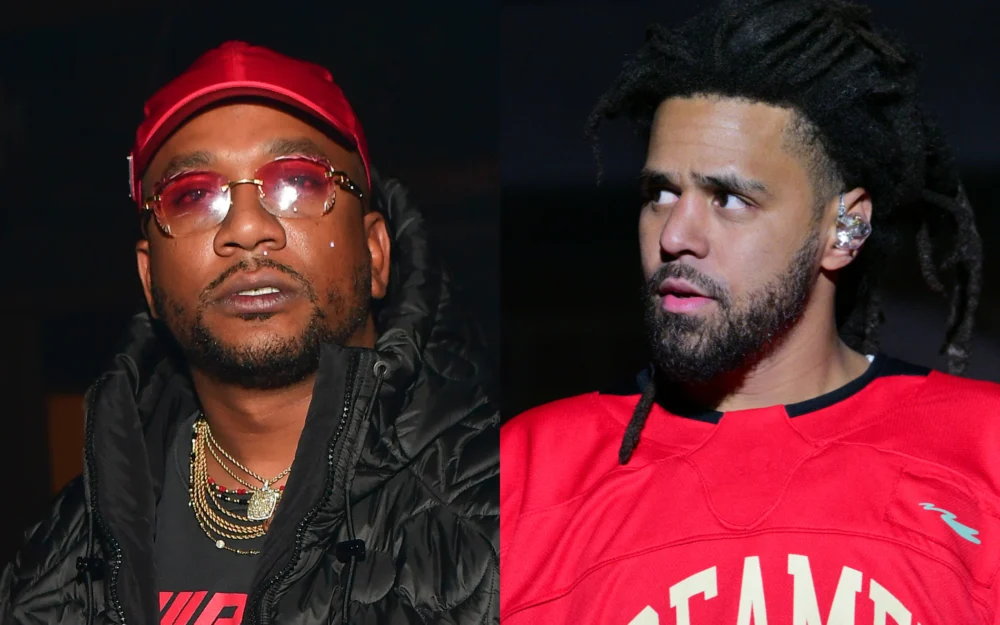
The competitive landscape of hip-hop has been ignited once again as veteran rapper CyHi The Prynce has unleashed a new track, "B.R.A. Lost Control," directly targeting fellow artist J. Cole. The song, a lyrical onslaught produced by Brian AllDay and Mark Byrd, sees the longtime Kanye West affiliate challenging Cole’s long-held self-proclaimed title of "Best Rapper Alive." This latest diss track appears to stem from a lingering tension, potentially reignited by Cole’s 2016 track "False Prophets," which was widely interpreted as a critique of CyHi’s former mentor, Kanye West.
The Genesis of the Conflict: "False Prophets" and Lingering Resentment
The narrative of this lyrical confrontation can be traced back to the release of J. Cole’s "False Prophets" in November 2016. The song, featured on his "4 Your Eyez Only" album, included verses that many fans and critics interpreted as jabs at Kanye West, particularly in light of West’s public struggles and perceived creative detours at the time. Lines such as "When you feelin’ like you’re the only nigga that made it / Then you the only one that’s gon’ be left to fade" and "Warm nips on your chest, you was a young gunner / Now you’re older, you’re a father, you’re a husband / Then you’re looking in the mirror like ‘Who the f*** is this?’" were widely dissected and applied to West’s evolving public persona and career trajectory.
CyHi The Prynce, a prominent member of Kanye West’s G.O.O.D. Music label at the time, publicly expressed his disapproval of Cole’s perceived commentary. While "False Prophets" was not explicitly a diss track aimed at CyHi himself, his strong loyalty to West and his own assertive lyrical style positioned him as a potential defender of his label head. The implicit accusation of Cole criticizing West seemed to strike a chord with CyHi, laying the groundwork for future retaliatory measures.
"B.R.A. Lost Control": A Direct Challenge to Cole’s Supremacy
"B.R.A. Lost Control" marks a decisive moment where CyHi The Prynce transitions from a perceived defender to a direct challenger. The song’s title itself is a provocative play on words, referencing the "Best Rapper Alive" moniker and suggesting a loss of control over this status. From the opening bars, CyHi makes his intentions clear:
"I been hearing a lot of nggas claim the best rapper alive / Two things can be true, that’s a factual lie."*
This immediate assertion sets the stage for a lyrical dismantling of J. Cole’s claim to the throne. CyHi doesn’t shy away from referencing past encounters, notably alluding to a lyrical confrontation between J. Cole and Kendrick Lamar, and suggesting Cole’s apprehension:
"You was scared of our good brother in that Grand National, why? / Shoulda knew you and that lil’ Honda was gonna have to collide."
The "Grand National" and "Honda" references are subtle but potent, likely alluding to the perceived power dynamics and perceived differences in stature between artists. This line suggests that Cole’s perceived fear or hesitation in a direct lyrical showdown with a peer like Kendrick Lamar undermines his claim to being the undisputed best.
The song further escalates the personal nature of the diss by directly addressing Cole and referencing "False Prophets":
"But tell St. John that them raps just ain’t that jaw-dropping / You forgot I still owe you for ‘False Prophets’? / I rap punches that’s hard as Bernard Hopkins / And ain’t no yes men over here, my dawg, stop it."
Here, CyHi explicitly links the current track to the past grievance. The reference to Bernard Hopkins, a legendary middleweight boxer known for his defensive prowess and powerful punches, serves as a metaphor for the impactful and potentially damaging nature of his lyrical attacks. The assertion of having "no yes men" suggests an unfiltered, honest critique, contrasting with what he might perceive as a more insulated or protected environment for Cole.
The latter part of the verse paints a vivid picture of unwavering loyalty and defiance:
"We like the band on the Titanic / We goin’ down with the ship before we go jumpin’ off it / So watch your mouth before you go overtalking / It’s cool ’til you run into one of his underbosses."
This analogy powerfully conveys a sense of collective solidarity and a willingness to face any consequence together. The "Titanic" metaphor suggests that CyHi and his associates are committed to their path and their allegiances, even in the face of perceived disaster. The warning to "watch your mouth" and the mention of "underbosses" adds a layer of intimidation, implying that any further disrespect could have repercussions from his wider network of allies.
Lyrical Prowess and Cultural Commentary
Beyond the direct disses, "B.R.A. Lost Control" also serves as a showcase for CyHi The Prynce’s own lyrical dexterity. The track is replete with clever wordplay, intricate metaphors, and cultural references, demonstrating the very skills he believes elevate him above his peers.
In the first verse, CyHi employs a complex series of puns and allusions, particularly touching on religious and cultural themes:
"I came back just to crash the summer / I put more fire on wax than Kwanzaa / ‘Cause whatever he brew [Hebrew] can be used by the bartender / Mazel tov! Shots to the glass or the car windshield / That might’ve went over your yarmulke / ‘Cause Hannukah might be the only event my bars miss for [bar mitzvah],"
This section is a testament to CyHi’s intellectual approach to lyricism. The play on "brew" and "Hebrew," the references to Kwanzaa, Hanukkah, and bar mitzvahs, and the imagery of "shots to the glass or the car windshield" all contribute to a dense, multi-layered verse. The humor and sharp wit embedded within these lines highlight his confidence in his ability to craft complex and engaging narratives. The phrase "bars miss for [bar mitzvah]" is a particularly clever double entendre, implying that his lyrical misses are so rare they would be as improbable as missing a significant religious milestone.
CyHi also creatively samples and recontextualizes classic hip-hop material. His interpolation of The Pharcyde’s iconic "Passin’ Me By" adds another layer of homage and commentary:
"Gun powder, the gunfire, the harmonics / Of multiple shots going off it’s called violence / Bullets keep passin’ me by, I’m far-sided."
This reimagining of a beloved track turns a song about fleeting romance into a statement of resilience and avoidance of conflict. The "bullets keep passin’ me by" line, coupled with "far-sided," suggests a strategic detachment and an ability to navigate dangerous situations unscathed, further reinforcing his perceived superiority and invincibility.
Broader Context: G.O.O.D. Music’s History with J. Cole
CyHi The Prynce is not the first artist associated with Kanye West’s G.O.O.D. Music label to express grievances with J. Cole. The "False Prophets" incident had a ripple effect, with other artists and West himself weighing in on the perceived disrespect.
Kanye West, in a notable interview with Justin Laboy in the past, made strong condemnations of J. Cole. He stated, "I don’t listen to J. Cole… I just heard he had a song called ‘False [Prophets]’ and somebody told me it’s halfway about me." West further escalated his criticism, referring to Cole as "pussy" for issuing an apology to Kendrick Lamar, suggesting a perceived lack of conviction or courage in Cole’s actions. This public stance from West himself likely emboldened artists within his circle, including CyHi, to voice their own sentiments.
The history of G.O.O.D. Music has often been characterized by a strong sense of loyalty and a distinct artistic identity, frequently positioned in contrast to other prominent figures in the hip-hop world. This latest exchange fits into a larger narrative of artistic rivalries and the ongoing discourse surrounding lyrical skill, influence, and authenticity within the genre.
Implications and Future Outlook
The release of "B.R.A. Lost Control" injects a fresh wave of tension into the rap game. For fans of lyrical battles and artist-driven narratives, this diss track offers a compelling storyline to follow. It raises questions about the subjective nature of the "Best Rapper Alive" title and the criteria used to evaluate such claims.
- Artistic Validation: CyHi’s move is a clear attempt to assert his own lyrical prowess and reclaim a narrative that he feels has been unfairly challenged. By directly addressing J. Cole, he is forcing a conversation about their respective places in the hip-hop hierarchy.
- Fan Engagement: Such lyrical confrontations often galvanize fan bases, leading to online debates, analyses of lyrics, and predictions of potential responses. This engagement is a vital part of the hip-hop ecosystem.
- Career Trajectory: For CyHi, this track could serve as a significant career moment, reintroducing him to a wider audience and solidifying his reputation as a formidable lyricist. For J. Cole, it presents an opportunity to address the criticism directly or to continue his established artistic path, potentially letting the music speak for itself.
- The Nature of "Beef": This incident highlights the enduring tradition of lyrical "beef" in hip-hop, where artists use their music to challenge, critique, and establish dominance. The stakes are often not just about ego but about artistic legacy and influence.
While J. Cole has not yet issued a direct response to "B.R.A. Lost Control," the hip-hop community will undoubtedly be watching closely. The potential for a lyrical rebuttal from Cole could further escalate this exchange, adding another chapter to the ongoing saga of artistic rivalry and lyrical warfare that defines the genre. The impact of this track will ultimately be measured not only by its immediate reception but also by any subsequent responses and its lasting effect on the perception of both artists within the competitive landscape of contemporary hip-hop.
