

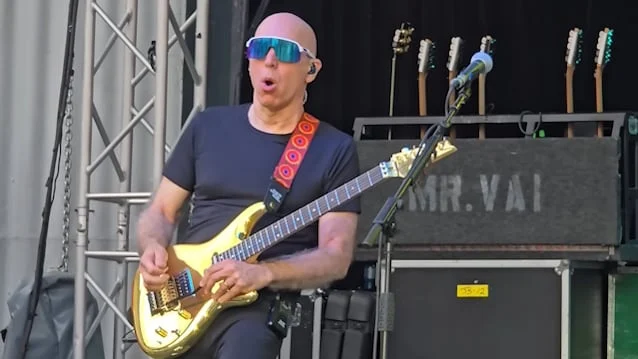
In a recent and candid interview with The Weekly Show With David J. Maloney, acclaimed guitarist Joe Satriani delved into the intricate circumstances surrounding a proposed all-star Van Halen tribute project that ultimately failed to materialize. He also provided insight into his eventual participation in the highly successful 2024 "The Best Of All Worlds" tour, a venture that saw him performing alongside Sammy Hagar and Michael Anthony, celebrating a vast catalog of rock music, including significant Van Halen material. The conversation offered a unique perspective on the complexities of legacy projects and the differing approaches to honoring musical heritage.
The Unfulfilled Van Halen Tribute Project
The genesis of the proposed Van Halen tribute, according to Satriani, began with direct overtures from David Lee Roth and Alex Van Halen. They were reportedly insistent on Satriani being the guitarist to reproduce the iconic guitar parts of the late Eddie Van Halen. Satriani, however, expressed significant reservations from the outset.
"Well, it started, really, when Dave and Alex had called, and they wanted to put together a band, and they were insisting that I was the guy to do it," Satriani recounted. He elaborated on his initial reluctance, emphasizing that he felt he was not the appropriate choice for such a role. "I kept saying, ‘I’m not the guy. Call Nuno [Bettencourt]. He can really do it.’ And there’s thousands of kids around the world who’ve dedicated their life to sounding exactly like Ed. And I said, ‘I’ve always tried not to sound like Ed.’ I’m a huge fan, but I’ve tried to respect that."
Despite his persistent declinations, Roth and Alex Van Halen remained steadfast in their pursuit. The legendary guitarist confirmed that rehearsals did indeed take place, bringing the project tantalizingly close to its first performance. However, the initiative began to unravel. "We rehearsed. We came really close to doing our first show, but it all kind of started to fall apart, and I’m not really sure what happened with that," Satriani stated, admitting to a degree of uncertainty about the specific reasons for the project’s demise. He also cited his own busy schedule as a factor, leaving him in a state of passive waiting as the situation evolved.
The Emergence of "The Best Of All Worlds" Tour
The landscape shifted significantly when Satriani found himself in discussions with Sammy Hagar. The "Red Rocker" proposed an alternative tour concept that would not be a direct tribute to Eddie Van Halen but rather a broader retrospective of his own and his bandmates’ careers. This included material from Montrose, Hagar’s solo work, Chickenfoot, and crucially, select Van Halen era songs.
"When it seemed like what was going on in the [Van Halen] family and the bandmembers was getting really out of hand, Sam had called and he surprised me by saying, ‘Look, I know you’ve been going through this thing with those guys, and it’s insane and everything. How about if we did a retrospective tour – not an Eddie Van Halen tribute thing – but where we get to do Montrose, Hagar, Chickenfoot, my stuff and his era, and even some David Lee Roth era of Van Halen?’" Satriani explained.
This proposal resonated with Satriani for several reasons. The prospect of collaborating again with Hagar and Michael Anthony, with whom he had previously formed the successful supergroup Chickenfoot, was a significant draw. "I liked that idea, because I know Sam and Mike very well – they’re just super-great people and they’re always fun to hang out with and play with," he said. Furthermore, the concept of creating their own distinct sound as a band, rather than attempting to replicate existing performances, appealed to his artistic sensibilities. "And then I liked the idea that we would create our own sound as a band. And we kind of had it with Chickenfoot, so it felt like we weren’t trying to copy anybody else."
Even within this new framework, Satriani felt compelled to reiterate his distinctive playing style to Hagar. "But still, just technically, I had to remind Sam, I said, ‘Sam, I’m gonna tell you what I told Alex, which is I don’t really play like Eddie.’" Hagar’s response, however, underscored the different philosophy behind "The Best Of All Worlds" tour. "’That’s not what it’s about. We’re not gonna do that. Let the imitators do that. Leave that for social media,’" Hagar reportedly told Satriani. This clear distinction – focusing on celebrating the music rather than precise replication – was a key factor in Satriani’s acceptance of the tour.
Navigating Sonic Authenticity and Equipment Challenges
The practicalities of performing a diverse setlist spanning different eras and sonic landscapes presented a significant hurdle. Satriani highlighted the substantial challenges in transitioning equipment and reconfiguring guitar tones to authentically represent the varied sounds within a single show.
"However, it was difficult to make the equipment transition, and that that required not only a lot of money, but just a lot of changing of direction, of equipment to try to figure out, how do you play stuff within one show that is so old, like the Montrose stuff, and then slowly transition… Even from ‘Ain’t Talkin’ ‘Bout Love’ to ‘Poundcake,’ the sound of the guitar is just so different," Satriani elaborated. The band engaged in extensive discussions about how to approach these sonic shifts without disrupting the overall flow of the performance. The consensus, Satriani noted, was to "find a sound" that could accommodate the breadth of the material, rather than attempting to perfectly emulate every distinct tone.
This pursuit of a versatile and authentic sound led to significant technical exploration. Working with engineer Dylana Scott of 3rd Power, Satriani focused on achieving a sound that evoked a specific transitional period in Eddie Van Halen’s playing. "Working with the guys from 3rd Power, we figured out, Dylana [Scott], she’s just an amazing engineer, and she figured out with this amp, this Dragon amp, that she could get this sound that I was aiming for, which was basically kind of like ‘Live Without A Net’ [from] Van Halen, which was a very interesting transition point for Ed where he was go leaving the Marshalls and heading towards using the Soldano and he was going into the stereo chorus phase, but it still sounded like it worked for the David Lee Roth stuff, which was very different sounding."
Satriani emphasized the psychological aspect of sound, noting, "I mean, you could go up there and play the gig with any sound, but to get in this right frame of mind where you are inspiring yourself, you really do have to hear the right sound, to some degree. That has been an ongoing thing. And we’re still working on it." This dedication to sonic authenticity, even within a celebratory tour, underscores Satriani’s commitment to his craft.
Contrasting Approaches to Legacy and Collaboration
In a January 2024 appearance on "The Hook Rocks" podcast, Satriani offered further analysis on why "The Best Of All Worlds" tour succeeded where the Van Halen tribute faltered. He attributed the difference in outcomes to contrasting philosophies and approaches among the key figures involved.
"That’s tough. I didn’t know Eddie [Van Halen] and I don’t know the family and I don’t think I’ll ever really understand David Lee Roth," Satriani admitted. "I thought I really understood Alex. And I think I do. I really think I understand his point of view or where he’s coming from."
His core observation centered on Sammy Hagar’s inclusive and fan-centric approach to music and performance. "I tend to think that the real difference here is that Sammy has a real sort of inclusive way of looking at life and he notices when there’s conflict that is getting in the way of doing something good and he’ll try to fix it," Satriani explained. He provided a concrete example: "So as a result, it’s just like he says, ‘Yeah, we’re gonna do ‘Ain’t Talkin’ ‘Bout Love.’ I know it’s not my song, but that’s cool.’ Now you ask David Lee Roth, ‘Hey, are you gonna do ‘5150’?’ Of course he’s never gonna do it." This highlights a fundamental difference in willingness to embrace and perform material outside of one’s primary era or personal hits.
Satriani contrasted this with David Lee Roth’s perceived inflexibility. "So there’s a big difference there, is that you have one guy who is very flexible because he’s thinking about the fans, and then you have another guy who, I don’t know why Dave is so inflexible on a couple of subjects – I really don’t, because I don’t know him." He even mused about seeking advice from guitarist Steve Vai, who has a closer relationship with Roth, to gain a deeper understanding.
Satriani expressed his belief that Alex Van Halen’s intentions for the tribute were genuine, but the outcome was contingent on broader dynamics. "I felt that Alex really wanted to do it and his heart was pure in its intention. But I don’t know about Dave." He reiterated his confidence in the pure intentions of Hagar and Anthony: "I know that Sammy and Mike, their intentions are pure. They really do wanna celebrate the music and they’re willing to mend any fence to make it happen on stage. They’re the original guys. It’s more than just a tour. And you feel that when you’re standing next to Sammy and Mike. There’s just an immense amount of power and love with the two of them and playing those songs. And people, they want to experience it and they should be able to experience it."
Looking towards the future, Satriani expressed hope for a resolution that would allow for a proper tribute to Eddie Van Halen, identifying his son, Wolfgang Van Halen, as the natural successor to carry on the legacy. "I would hope at some point that [Alex, Eddie’s son Wolfgang Van Halen and David] figure it out. Basically, Wolfgang is the guy to do it – he’s the guy to do any tribute there is. The rest of us are just gonna be copying the album as close as we can, but it’ll be fodder for the guitar army out there to criticize, like, ‘Well, you should have done it like this,’ and, ‘He could have done it like that,’ and, ‘She should have done it like this,’ because we’re not Eddie, and we’re not Wolfgang."
Satriani concluded this line of thought by suggesting that the ultimate decision and resolution lie with the Van Halen family. "It’s taken a while for me to get a really good perspective on it, but I do think that we should all just kind of leave that alone and let them figure it out. It really is up to, I think, Wolfgang and his uncle Alex to figure this out."
Deconstructing Eddie Van Halen’s Guitar Mastery
In a December 2023 interview with Ultimate Guitar’s Justin Beckner, Satriani delved into the technical and stylistic nuances of emulating Eddie Van Halen’s playing for "The Best Of All Worlds" tour. He candidly discussed the profound challenge of stepping outside his own deeply ingrained playing habits to embody another artist’s signature sound.
"The main thing is that for the last five decades I’ve tried so hard to be myself and to be me and not copy anybody," Satriani stated. His solo career, which began in the late 1980s, specifically reinforced this dedication to individuality. "I’ve been lucky, since the late ’80s, to have a solo career, so I really had a job that forced me to be myself as much as possible. So I made a point not to play like anybody."
He likened the difficulty to learning a song at a party: "But it happens eventually when you’re having fun, you’re at a party and someone says, ‘Oh, can you play this song?’ and you realize, ‘I have no idea how to play that song. I love that song. I’ve listened to it a million times. I don’t know what the guy’s doing.’" The learning process, he found, was often awkward because his ingrained techniques clashed with the original artist’s approach. "And then you go to learn it and you go, ‘Wow, that’s really weird. It feels so awkward for me to be like this.’ And it’s not the parts, ’cause I can hear the chords and I know what everything is when I hear it. It’s just the sensibility of timing, vibrato, picking. If you’re so deep into your own thing, it’s really hard to get out of it and try to properly emulate somebody else’s playing."
Satriani used the hypothetical scenario of asking Eddie Van Halen to play his song "Summer Song" to illustrate the point. "It would almost be like if you gave a guitar to Eddie and you said, ‘Okay, Eddie, we want you to play ‘Summer Song’ note for note.’ He’d be, like, ‘What? I don’t play like that. I don’t do that. I just kind of do this, this and this.’" He acknowledged that while fans would embrace any rendition from Eddie, it wouldn’t be an exact replication.
He drew parallels to his own experiences in cover bands during his youth, where the goal was to closely replicate artists like Led Zeppelin, Black Sabbath, and The Rolling Stones. However, he recognized that true emulation of iconic guitarists like Angus Young of AC/DC or Jeff Beck was ultimately unattainable due to their unique signatures. "If I go to play AC/DC, there’s no way I can do Angus’s [Young] vibrato. He just has his own vibrato. If you’re gonna try to play like Jeff Beck – he’s so personal. You can play the notes and remind people of this part he did and that part, but it’s not gonna sound quite the same."
Satriani identified three key areas where Eddie Van Halen’s playing differed significantly from his own: timing, vibrato, and right-hand technique.
Timing and Phrasing: The Beat and the Pocket
One of the most significant distinctions Satriani noted was Eddie Van Halen’s precise placement on the beat, often creating a sense of pushing forward, yet maintaining impeccable timing. "Number one, he plays so on the beat and makes it feel like he’s pushing the beat, but he’s actually not. It’s really amazing how he does it," Satriani observed. He contrasted this with his own tendency to play slightly behind the beat, a technique he developed while focusing on melody.
"And I realized, when I went back and I listened to my stuff back to back, I thought, ‘Oh, that’s me, sitting on the backbeat as much as I can,’ because I’m playing the melody. When you play the melody, you don’t wanna be on top. Actually, you want the band to be pushing, and you’re sitting back here, like a singer, playing," he explained. He referenced vocalists like Robert Plant and hip-hop artists who often sit in the pocket, intentionally playing with timing for expressive effect.
This ingrained habit posed a challenge when tackling Van Halen’s more rhythmically aggressive material. "So that’s something I’ve worked on my whole life is ‘sit back, sit back, sit back,’ and all of a sudden you go to play a song like ‘I’m The One,’ and it’s like, ‘No, you have to be the guy way in front.’ And Alex [Van Halen] is gonna be going, ‘No, no. Sit back here.’ And that’s a difficult sensibility when every nerve ending in your body is saying, ‘Sit back.’ But to make the song work, you’ve gotta sit forward. That’s the first thing I noticed, like the difference between Eddie’s sensibility in timing and mine in terms of timing."
Vibrato and Tapping: Personal Signatures
Regarding vibrato, Satriani found less of a divergence. "Our vibratos aren’t that different," he stated. However, the use of the pick and the development of tapping techniques created further distinctions. Satriani’s pick-holding technique, which leaves his index finger free for tapping, differs from Van Halen’s approach. "He holds hick pick [with his thumb and middle finger], so he’s always got [his index] finger for tapping, and I don’t. So I always have to do something."
Satriani’s early adoption of pick hammer-ons was a conscious effort to develop a unique sound and approach. He observed that while tapping had been around for decades, his generation began to explore its potential more broadly. He recognized that Van Halen’s use of tapping was multifaceted, serving various purposes from melodic embellishment to rhythmic drive. "The way that he would do the tapping, when he would use it, [was] totally opposite of the way that I had forced myself to go with it."
Right-Hand Speed and Swing
The third significant area of difference was Eddie Van Halen’s exceptional right-hand speed and aggressive swing. "Again, we’re talking about someone who was just an incredible virtuoso in several areas. One of the things that Eddie had was this super-tight swing that was ultrafast with his right hand," Satriani explained. He acknowledged that developing such a technique would require dedicated practice. "And that is something, again, that once… I remember hearing for the first time and thinking, ‘Well, I’m gonna have to work on that.’ That’s gonna take me, I thought, I bet, three months of 45 minutes a day just working with a metronome to work that into my bag of tricks.’ ‘Cause that’s kind of like what it is."
The Legacy of Collaboration and Unfinished Business
The interviews with Satriani provide a comprehensive look at the complex dynamics surrounding the legacy of Van Halen. The failed tribute project highlights the challenges of recreating iconic sounds and navigating personal dynamics within a band’s history. The success of "The Best Of All Worlds" tour, on the other hand, demonstrates the power of celebrating music with a spirit of inclusivity and a focus on shared enjoyment.
It’s worth noting the historical context of Hagar and Anthony’s collaborations with Van Halen. They previously toured together in 2004, a tour that reportedly involved significant concessions from Michael Anthony regarding financial terms and rights to the band’s name and logo. Hagar’s reconciliation with Eddie Van Halen prior to his passing in October 2020 added another layer to the ongoing narrative of the band and its members.
Satriani’s reflections offer a valuable perspective on the artistic and personal considerations that shape musical tributes and collaborative projects. His insights underscore the enduring impact of Eddie Van Halen’s guitar playing and the ongoing efforts to honor his unparalleled legacy, whether through direct emulation or through broader celebrations of his musical contributions. The ultimate resolution of a definitive Van Halen tribute likely rests with the family, particularly Wolfgang Van Halen, who Satriani identifies as the most fitting custodian of his father’s musical spirit.
