

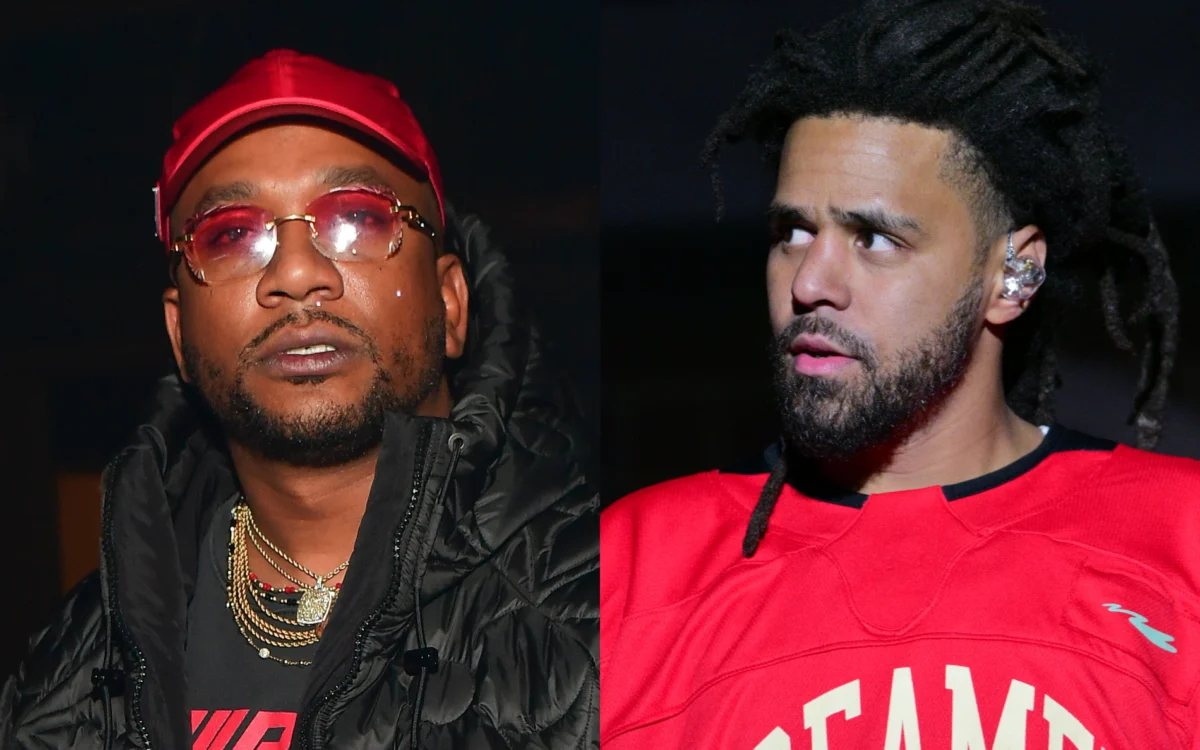
Atlanta rapper CyHi The Prynce has unleashed a blistering new track, "B.R.A Lost Control," directly targeting J. Cole and challenging his self-proclaimed "Best Rapper Alive" status. The song, produced by Brian AllDay and Mark Byrd, marks a significant escalation in the lyrical feud between the two artists, delving into past grievances and asserting CyHi’s own lyrical dominance. This latest salvo not only highlights the competitive nature of the hip-hop landscape but also resurrects the lingering tension stemming from J. Cole’s 2016 track "False Prophets," widely interpreted as a diss against CyHi’s former G.O.O.D. Music label boss, Kanye West.
The genesis of this renewed conflict can be traced back to the critical reception and lyrical content of "False Prophets." Released in late 2016, the song sparked considerable debate within the hip-hop community due to its pointed verses that seemed to address several prominent figures, most notably Kanye West. While Cole never explicitly named individuals, the references to a "superstar" who had "lost his mind" and seemed to be "losing faith" resonated strongly with West’s public persona at the time, marked by a series of controversial statements and erratic behavior. CyHi The Prynce, a close associate and frequent collaborator of Kanye West, perceived these verses as a direct attack on his mentor and a challenge to the established hierarchy within the industry.
CyHi’s "B.R.A Lost Control" opens with a direct challenge to Cole’s claim of being the "Best Rapper Alive." The lyrics immediately set a confrontational tone: "I been hearing a lot of n*ggas claim the best rapper alive / Two things can be true, that’s a factual lie." This opening salvo is not merely a boast but a strategic move to undermine Cole’s perceived standing in the rap pantheon. The track then pivots to a specific reference to a past lyrical exchange between J. Cole and Kendrick Lamar, a rivalry that captivated fans but was ultimately seen by many as a non-event. CyHi uses this to further question Cole’s mettle: "You was scared of our good brother in that Grand National, why? / Shoulda knew you and that lil’ Honda was gonna have to collide." This allusion to Cole’s vehicular choice versus Lamar’s is a subtle jab at perceived disparity in their lyrical power or perhaps their willingness to engage in a full-blown conflict.
The core of CyHi’s animosity, however, appears rooted in the "False Prophets" incident. He explicitly calls out Cole, referencing the track and its lingering impact: "But tell St. John that them raps just ain’t that jaw-dropping / You forgot I still owe you for ‘False Prophets’? / I rap punches that’s hard as Bernard Hopkins / And ain’t no yes men over here, my dawg, stop it." The comparison to Bernard Hopkins, a legendary middleweight boxing champion known for his defensive prowess and knockout power, serves as a potent metaphor for the lyrical force CyHi claims to possess. His assertion that there are "no yes men" around him suggests a commitment to unfiltered truth and a rejection of sycophancy, positioning himself as an authentic voice in contrast to what he may perceive as an insincere or calculated approach from Cole.
Further elaborating on his loyalty and defiance, CyHi employs the striking metaphor of the Titanic: "We like the band on the Titanic / We goin’ down with the ship before we go jumpin’ off it / So watch your mouth before you go overtalking / It’s cool ’til you run into one of his underbosses." This powerful imagery signifies an unwavering commitment to his affiliations and a willingness to face consequences rather than abandon his principles or allies. The warning about encountering "underbosses" subtly implies that his loyalties extend beyond himself and that any aggression directed towards him could have broader repercussions within his circle.
"B.R.A Lost Control" is not just a vehicle for lyrical warfare; it also serves as a showcase for CyHi The Prynce’s own celebrated lyrical dexterity. The Atlanta native, known for his intricate wordplay and clever punchlines, demonstrates his command of the English language throughout the track. In the first verse, he weaves a complex tapestry of cultural and religious references, including a notable passage that plays on words related to Jewish holidays: "I came back just to crash the summer / I put more fire on wax than Kwanzaa / ‘Cause whatever he brew [Hebrew] can be used by the bartender / Mazel tov! Shots to the glass or the car windshield / That might’ve went over your yarmulke / ‘Cause Hannukah might be the only event my bars miss for [bar mitzvah]." This intricate wordplay highlights his intellectual approach to lyricism, demonstrating a capacity to engage listeners on multiple intellectual and cultural levels. The Kwanzaa reference further emphasizes his fiery delivery and impact, while the intricate Hebrew and Hanukkah puns showcase a sophisticated understanding of linguistic nuance.
CyHi also pays homage to hip-hop’s rich history by cleverly flipping a sample from The Pharcyde’s classic 1992 hit, "Passin’ Me By." He twists the familiar melody and theme into a statement of his own resilience and lyrical superiority: "Gun powder, the gunfire, the harmonics / Of multiple shots going off it’s called violence / Bullets keep passin’ me by, I’m far-sided." This adaptation not only demonstrates his deep appreciation for hip-hop’s foundational elements but also repurposes a well-known track to convey a message of invincibility and distance from the fray, implying that he operates on a level beyond the typical conflicts within the genre.
The friction between CyHi The Prynce and J. Cole is not an isolated incident within the G.O.O.D. Music camp. The fallout from "False Prophets" has seen other artists affiliated with Kanye West express their displeasure. Notably, Kanye West himself has been vocal about his perception of Cole’s track. In an explosive interview with Justin Laboy in the past year, West made disparaging remarks about Cole, even stating his dislike for Cole’s music. "I don’t listen to J. Cole… I just heard he had a song called ‘False Prophets’ and somebody told me it’s halfway about me," West stated, further characterizing Cole as "pussy" for his perceived apology to Kendrick Lamar. This suggests a broader defensive posture from West and his close circle regarding any perceived criticism or challenge to his legacy.
The implications of CyHi’s "B.R.A Lost Control" extend beyond a simple rap beef. It reignites a discussion about authenticity, lyrical integrity, and the perceived hierarchy within contemporary hip-hop. By directly challenging J. Cole’s "Best Rapper Alive" claim, CyHi positions himself as a contender, not just a supporter of his label boss. The timing of this release, amidst a period of intense lyrical output from various artists, further amplifies its significance. It forces a re-evaluation of who holds the mantle of lyrical supremacy and what criteria are used to measure it.
Furthermore, the resurfacing of the "False Prophets" controversy highlights the long-lasting impact of lyrical accusations and interpretations. While J. Cole may have moved on from the discourse surrounding that track, CyHi The Prynce’s willingness to revisit and retaliate indicates that the wounds, or at least the perceived slights, remain fresh. This dynamic underscores the enduring power of diss tracks and their ability to shape narratives and fuel ongoing rivalries within the music industry. The strategic deployment of historical context, personal loyalty, and advanced lyrical techniques in "B.R.A Lost Control" suggests that CyHi The Prynce is not simply engaging in a fleeting exchange but is making a calculated effort to redefine his position and challenge established perceptions within the hip-hop hierarchy. The response, or lack thereof, from J. Cole and his camp will undoubtedly be closely watched by fans and critics alike.
