

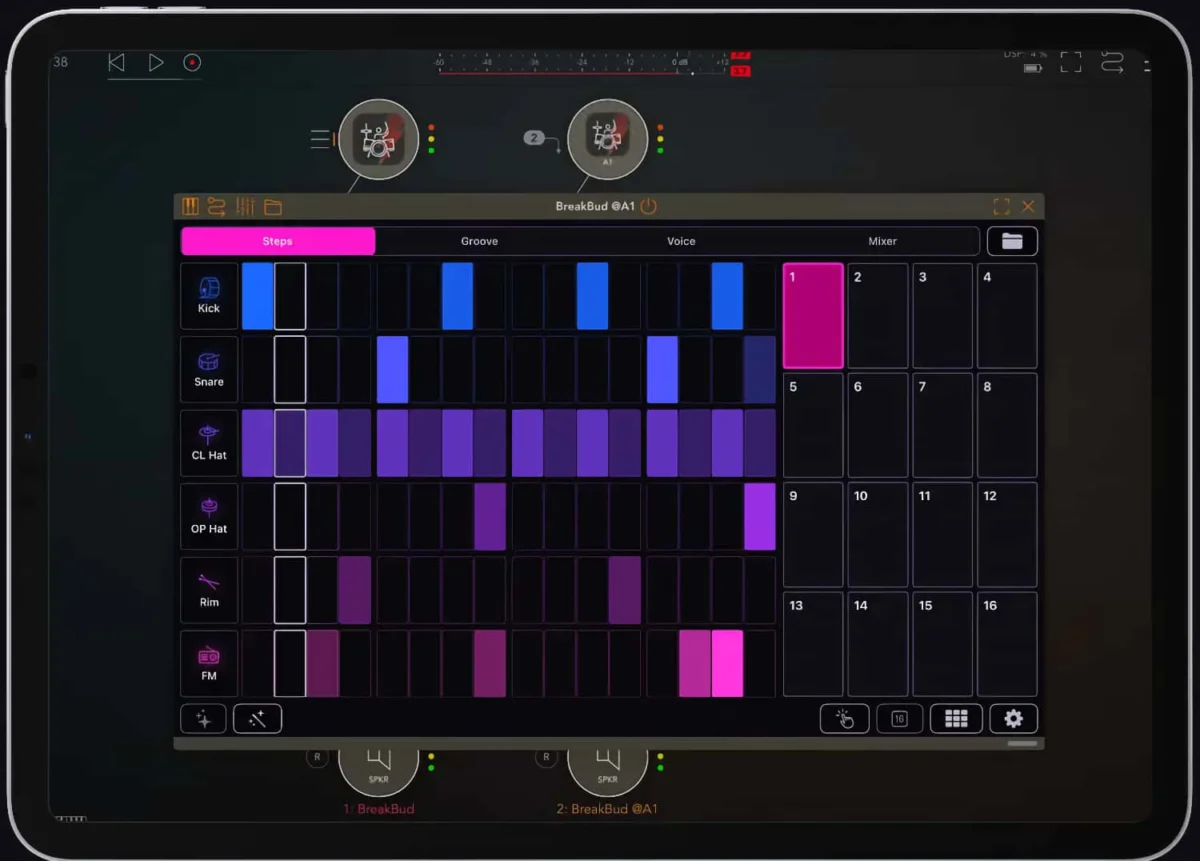
The mobile music production landscape has witnessed a significant expansion with the official release of BreakBud, a dedicated breakbeat drum synthesizer developed by Cem Olcay. Designed specifically for the iOS ecosystem, BreakBud arrives as a versatile tool for electronic music producers, offering a streamlined approach to creating complex rhythmic patterns through a combination of synthesis and a performance-oriented interface. The application, which supports the AUv3 (Audio Units version 3) standard, allows for seamless integration into various digital audio workstations (DAWs) on the iPad and iPhone, marking another milestone in the ongoing evolution of professional-grade mobile audio software.
The Architecture of BreakBud
At its core, BreakBud is built around a 16-pad interface, a familiar layout for beatmakers that facilitates tactile interaction. Unlike many drum machines that rely heavily on pre-recorded samples, BreakBud emphasizes synthesis. It features six distinct synthesized drum voices, each engineered to provide the punch, snap, and tonal flexibility required for the breakbeat genre. This synthesis-first approach allows users to manipulate the fundamental characteristics of each sound—such as pitch, decay, and harmonic content—without the artifacts often associated with time-stretching or pitching samples.
The application’s design philosophy centers on the "breakbeat" aesthetic, a style characterized by syncopated rhythms and a high degree of percussive energy. By providing six dedicated voices, Olcay has focused the tool on the essential elements of a drum kit: kick, snare, various percussion, and hi-hats. Each voice can be independently triggered and modulated, allowing for the creation of intricate polyrhythms and the "ghost notes" that are foundational to the breakbeat sound.
The Developer’s Context and Legacy
Cem Olcay has established a reputation within the iOS music community as a developer who prioritizes utility and modularity. His previous contributions to the App Store, often categorized under the "Bud" series—including StepBud, SnakeBud, and BudEdit—have focused on MIDI sequencing and generative music tools. BreakBud represents a natural progression for Olcay, moving from the control of external sounds to the generation of sound itself.
The release of BreakBud follows a period of intense development in the mobile audio sector, where developers are increasingly moving away from "all-in-one" workstations in favor of specialized, high-quality "micro-apps." These apps are designed to do one thing exceptionally well and interact with other software via the AUv3 protocol. Olcay’s entry into the drum synthesis market reflects a broader industry trend toward modularity, where a producer might use BreakBud for drums, another app for bass synthesis, and a third for spatial effects, all hosted within a single environment like AUM, Loopy Pro, or Apple’s Logic Pro for iPad.
Technical Specifications and AUv3 Integration
The inclusion of AUv3 support is perhaps the most critical technical feature of BreakBud. The AUv3 standard is the mobile equivalent of VST or AU plugins on desktop systems. It allows BreakBud to be opened as multiple instances within a host application. For a producer, this means they could have one instance of BreakBud dedicated to a standard 4/4 rhythm while another instance handles complex, off-kilter percussion, with both running simultaneously and sharing the same clock and transport controls.
Furthermore, the app’s integration with iOS MIDI standards ensures that it can be controlled by external hardware. Producers can map the 16 pads to physical MIDI controllers, such as the Akai MPC or Novation Launchpad, bridging the gap between tactile hardware and the portability of a tablet. This connectivity is essential for live performers who require the reliability of a dedicated synth engine but prefer the feel of physical buttons and knobs.
A Chronology of Mobile Drum Synthesis
The journey toward apps like BreakBud began over a decade ago with the launch of the first iPad. Early drum machines on the platform were often limited by processing power and lacked the low-latency performance required for professional use. However, the timeline of development has accelerated rapidly:

- 2010–2014: The "Toy" Era. Most drum apps were simple sample players with high latency and limited connectivity.
- 2015–2018: The Rise of Inter-App Audio and early AUv3. Developers began creating more sophisticated synthesis engines as Apple improved the iOS audio stack.
- 2019–2022: The Professional Pivot. Apps like Hammerhead and various Moog emulations proved that iOS could handle complex synthesis.
- 2023–Present: The Desktop-Class Era. With the introduction of M-series chips in iPads, the overhead for synthesis vanished, allowing developers like Cem Olcay to create high-fidelity instruments like BreakBud that rival desktop plugins.
BreakBud enters the market at a time when the distinction between "mobile apps" and "pro software" is virtually non-existent in terms of audio quality. The decision to price the app at $6.99 USD positions it as an accessible entry point for beginners while remaining an impulse-buy for professionals looking to expand their sonic palette.
Market Impact and User Reception
While official sales figures for niche audio applications are rarely made public, the initial reception within the iOS production community has been positive. Industry observers note that there is a consistent demand for drum machines that move beyond the standard "808/900" emulations. The focus on breakbeats—a genre that has seen a resurgence in popular music through the revival of Jungle and Drum and Bass—makes BreakBud a timely release.
Analysts suggest that the success of such apps depends on their "tweakability." Modern producers are less interested in static loops and more interested in "living" sounds that can be modulated in real-time. BreakBud’s synthesis engine addresses this by allowing parameters to be automated or changed on the fly. This level of control is a significant selling point compared to traditional sample packs, which offer limited flexibility once a loop is rendered.
The Significance of Breakbeat Synthesis
To understand the value of BreakBud, one must consider the technical difficulty of synthesizing a breakbeat. Traditionally, breakbeats were created by taking a drum solo from a funk record—most famously the "Amen Break" from The Winstons’ "Amen, Brother"—and slicing it into individual hits. While this provided a specific "grit," it limited the producer to the original recording’s tonality.
Synthesized breakbeats, as offered by BreakBud, provide a different advantage. They offer "clean" transients and the ability to tune the drums to the key of the track. This is particularly important in sub-heavy genres like Drum and Bass, where the kick drum must sit perfectly with the bassline to avoid frequency masking. By using a dedicated synth like BreakBud, producers can sculpt the fundamental frequency of the kick and the snap of the snare to ensure maximum clarity in a mix.
Broader Implications for the iOS Audio Ecosystem
The launch of BreakBud is symptomatic of a larger shift in the music industry. As hardware costs remain high and studio space becomes a luxury, the "studio in a backpack" concept has become a reality. Apple’s recent release of Logic Pro for iPad has further validated this movement, creating a vacuum for high-quality third-party plugins.
BreakBud fills a specific niche within this ecosystem. It is not trying to be a full DAW or a comprehensive workstation; it is a specialized tool. This modular approach is favored by the "Pro" user base on iOS, who prefer to build custom signal chains. The availability of such tools at a fraction of the cost of desktop equivalents (which often range from $50 to $200) is democratizing music production, allowing creators from various economic backgrounds to access professional-grade sound design tools.
Future Outlook and Conclusion
As Cem Olcay continues to update BreakBud, the community expects further refinements, potentially including more synthesis models or expanded MIDI mapping capabilities. The developer has already provided tutorial materials to assist users in getting started, signaling a commitment to long-term support for the application.
In conclusion, BreakBud represents a sophisticated intersection of synthesis, performance, and portability. By focusing on the specific needs of breakbeat production and leveraging the power of the AUv3 standard, Cem Olcay has provided iOS users with a powerful new instrument. Its release reinforces the iPad’s position as a legitimate platform for sound design and composition, offering a glimpse into a future where the boundaries between mobile and desktop production continue to blur. For $6.99, BreakBud is not merely an app; it is a testament to the technical heights currently achievable in the palm of one’s hand, providing a dedicated engine for the rhythms that have defined electronic music for decades.
