

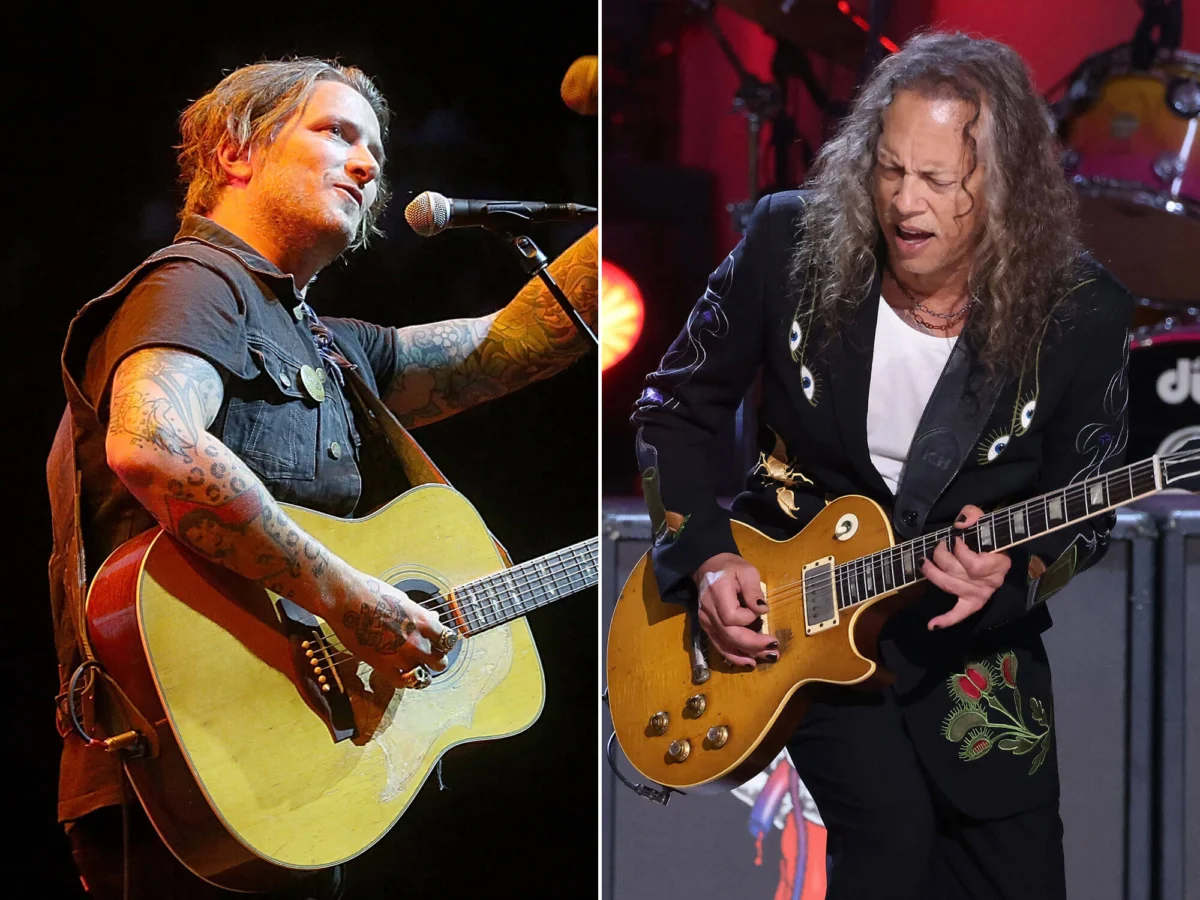
The narrative of iconic guitars often intertwines with the legends who wield them, creating instruments imbued with a mystique that transcends their mere material composition. Among these hallowed six-strings, the 1959 Gibson Les Paul Standard affectionately known as "Greeny" stands as a titan. Its storied history, marked by ownership from three titans of rock and blues – Peter Green, Gary Moore, and currently Kirk Hammett – has cemented its status as one of the most revered and valuable guitars in existence. However, a recent revelation from acclaimed singer-songwriter and producer Butch Walker has cast a new light on Greeny’s journey, detailing a significant moment where fate could have taken a dramatically different turn, placing the legendary instrument into his hands before its eventual acquisition by Metallica’s lead guitarist.
Greeny’s Storied Provenance: From Blues-Rock Pioneer to Metal Icon
The legend of Greeny begins in the late 1960s with its first iconic owner, Peter Green, co-founder of Fleetwood Mac. Green, a virtuoso whose soulful playing and distinctive tone influenced generations, acquired the 1959 Les Paul Standard for a reported £100 (approximately $250 at the time) from a music store in London. What set Greeny apart from other Les Pauls was its unique, almost ethereal, out-of-phase sound, which Green reportedly achieved by accidentally or intentionally reversing the magnet in the neck humbucker pickup. This sonic anomaly became a hallmark of Fleetwood Mac’s early blues-rock sound, famously heard on tracks like "Oh Well," "Albatross," and "The Green Manalishi (With the Two Prong Crown)." Green’s playing with Greeny was characterized by its melodic lyricism, searing sustain, and a vocal-like quality that made the guitar an extension of his deeply expressive musicality. His era with the guitar established its initial, profound musical heritage.
In 1970, as Peter Green grappled with personal challenges and sought to distance himself from the commercial pressures of fame, he offered Greeny to a young, aspiring guitarist named Gary Moore. Moore, a fervent admirer of Green, initially hesitated, feeling unworthy of such an instrument. However, Green insisted, selling it to Moore for the same price he had paid for it, reportedly with the condition that Moore would one day sell it for the same amount if he ever decided to part with it. Moore would honor this promise decades later, though the guitar’s value had by then skyrocketed.
Gary Moore’s ownership marked the second illustrious chapter in Greeny’s life. For over three decades, Greeny was Moore’s primary instrument, accompanying him through his diverse career, from hard rock with Thin Lizzy to his celebrated resurgence as a blues maestro. It became synonymous with his fiery, impassioned playing and the signature tone that defined his solo albums like "Still Got the Blues" (1990). Moore’s aggressive yet melodic style, often characterized by sustained, vocal-like bends and a raw intensity, was intrinsically linked to Greeny’s unique sonic palette. The guitar was not just an instrument but a crucial component of Moore’s identity, making it instantly recognizable to fans worldwide. Its presence on countless albums and stages further cemented its mythical status, expanding its historical footprint beyond its initial blues-rock origins into the realm of mainstream rock and blues.
The third and current custodian of Greeny is Kirk Hammett, lead guitarist for the legendary metal band Metallica and a renowned collector of vintage guitars. Hammett acquired Greeny in 2014 for an undisclosed sum, widely reported to be in the millions, a testament to its unparalleled provenance and desirability. Hammett has since made it a point to play Greeny regularly on stage with Metallica, ensuring that the guitar’s voice continues to resonate with new generations of fans. His philosophy is not to keep such an instrument locked away in a vault but to allow its music to continue living, honoring the legacies of its previous owners.
Butch Walker’s Near Miss: A Quarter-Million Dollar Decision
It is within this rich historical context that Butch Walker’s recent revelation takes on particular significance. In a candid interview with Guitar World, Walker disclosed that he had a fleeting opportunity to purchase Greeny before it landed in Kirk Hammett’s collection. Walker, known for his successful solo career and prolific work as a producer for artists such as P!nk, Avril Lavigne, Taylor Swift, and Fall Out Boy, recounted the moment with a blend of admiration and palpable regret.
"Gary Moore was one of my heroes," Walker stated, emphasizing his profound respect for the blues-rock icon. "I had an opportunity to buy Greeny before it was really making the rounds, and Kirk Hammett bought it. But I just wasn’t ready to spend $250,000 on a guitar at that stage in my life and my career." This statement provides a crucial timeline: the offer came when Gary Moore was preparing to sell, predating Hammett’s 2014 acquisition. It also highlights the substantial, though relatively lower, price point at which the guitar was circulating before its value escalated even further due to heightened demand and its ultimate sale to a high-profile collector.
Walker elaborated on how the opportunity arose: "My buddy was a guitar broker, and it started circulating that Gary was going to sell. It had belonged to Peter Green as well, which was cool, but I was actually more psyched that it was Gary Moore’s." This detail underscores the personal connection Walker felt to the guitar through Moore, a musician who profoundly inspired him. His candid admission of regret — "I highly regret not coming up with the money somehow. Obviously, that was just a Tuesday and a lunch tab for Kirk Hammett" — encapsulates the stark reality of the high-stakes market for such instruments and the financial disparity that often dictates who can acquire them.
At the time of this offer, while Butch Walker had already established a significant career, his professional focus might have been directed differently. His extensive production credits, spanning multiple genres and consistently yielding chart-topping hits, attest to his success. However, investing a quarter of a million dollars into a single instrument, no matter how iconic, represents a substantial financial decision that not every artist, even a successful one, is prepared to make. It reflects a choice between significant personal capital investment and other career or life priorities, a choice many would face when confronted with such a unique, yet costly, opportunity.

The Anatomy of a Legend: Greeny’s Unique Sonic Characteristics and Market Value
Greeny’s allure extends beyond its illustrious former owners; its intrinsic characteristics contribute significantly to its legendary status and exorbitant value. The 1959 Gibson Les Paul Standard is already considered the holy grail of electric guitars due to its impeccable craftsmanship, premium tonewoods, and the legendary PAF (Patent Applied For) humbucker pickups. Only an estimated 600-650 Les Paul Standards were produced in 1959, making them exceptionally rare. Their exceptional playability and rich, resonant tone have made them highly sought after by collectors and musicians alike, commanding prices well into six figures even without a famous provenance.
However, Greeny’s out-of-phase wiring in the neck pickup gives it a distinctive, hollow, and nasal tone when both pickups are engaged in the middle position. This unique sonic fingerprint, often described as vocal-like or "liquid," sets it apart from other ’59 Les Pauls. This specific characteristic, coupled with the cumulative history of Peter Green’s revolutionary blues playing and Gary Moore’s electrifying blues-rock, elevates Greeny from a rare vintage instrument to an unparalleled cultural artifact. The guitar’s market value is thus a confluence of its rarity, its specific sonic attributes, and, most importantly, its unparalleled provenance.
When Gary Moore decided to sell Greeny, the market for vintage instruments, particularly those with such an iconic history, was already robust. The $250,000 price tag Butch Walker faced, while substantial, represented a point in time before the guitar’s value truly exploded. By the time Kirk Hammett acquired it in 2014, reports circulated that the price had soared significantly, with some estimates placing it well over $2 million, showcasing the rapid appreciation of such unique assets. This escalation highlights the investment potential of legendary instruments, transforming them from mere tools of artistic expression into valuable commodities.
Kirk Hammett’s Stewardship and the Broader Impact
Kirk Hammett’s acquisition of Greeny was not merely a transaction; it was an act of custodianship that ensured the guitar’s continued public life. Unlike some collectors who might display such a treasure behind glass, Hammett regularly brings Greeny on tour with Metallica, playing it during their live performances and allowing its unique voice to be heard by millions. This act of "living history" further solidifies Greeny’s legend.
Moreover, Hammett has been remarkably generous in sharing the experience of Greeny with other notable guitarists. Al Di Meola, Jack White, and Jake E. Lee are among the celebrated musicians who have had the privilege of playing the iconic instrument, adding new chapters to its already rich narrative. This gesture not only honors Greeny’s legacy but also fosters a sense of community among guitarists, recognizing the shared inspiration derived from such a monumental instrument.
In a March 2025 interview with The Telegraph, Hammett offered further insight into the guitar’s path to him. He revealed that several other "major players," including his Metallica bandmate James Hetfield, had been offered Greeny before he eventually purchased it, but had "passed on it for whatever reason." Hammett’s immediate connection to the instrument was unequivocal: "when I saw Greeny, I knew in less than a minute that I was never gonna give it back! I had such an instant connection to that guitar, it’s such an amazing source of inspiration and it’s my best-sounding guitar." This statement from Hammett underscores the almost mystical bond musicians often feel with certain instruments, particularly those with such profound historical weight.
The "What If" and Enduring Legacy
Butch Walker’s candid admission prompts a fascinating "what if" scenario. Had he managed to secure the funds and acquire Greeny, how might his own musical output, both as an artist and a producer, have been influenced? Would Greeny have lent its distinctive voice to the pop anthems of P!nk or Taylor Swift, or perhaps fueled a new, blues-infused direction in Walker’s solo work? While such speculation remains purely hypothetical, it highlights the profound impact that an instrument of Greeny’s caliber can have on an artist’s creative journey.
Ultimately, Greeny’s story is a microcosm of the broader narrative of iconic instruments in music history. These guitars are more than just wood and wire; they are vessels of human creativity, passion, and innovation. They carry the echoes of countless performances, the fingerprints of legendary artists, and the soul of the music they helped create. Butch Walker’s missed opportunity is a poignant reminder of the rare windows of chance that sometimes open in the lives of musicians, and the enduring regret that can accompany a path not taken. Yet, Greeny’s journey continues, its unique voice amplified by Kirk Hammett, ensuring that its legendary status remains firmly cemented in the annals of music history, inspiring guitarists and music lovers for generations to come. The guitar’s odyssey, from a modest purchase by Peter Green to its current revered status, exemplifies the power of artistic provenance to transform an object into an invaluable cultural treasure.
