

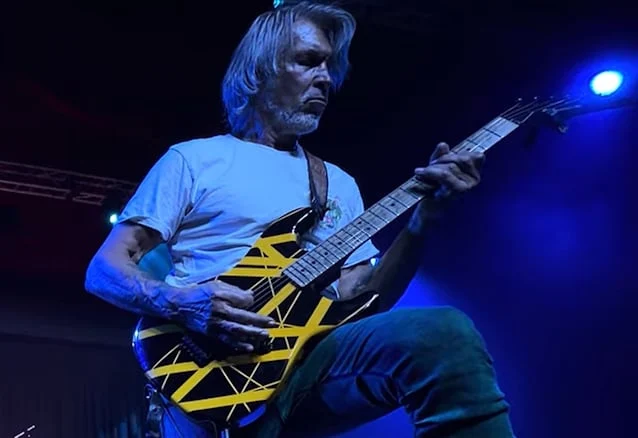
In a candid interview with The Music Zoo owner Tommy Colletti, legendary Dokken guitarist George Lynch delved into his memories of witnessing Van Halen’s meteoric ascent in the Southern California club scene of the mid-1970s. Lynch’s recollections offer a vivid picture of the raw energy and groundbreaking innovation that characterized Eddie Van Halen’s early performances, a phenomenon that profoundly impacted Lynch and countless other musicians of his generation. The interview, transcribed by BLABBERMOUTH.NET, reveals Lynch’s deep respect for Eddie Van Halen, not only as a revolutionary guitarist but also as a surprisingly introverted and generous individual.
The Dawn of a Guitar Revolution: Van Halen’s Club Days
Lynch vividly recalled attending a pivotal show at the Golden West Ballroom in Norwalk, California, where he saw UFO perform alongside Van Halen. "I saw UFO play with Van Halen at the Golden West Ballroom in Norwalk, California, near where we lived," Lynch stated. "We played there a lot. It was somewhat dramatic, because I don’t know if UFO knew what they were in for. And I love UFO — we all love UFO — but they got their ass kicked. I mean, they came up, and I don’t think they were ready for that."
This anecdote underscores the immediate and overwhelming impact Van Halen, and particularly Eddie Van Halen’s guitar playing, had on audiences and fellow musicians alike. In an era where rock music was already evolving, Van Halen injected a level of technical prowess and unbridled energy that was unprecedented. Lynch pinpointed this period as a critical juncture, describing Eddie Van Halen’s introduction of virtuosic, high-energy technical guitar playing, including techniques like two-handed tapping, to the Sunset Strip scene as a true paradigm shift.
A Mind-Bending Revelation: The Mammoth and Early Van Halen Era
Lynch elaborated on the transformative nature of witnessing Eddie Van Halen’s talent firsthand. "There was a paradigm shift in the music universe," Lynch explained. "Well, to see it up close and personal as it was happening, in [Eddie’s pre-Van Halen band] Mammoth and also early Van Halen, it was mind bending to see that in person. It was just insane. I mean, I’d just go to my studio or go home and just get on my guitar for eight hours and go, ‘I gotta step up. This is insane.’"
This personal anecdote highlights the intense pressure and inspiration that Eddie Van Halen’s playing instilled in his contemporaries. The sheer audacity and innovation displayed by Van Halen pushed the boundaries of what was considered possible on the guitar, forcing other musicians to re-evaluate their own skills and creative approaches. The period between the late 1970s and early 1980s saw a significant acceleration in guitar technique and expression within hard rock and heavy metal, with Eddie Van Halen often cited as the primary catalyst.
Evolution of a Legend: From Les Paul to Iconic Tone
Lynch’s recollections also shed light on the evolution of Eddie Van Halen’s early sound and gear. He described seeing Eddie perform when he was still utilizing a Les Paul guitar through Fender Bandmaster or Bassman amplifiers, and later the Music Man amplification. Even in these earlier stages, Lynch was captivated. "I’d seen him when he was playing with a Les Paul through a Bandmaster or Bassman. And then the Music Man and all that period. And he was still amazing. He didn’t have the tapping. He didn’t have the bar. And it’s still insane. And different. It wasn’t Van Halen like you think of him now. It was a different thing, ’cause he had more of the [Eric] Clapton influence. It was a little more meat and potatoes, but it was still — I think, in a way, even cooler because we’re so used to Eddie and what he does. But not very many people have heard that. And that, to me, is even more interesting, from a guitar player’s perspective."
This detailed observation is significant as it points to Eddie Van Halen’s innate musicality and innovative spirit that transcended specific gear or techniques. While his later adoption of the Floyd Rose tremolo system and the development of his iconic "brown sound" became hallmarks of his style, Lynch’s insight reveals that the core of Eddie’s genius was present even before these signature elements were fully realized. The reference to Clapton’s influence suggests a foundation in blues-rock that Eddie Van Halen then infused with his own revolutionary flair, creating something entirely new.
The Unsung Influence: Terry Kilgore and REDDI KILLOWAT
Beyond Eddie Van Halen’s direct impact, Lynch also brought attention to another influential figure from the 1970s Southern California scene: Terry Kilgore. Lynch credited Kilgore, a friend and contemporary of Eddie Van Halen, with playing a role in shaping Eddie’s early playing style. "Terry was in REDDI KILLOWAT," George recalled. "It was a three-piece band that was… They didn’t have [a great frontman like] David Lee Roth, they didn’t have the image, they didn’t have the looks, they didn’t have the songs, but Terry was, I thought, maybe even better than Eddie. I think Eddie kind of took a lot of the stuff — well, not a lot, but some of the things Terry was doing, obviously, because they were friends."
This revelation adds a layer of complexity to the narrative of Eddie Van Halen’s influences. While Eddie’s own genius is undeniable, Lynch’s statement suggests a peer-to-peer exchange of ideas and techniques within the vibrant local music scene. Terry Kilgore, though perhaps not achieving the same global fame, was clearly a formidable guitarist whose work resonated with and inspired Eddie Van Halen. Research into REDDI KILLOWAT confirms their presence in the Southern California club circuit during the same period as early Van Halen and Mammoth, further supporting the plausibility of this musical cross-pollination. This highlights the collaborative and competitive spirit that often fuels artistic breakthroughs.
The Profound Loss of a Guitar Giant
Lynch also spoke with deep emotion about the impact of Eddie Van Halen’s passing in October 2020. He described the loss as deeply personal and widely felt within the guitar community. "That hit me personally very hard, and every guitar player I know, pretty much, kind of felt the same way," Lynch stated. He contextualized this grief within a broader landscape of musical icons lost in recent years, including David Bowie, George Michael, Prince, and Tom Petty, but emphasized that Eddie’s death held a unique significance for him and his peers.
"But Eddie was on another level, because, obviously, we’re a little closer as far as what we do, and we kind of came up in the same place at the same time and had some connections and all that, so that’s why it was more profound, I think," Lynch explained. He further acknowledged his own stylistic debt to Van Halen, admitting, "I learned a lot from him, and I based a lot of my style on him. Even though we were compatriots in a way, he was way beyond me, so I lifted a lot of stuff from him and got inspired by him, as we all did."
Lynch’s description of their shared background—"He’s a Southern California guy, and we were like kind of neighbors and played the same clubs and played on the same stages together and hung out"—underscores the sense of camaraderie and shared experience within the regional music scene that fostered such extraordinary talent. He specifically mentioned Dokken’s participation in the 1988 "Monsters of Rock" tour with Van Halen, a significant moment in their professional relationship and a testament to their shared presence on major concert stages. "So, yeah, that was a pretty tough one. It hits close to home, too, I think, for us when our friends start disappearing, because it’s a lonelier place after that."
The Quiet Innovator: Eddie Van Halen’s Private Persona
When asked about the more personal, "fun side" of Eddie Van Halen’s personality, Lynch offered a surprising insight into the guitarist’s introverted nature. "He was just incredibly shy. He was just a super introvert," Lynch revealed. "I mean, all the guy did was just sit in his room and play guitar his whole life, and drink his beers and smoke his cigarettes, and developed what he developed. He changed the guitar world. I think he was just sort of burdened with this whole fame thing and being a human being in a complicated world. It isn’t always so nice. He was a super-sensitive guy, which allowed him to be this incredible musician, as you have to have that sort of sympathy and empathy. A lot of people thought he wasn’t that nice of a person, but it was just ’cause he was really quiet. He was a little bit scared, but he spoke so beautifully through his instrument."
This portrayal challenges the rock star stereotype and highlights the dedication and perhaps even the personal cost of Eddie Van Halen’s extraordinary musical journey. Lynch’s observation that Eddie’s sensitivity was a key component of his musical genius is a poignant reminder that profound artistic expression often stems from deep emotional wells. The idea that he was "burdened" by fame suggests a man who found solace and expression primarily through his guitar, rather than in the spotlight itself.
Generosity and Camaraderie: Sharing the Stage and the Gear
Despite his shyness, Lynch recounted instances of Eddie Van Halen’s remarkable generosity and kindness, particularly during the "Monsters of Rock" tour. "But we had moments," he continued. "We used to hang out. ‘Monsters of Rock,’ we’d go almost every night. When Valerie [Bertinelli, Eddie’s then-wife] wasn’t out, we’d jam. We’d just sit in our hotel room and just play guitar all night. It was pretty awesome."
Lynch also shared a significant story about Eddie’s willingness to help him out when he experienced technical difficulties with his own equipment. "And actually, I had some issues with my gear out there on the ‘Monsters’ tour, and [Van Halen] were the headliner, obviously. And he was so sweet, ’cause he was, like, ‘Hey, man, take anything you want of mine.’ So I did half that tour with his gear. That’s pretty insane, ’cause headliners usually don’t do stuff like that. They’re just, like, ‘That’s your problem. Figure it out,’ which is fair. But he was very sweet: ‘Just take anything you want — heads, cabinets.’ I used his rig for, like, half that tour. It was pretty sweet."
This act of extraordinary generosity underscores Eddie Van Halen’s character and his commitment to fellow musicians. In a high-stakes touring environment, where equipment issues can derail performances, Van Halen’s willingness to share his entire rig speaks volumes about his collaborative spirit and his respect for Lynch and Dokken.
A Legacy of Inspiration: Eddie’s Gift to the Next Generation
Further illustrating Eddie Van Halen’s impact on younger musicians, Lynch recounted a deeply personal moment when Eddie gave his son a guitar lesson. "He gave my son a guitar lesson," George added. "My kid was going to GIT [Guitar Institute of Technology], and he wanted to be a guitar player like his dad. And I took him to meet Eddie at a show, and Eddie’s, like, ‘You know what? You’re a guitar player? Let me show you…’ So they went back in the warmup room and he gave my son a little lesson. That was pretty cool. Who does that?"
This heartwarming anecdote highlights Eddie Van Halen’s role not just as a revolutionary artist but also as a mentor and inspirer. The fact that he would take time out of his demanding schedule to personally guide a young, aspiring guitarist demonstrates his deep connection to the craft and his desire to pass on his passion.
The Pursuit of Tone: Catching Up to a Guitar God
Lynch’s reflections on the influence of Eddie Van Halen extend back to his own early career. In a 2009 interview with Guitar Player magazine, he admitted to feeling a sense of jealousy and a drive to improve in response to Van Halen’s early success. "We were jealous and we were all trying to play catch up," Lynch recalled. "We thought, ‘Oh boy, we better get on board. This guy’s going to change the world.’ I remember my reaction when I first heard Eddie. I had been hearing about this guy with the weird European name. He’s got a torpedo onstage, the bass player wears clogs, they have bombs onstage, and the guy’s unbelievable. I saw him and it blew my mind."
He continued to describe the intense focus that followed: "They were still doing covers at the time — Rainbow, Montrose — and their original stuff was as good or better than their cover stuff, which was pretty exceptional. After their show, I went back to our band room and played my guitar until the sun came up. I thought, ‘Man, how can I get that tone?’"
Learning Through Reaction, Not Replication
Lynch also clarified his approach to incorporating influences into his own playing, emphasizing a process of "reacting" rather than direct emulation. "What I really did was sort of bounce off his stuff rather than emulate it," he explained. "I’ve done that with a lot of players. Instead of copying them, I react to them. I’ll think, ‘Well, Di Meola does this thing. I can do some alternate picking, so I won’t copy it but I’ll embed that a little bit into my toolbox and do it my own way.’ I’ve tried to do that with any player who has influenced me: Clapton, Hendrix, Schenker, Eddie, Holdsworth. I couldn’t play any of their stuff note for note to save my life, but I can capture the gist of what they’re doing by being exposed to it. I can get the essence."
This nuanced perspective reveals Lynch’s sophisticated understanding of musical influence. He views iconic players not as templates to be copied but as sources of inspiration that provoke new creative avenues. By analyzing the "essence" of their playing, he integrates elements into his own unique style, contributing to the rich tapestry of guitar music.
Eddie Van Halen’s passing marked the end of an era, but his influence continues to resonate through the music of countless guitarists, including George Lynch, who remains a testament to the enduring power of innovation, dedication, and the profound impact one musician can have on the world.
