

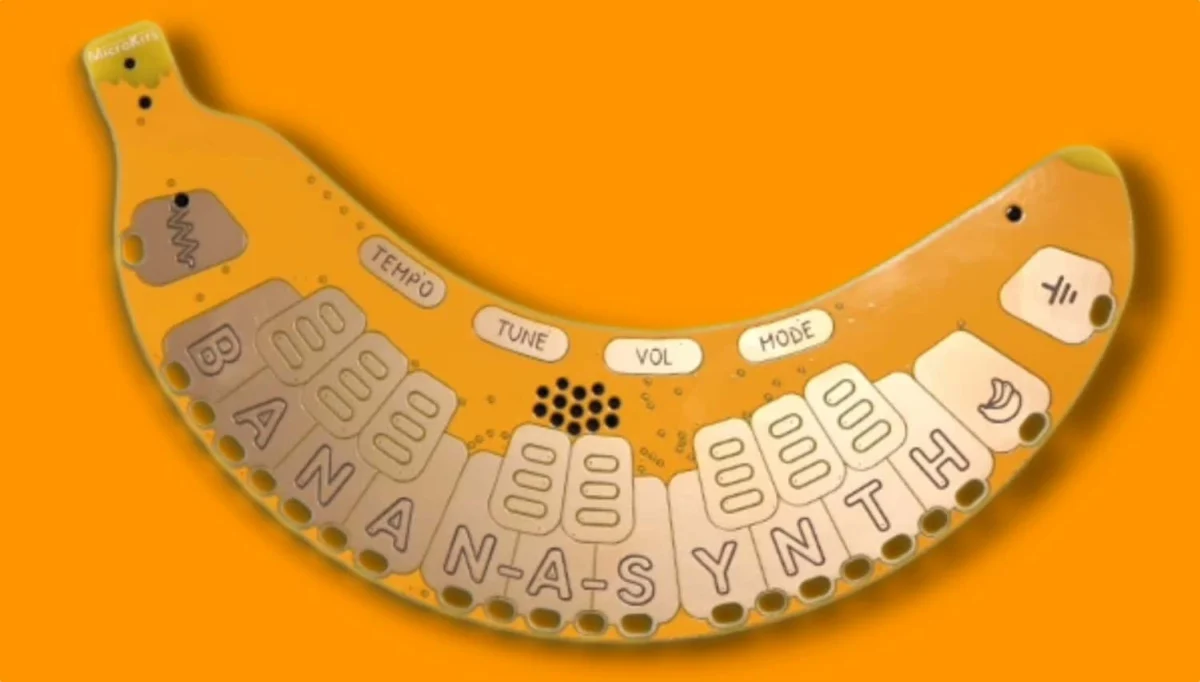
MicroKits, the hardware design firm led by David Levi, has officially announced the launch of its latest electronic musical instrument, the Banan-a-Synth, currently seeking production funding through a dedicated Kickstarter campaign. This new device represents a significant evolution of the company’s previous design philosophy, which prioritized accessibility and tactile experimentation in the realm of analog and digital synthesis. The Banan-a-Synth distinguishes itself through a unique, banana-shaped yellow chassis that serves as a functional interface for both novice musicians and experienced synthesists. Having already surpassed its initial funding goals within the first phase of the campaign, the project highlights a growing consumer appetite for "playful" hardware that bridges the gap between educational STEM tools and professional-grade electronic music equipment.
The Evolution of MicroKits and the Path to the Banan-a-Synth
The development of the Banan-a-Synth is not an isolated event but rather the culmination of years of iterative design within the MicroKits ecosystem. David Levi, the founder and lead engineer, previously gained recognition in the synthesizer community for the "Synth-a-Sette," a portable analog synthesizer housed in a cassette-style enclosure. The Synth-a-Sette was lauded for its ability to transform everyday conductive objects—ranging from soda cans to actual pieces of fruit—into makeshift musical keys via alligator clips and capacitive touch technology.
Building upon this foundation, the Banan-a-Synth adopts the whimsical form factor of its namesake fruit while significantly expanding the internal circuitry and user interface. Unlike its predecessor, which relied heavily on external attachments for a full "keyboard" experience, the Banan-a-Synth features a built-in touch-sensitive keyboard integrated directly onto its surface. This allows for immediate playability "out of the box" while retaining the modular, experimental spirit that defined MicroKits’ earlier offerings. The transition from the rectangular, utility-focused design of the Synth-a-Sette to the ergonomic, curved aesthetic of the Banan-a-Synth reflects a broader trend in the boutique hardware industry: the fusion of high-level functionality with high-concept industrial design.
Technical Specifications and Functional Design
At its core, the Banan-a-Synth operates on the principles of capacitive sensing. This technology allows the device to detect the minute electrical charges present in the human body, translating physical touch into control voltages and digital signals that trigger the internal sound engine. The device is designed to be highly responsive, catering to various playing styles, from rapid rhythmic tapping to sustained melodic phrasing.
The interface includes a series of touch pads that act as a traditional musical scale. However, the true technical versatility of the Banan-a-Synth lies in its external connectivity. Users are encouraged to utilize the included alligator clips to connect the synthesizer to any conductive material. This effectively turns the environment into a musical instrument. In educational settings, this feature is often used to demonstrate the conductivity of biological materials—such as the moisture content in a real banana—thereby providing a practical application for physics and electronics theory.
While the primary focus is on playability, the internal sound engine has been refined to offer a broader palette of tones than previous iterations. The synthesis architecture allows for a range of sounds from "buzzy" low-frequency oscillators to shimmering high-pitched leads. This versatility ensures that the device functions not merely as a novelty item but as a legitimate tool for sound design and music production.
Chronology of the Banan-a-Synth Project
The timeline of the Banan-a-Synth’s development follows a standard trajectory for successful boutique hardware launches, beginning with a lengthy prototyping phase.
- Conceptualization (Q3 2023): Following the positive market reception of the Synth-a-Sette, David Levi began sketching designs for a dedicated "fruit-themed" synthesizer that would serve as both a mascot for the brand and a more robust instrument.
- Prototyping and Alpha Testing (Q1 2024): Initial circuit boards were developed to test the sensitivity of the capacitive touch pads. Early 3D-printed enclosures were used to determine the optimal curvature for ergonomic play.
- Beta Iteration and Community Feedback (Q2 2024): MicroKits shared early footage of the prototype with the electronic music community, gathering feedback on the layout of the touch keyboard and the durability of the external connectors.
- Kickstarter Launch (Current Phase): The official campaign went live with an entry-level backing price of $56 USD. The project achieved its funding target within the initial launch window, ensuring that production would proceed.
- Projected Manufacturing and Distribution (Late 2024): With the funding secured, MicroKits is expected to move into the mass production phase, with the first units slated for delivery to backers following rigorous quality control testing.
Market Context and Supporting Data in Crowdfunded Synthesis
The success of the Banan-a-Synth occurs within a broader economic context where "boutique" synthesizers are capturing a larger share of the hobbyist market. According to market research on the musical instrument industry, the segment for portable and educational synthesizers has seen a 15% year-over-year growth since 2021. This growth is driven largely by the democratization of electronics manufacturing and the rise of platforms like Kickstarter, which allow independent designers to bypass traditional retail barriers.
Data from similar crowdfunding campaigns suggests that projects priced between $50 and $150 USD have the highest success rate in the "Music Technology" category. At a starting price of $56, the Banan-a-Synth occupies a strategic "sweet spot" that appeals to gift-buyers, educators, and synthesizer collectors alike. Furthermore, the conversion rate for "returning creators"—designers like David Levi who have successfully fulfilled previous campaigns—tends to be 30% higher than first-time creators, as they have already established a baseline of trust with the community regarding delivery timelines and build quality.
Official Statements and Industry Reception
While formal press releases from major retail distributors are pending, the reaction from the independent synth community has been largely positive. David Levi has emphasized that the goal of MicroKits is to "lower the barrier to entry for electronic music." In promotional materials, Levi noted that the Banan-a-Synth was designed to be "unintimidating," contrasting with the often-complex "wall of knobs" found on traditional modular synthesizers.
Industry analysts have noted that the Banan-a-Synth follows in the footsteps of "toy-adjacent" but functional instruments like the Teenage Engineering Pocket Operator series or the Korg Volca line. These products prove that there is a significant market for instruments that prioritize portability and a "fun" user experience without sacrificing the core sonic capabilities required for serious music making. The Banan-a-Synth’s specific focus on conductivity also aligns it with the "Maker Movement," appealing to individuals who enjoy DIY electronics and circuit bending.
Broader Implications for STEM Education and Music Technology
Beyond its role as a musical instrument, the Banan-a-Synth carries significant implications for the STEAM (Science, Technology, Engineering, Arts, and Mathematics) educational sector. By integrating electronic circuitry with a recognizable, non-technical form factor, the device serves as an effective gateway for students to learn about:
- Capacitance and Conductivity: Understanding how electricity moves through different materials, including human skin and organic matter.
- Signal Processing: Learning how a physical touch is converted into an analog or digital audio signal.
- Industrial Design: Observing how the physical shape of a device can influence its ergonomics and the way a user interacts with technology.
As schools increasingly look for ways to integrate arts into technical curricula, devices like the Banan-a-Synth provide a tangible, tactile way to engage students who might otherwise be deterred by the abstract nature of coding or pure physics.
Risks, Challenges, and Forward-Looking Statements
Despite the early success of the Kickstarter campaign, the project faces the standard challenges inherent in hardware production. Supply chain fluctuations for semiconductors and specialized plastics can impact delivery dates, a common occurrence in the post-pandemic manufacturing landscape. MicroKits has acknowledged these risks, noting that transparency with backers will remain a priority throughout the production cycle.
Looking forward, the Banan-a-Synth may pave the way for a series of themed instruments from MicroKits, potentially creating a "fruit basket" of synthesizers with varying sonic characteristics. If the Banan-a-Synth maintains its momentum through the fulfillment phase, it will solidify David Levi’s position as a key innovator in the niche market of educational music hardware.
The project remains open for backing on Kickstarter, with various tiers offering the synthesizer itself, educational bundles, and potential "stretch goal" enhancements. As the campaign nears its conclusion, the focus will shift from marketing to the logistical complexities of bringing a yellow, banana-shaped synthesizer from a digital prototype to a physical reality in the hands of musicians worldwide.
