

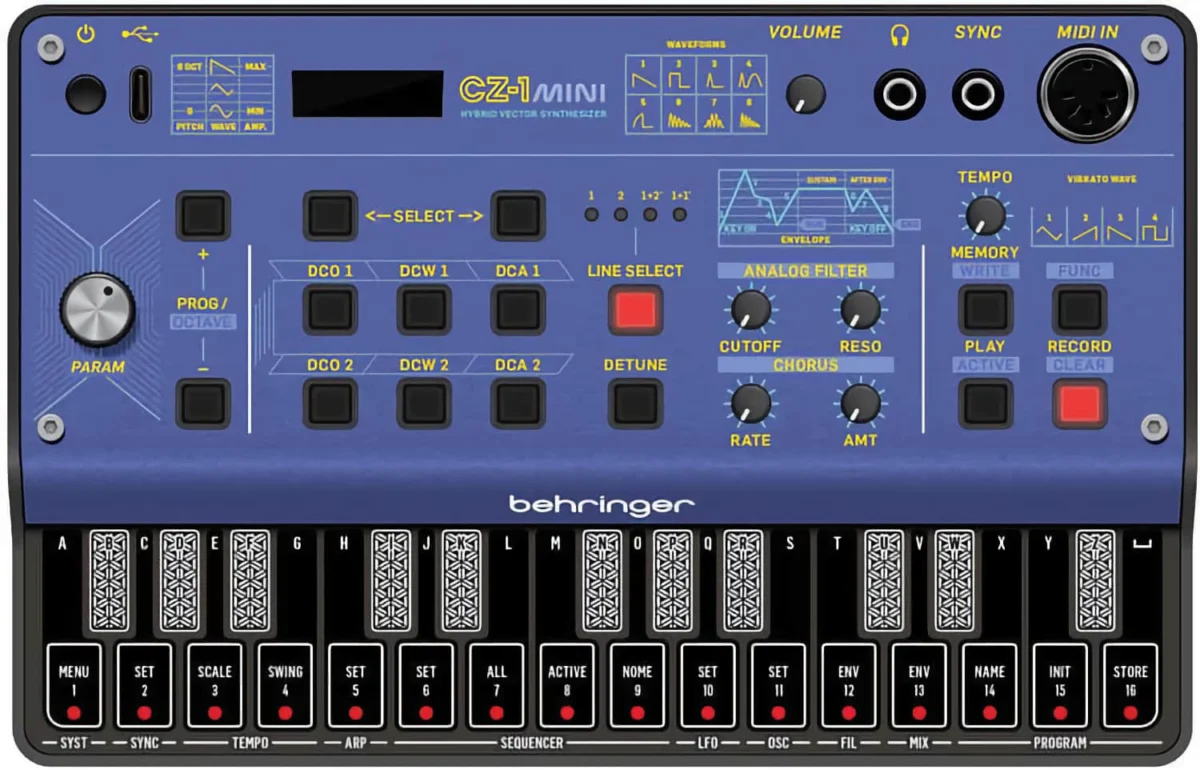
The landscape of digital music production has seen a significant shift toward the integration of hardware and software, a trend further solidified by the recent release of a dedicated online editor for the Behringer CZ-1 synthesizer. Developed by Gary White, the Behringer CZ-1 Editor is a web-based utility designed to provide a more intuitive interface for managing the complexities of Phase Distortion (PD) synthesis. The tool is offered as a free service, aiming to lower the barrier of entry for musicians and sound designers utilizing Behringer’s modern recreation of the classic Casio architecture.
By leveraging modern web technologies, the editor allows users to manipulate the internal parameters of the hardware in real-time through a standard web browser. This development addresses a common challenge in hardware synthesis: the limitation of small physical screens and multi-layered menus. The editor provides a visual representation of the synthesizer’s signal path, making the intricate relationships between oscillators, filters, and amplifiers more transparent to the end user.
Overview of the Behringer CZ-1 Editor Functionality
The primary objective of Gary White’s editor is to demystify the programming process associated with the CZ-1. Phase Distortion synthesis, while powerful, often requires a deep understanding of how non-linear waveforms are generated and modulated. The editor’s user interface (UI) has been specifically engineered to provide visual feedback. Panels within the interface are dynamically highlighted when they become accessible based on the current patch configuration, and the editor utilizes animations to convey how specific parameter changes affect the sound engine.
To assist users of varying skill levels, the developer has integrated a comprehensive "hover-over" help system. By positioning the cursor over any given control, the user is presented with a detailed description of that control’s function. This educational component is intended to serve as both a utility for experienced programmers and a learning tool for those new to the Phase Distortion synthesis method.
Technical Infrastructure and Browser Compatibility
The editor operates via the WebMIDI API, a protocol that allows web applications to enumerate, configure, and interact with MIDI devices connected to a user’s computer or mobile device. This eliminates the need for users to download and install traditional standalone software or drivers, facilitating a "plug-and-play" experience.
However, the reliance on WebMIDI introduces specific compatibility requirements. The developer has confirmed that the editor is fully functional on desktop computers and mobile devices using browsers that support the WebMIDI standard, such as Google Chrome, Microsoft Edge, and Opera. Notably, the editor does not currently support Apple’s Safari browser. This limitation is due to Apple’s ongoing restrictions regarding MIDI support within the Safari environment, a point of contention among developers of web-based music tools. Users on macOS or iOS are advised to utilize compatible third-party browsers to access the service.
The Legacy of Phase Distortion Synthesis
To understand the significance of the Behringer CZ-1 and its new editor, it is necessary to examine the historical context of Phase Distortion synthesis. Developed by Casio in the early 1980s, PD synthesis was designed as a direct competitor to Yamaha’s Frequency Modulation (FM) synthesis, which dominated the market via the DX7.
The original Casio CZ series, culminating in the flagship CZ-1 released in 1986, offered a unique approach to sound generation. Unlike FM synthesis, which relies on modulating the frequency of one operator with another, PD synthesis involves distorting the phase of a sine wave to create more complex waveforms, such as saws, pulses, and resonant squares. This method was prized for its ability to produce "analog-style" sounds with digital precision, without the notoriously steep learning curve associated with FM programming.
The Behringer CZ-1 is a contemporary reimagining of this technology. As a hardware clone, it seeks to replicate the sonic characteristics of the 1986 original while adding modern conveniences. However, the architecture remains complex, featuring eight-stage envelopes for the Digitally Controlled Oscillator (DCO), Digitally Controlled Wave (DCW), and Digitally Controlled Amplifier (DCA). The introduction of Gary White’s editor provides a modern solution to managing these twenty-four envelope stages, which can be cumbersome to program using the hardware’s physical buttons.
Chronology of the Project and Development
The release of the Behringer CZ-1 Editor follows a period of community-driven interest in the resurgence of vintage digital synthesis. As Behringer expanded its catalog to include digital recreations alongside its analog clones, the demand for sophisticated control software grew.
- Announcement of the Behringer CZ-1: Behringer first teased the development of a CZ-series clone as part of its broader initiative to bring classic synthesizers to a new generation at accessible price points.
- Hardware Release: Upon the release of the hardware, users noted the depth of the synthesis engine but also the challenges of "menu-diving" on a small LCD screen.
- Development of the Editor: Gary White identified a gap in the ecosystem for a free, cross-platform tool that did not require a Digital Audio Workstation (DAW) to function.
- Beta Testing and Refinement: Through iterative development, the UI was refined to include the animations and accessibility features present in the current version.
- Public Launch: The editor was officially launched as a free online service, hosted on a dedicated domain to ensure ease of access for the global user base.
Supporting Data: Synthesizer Architecture and Control
The Behringer CZ-1 features a dual-line architecture (Line 1 and Line 2), which allows users to layer two different sounds or detune them for a thicker texture. Each line contains its own set of DCOs, DCWs, and DCAs. The complexity of a single patch can involve over 100 individual parameters.
| Feature | Specification |
|---|---|
| Synthesis Type | Phase Distortion (PD) |
| Oscillator Count | 2 Lines (DCO 1 & DCO 2) |
| Envelopes | 8-Stage Envelopes for Pitch, Filter (DCW), and Amp |
| Waveforms | 8 Basic Waveforms per line |
| Connectivity | MIDI In/Out/Thru, USB MIDI |
| Editor Interface | WebMIDI / HTML5 / CSS3 |
The editor handles the transmission of System Exclusive (SysEx) data, which is the specific MIDI language used to communicate deep parameter changes to hardware. By translating the visual movements of the UI into SysEx strings, the editor ensures that every tweak made in the browser is reflected instantly in the hardware’s audio output.
Implications for the Music Industry and Sound Design
The release of this editor highlights several broader trends within the music technology industry. First, it underscores the increasing importance of the "open" web as a platform for professional-grade audio tools. The move away from proprietary, OS-specific installers toward browser-based solutions reflects a desire for greater interoperability.
Second, the project demonstrates the vital role of independent developers in supporting hardware ecosystems. While hardware manufacturers often focus on the production and distribution of physical units, the community frequently steps in to provide the software infrastructure that enhances the user experience. This symbiotic relationship between manufacturers like Behringer and independent creators like Gary White is a hallmark of the modern synthesizer market.
Furthermore, the educational aspect of the editor—specifically its ability to "shed light on how to program" the unit—serves an important role in preserving synthesis techniques. As vintage digital synthesis methods like Phase Distortion see a revival, tools that explain these concepts visually help ensure that these unique sonic signatures remain a part of the contemporary producer’s palette.
Official Context and Community Response
While Behringer has not officially commissioned the editor, the company has historically encouraged the development of third-party tools that add value to their products. Initial reactions from the synthesizer community have been largely positive, with users citing the "visual envelope editing" as a significant improvement over the hardware’s native interface.
Experts in the field of sound design have noted that the CZ-1’s eight-stage envelopes are among its most powerful features, allowing for sounds that evolve over long periods. However, these are also the most difficult to program without a visual graph. By providing these graphs in a web browser, White’s editor effectively transforms the CZ-1 from a preset-focused machine into a deep sound design workstation for its users.
Conclusion and Future Outlook
The release of the free Behringer CZ-1 online editor by Gary White represents a significant contribution to the community of hardware synthesizer enthusiasts. By providing a sophisticated, visual, and accessible interface for a complex synthesis engine, the tool enhances the utility of the hardware and democratizes the process of professional sound design.
As web standards continue to evolve, it is expected that more developers will follow this model, creating browser-based hubs for hardware control. For owners of the Behringer CZ-1, the editor is available immediately, requiring only a compatible browser and a MIDI connection to begin exploring the full potential of Phase Distortion synthesis. The project stands as a testament to the power of community-driven software development in the modern era of music production.
