

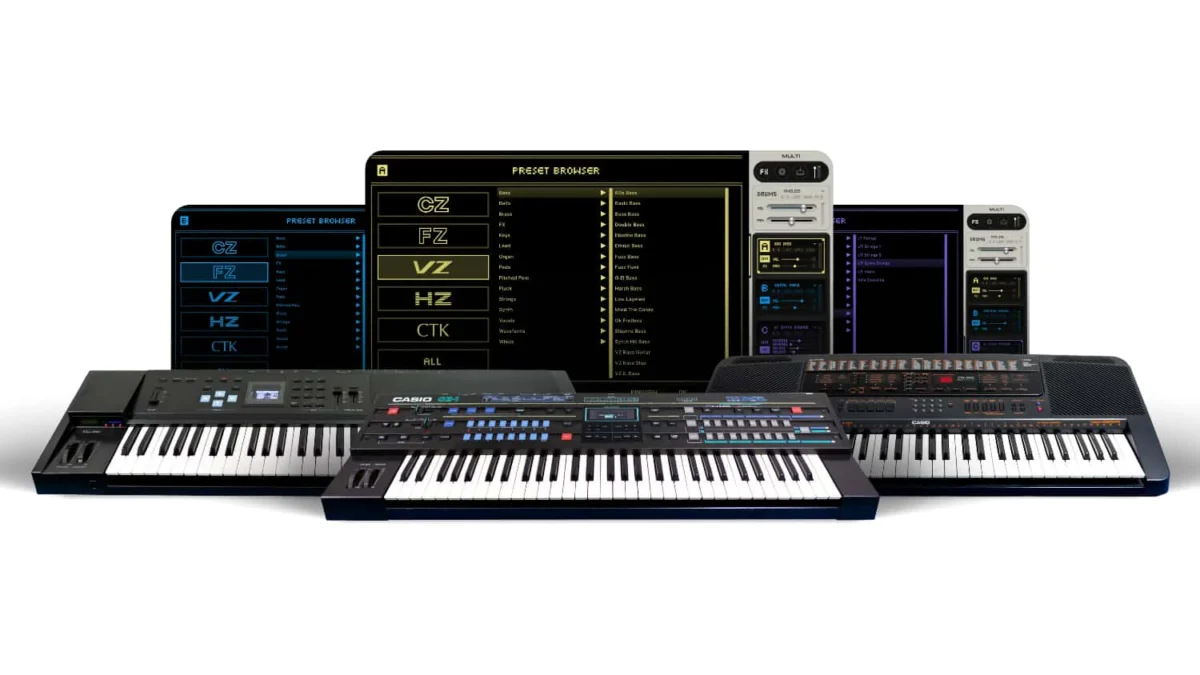
UVI has officially announced the release of Vintage Casio Legacy, a comprehensive virtual instrument suite that meticulously recreates the sonic profiles of six iconic electronic instruments from Casio’s historical catalog. This new collection serves as a digital archive and creative toolkit, offering modern music producers access to the distinct digital synthesis and sampling technologies that defined Casio’s contribution to the music industry during the 1980s and early 1990s. The suite includes six individual instruments—the CZ, FZ, VZ, HZ, CTK, and RZ—alongside a specialized Multi instrument designed to function as a unified performance workstation. By combining high-resolution hardware sampling with contemporary sound-shaping tools, UVI aims to bridge the gap between vintage digital aesthetics and modern production workflows.
The Vintage Casio Legacy collection is currently available for $199 USD and represents one of the most exhaustive efforts to date to preserve the specific timbral characteristics of Casio’s professional and semi-professional hardware lines. The library is massive in scope, featuring over 110,000 individual samples and more than 1,400 handcrafted presets, ensuring that the nuances of the original hardware’s digital-to-analog converters, filters, and unique synthesis methods are captured with high fidelity.
Historical Context: Casio’s Entry into Professional Synthesis
To understand the significance of the Vintage Casio Legacy, one must look back at the landscape of the musical instrument industry in the early 1980s. At the time, the market was dominated by expensive analog synthesizers from companies like Sequential Circuits and Roland, or complex FM (Frequency Modulation) synthesizers from Yamaha. Casio, primarily known for calculators and watches, entered the fray with a mission to democratize synthesis.
In 1984, Casio introduced Phase Distortion (PD) synthesis with the CZ-101. This was a revolutionary approach that provided a digital alternative to FM synthesis, offering similar harmonic complexity but with a much more intuitive programming interface. The CZ series became a massive success, used by legendary artists such as Vince Clarke, Orbital, and Jean-Michel Jarre. UVI’s inclusion of the CZ instrument in this collection pays homage to this era, capturing the "plastic yet punchy" character that defined mid-80s pop and electronic music.
Following the success of the CZ line, Casio expanded into high-end sampling and advanced digital synthesis. The FZ-1, released in 1987, was one of the first affordable 16-bit samplers, featuring a large graphic display and an analog filter—a rarity for digital samplers of that time. By including the FZ, VZ (Interactive Phase Distortion), and the RZ drum machine, UVI provides a chronological cross-section of Casio’s most innovative period.
Technical Specifications and Sound Engine Architecture
The Vintage Casio Legacy is built upon the UVI Engine, a powerful platform known for its efficiency and high-quality audio reproduction. The development process involved an extensive sampling phase where each piece of original hardware was recorded through high-end signal chains to ensure maximum clarity and dynamic range.
The collection is divided into six distinct modules:
The CZ (Phase Distortion)
The CZ module focuses on the Phase Distortion synthesis found in the CZ-1, CZ-101, and CZ-5000. Unlike traditional subtractive synthesis, which uses filters to remove harmonics from a waveform, PD synthesis distorts the phase of a sine wave to create complex timbres. UVI has captured the unique 8-stage envelopes and the specific "warped" digital textures that made the CZ series a staple for bass lines and percussive leads.
The FZ (16-bit Sampling)
The FZ module emulates the FZ-1, FZ-10M, and FZ-20M samplers. The FZ was renowned for its "dark" but high-fidelity sound, owing to its 16-bit resolution combined with an onboard analog low-pass filter. UVI’s recreation allows users to experience the grit and character of late-80s sampling without the technical hurdles of floppy disks and limited memory.
The VZ (iPD Synthesis)
The VZ module represents the VZ-1 and VZ-10M, which utilized Interactive Phase Distortion (iPD). This was Casio’s most complex synthesis engine, featuring eight internal oscillators (modules) that could be routed in various configurations. The resulting sounds were often metallic, glass-like, and evolving. UVI has simplified the interface while maintaining the depth of the original sound engine, providing presets that highlight the VZ’s capability for atmospheric pads and industrial textures.
The HZ (SD Synthesis)
The HZ module is based on the rare HZ-600, which utilized "Spectrum Dynamic" (SD) synthesis. This was a hybrid approach that combined low-bitrate waveforms with basic synthesis controls. It is often cited by collectors for its unique "lo-fi" charm, which has seen a resurgence in modern genres like vaporwave and lo-fi hip-hop.
The CTK (Wavetable and PCM)
The CTK module draws from Casio’s high-end home keyboards and workstations of the early 90s. These instruments utilized PCM (Pulse Code Modulation) and early wavetable synthesis to provide realistic acoustic emulations and lush digital pads. UVI’s inclusion of the CTK highlights the "pro-sumer" era where Casio began integrating more sophisticated sample-based synthesis into their keyboard lines.
The RZ (Digital Drum Machine)
The RZ module focuses on the RZ-1, a digital drum machine that allowed for 0.8 seconds of user sampling—a groundbreaking feature in 1986. The RZ-1 was a foundational tool for early hip-hop and house producers. UVI has captured the raw, 8-bit percussive hits and the specific rhythmic swing of the original hardware.
The Multi Instrument: A Modern Performance Workstation
Beyond the individual emulations, UVI has included a "Multi" instrument. This feature allows users to layer sounds from all six modules into a single interface. This effectively transforms the collection into a massive hybrid workstation, where a Phase Distortion bass can be layered with an iPD pad and an RZ drum kit.
The Multi instrument includes a dedicated mixer, global effects (such as reverb, delay, and modulation), and advanced arpeggiators. This capability addresses a common critique of vintage digital gear: while the sounds are unique, the original hardware was often difficult to integrate into a modern multi-track environment. By unifying these disparate synthesis methods, UVI provides a tool that is more than just a museum piece; it is a functional instrument for contemporary composition.
Industry Implications and Market Analysis
The release of Vintage Casio Legacy comes at a time when the music software market is experiencing a significant "digital revival." While the last two decades were dominated by emulations of 1970s analog synthesizers (like the Minimoog or Prophet-5), there is a growing demand for the specific "cold" and "crystalline" sounds of 1980s digital hardware.
Industry analysts suggest that Casio’s legacy is particularly ripe for rediscovery because many of the original units are now becoming mechanically unreliable. The CZ and VZ series, in particular, often suffer from failing LCD screens and tactile switches. By providing a stable, high-fidelity software alternative, UVI is ensuring that these unique synthesis methods remain accessible to a new generation of musicians.
Furthermore, the price point of $199 positions the Vintage Casio Legacy as a premium "boutique" library. While there are free or lower-cost emulations of individual Casio units available, UVI’s value proposition lies in the sheer volume of samples and the professional-grade UI. The inclusion of 110,000 samples indicates a level of "deep sampling" (recording every note at multiple velocities and settings) that is typically reserved for orchestral libraries.
Official Reactions and Community Impact
While official statements from Casio regarding the UVI partnership have not been widely publicized, the reaction from the synthesizer community has been overwhelmingly positive. Sound designers have noted that Casio’s digital hardware had a "soul" that was often overlooked because of the brand’s association with budget-friendly home keyboards.
"The CZ and VZ series were always the underdogs of the synth world," says one industry commentator. "They had a grit and a specific digital aliasing that sounded nothing like Yamaha’s FM. UVI capturing that specific converter ‘sheen’ is a big deal for producers who want that authentic 80s hardware sound without the eBay headache."
The inclusion of the FZ-1’s analog filter behavior is also a point of praise. In the hardware world, the FZ-1 is often sought after specifically because it allows digital samples to be processed through warm, resonant analog circuitry. UVI’s modeling of this signal path is a critical component of the library’s authenticity.
Conclusion: A Comprehensive Archive for the Modern Studio
UVI Vintage Casio Legacy stands as a definitive collection for anyone seeking the specific textures of the digital revolution. By meticulously sampling six distinct eras of Casio’s hardware history, UVI has created a library that functions as both a historical archive and a versatile production tool.
The suite’s 1,400+ presets provide an immediate entry point for those unfamiliar with Phase Distortion or iPD synthesis, while the 110,000+ samples offer the raw material for deep sound design. As music trends continue to cycle back toward the digital aesthetics of the late 20th century, the Vintage Casio Legacy is positioned to become a staple in the arsenals of electronic producers, film composers, and sound designers alike. The collection is available now via UVI’s website and compatible with all major DAWs through the UVI Workstation or Falcon.
