

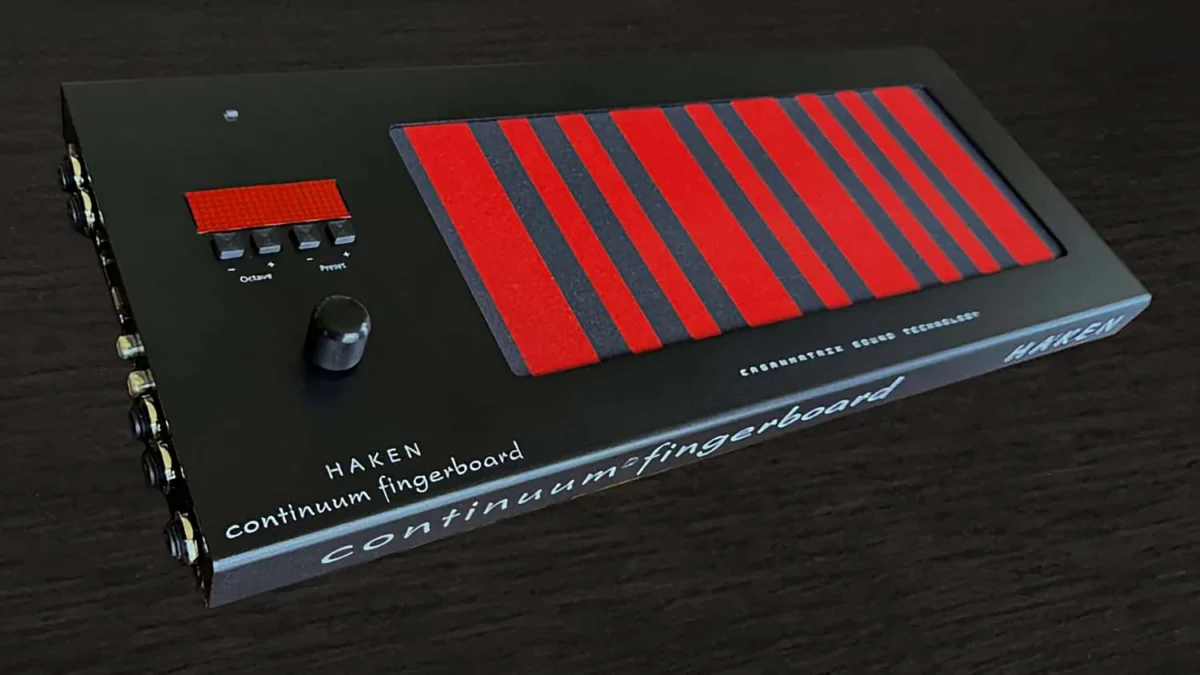
Haken Audio has officially announced the release of the Slim 21, the newest member of the Continuum Fingerboard family, marking a significant milestone in the evolution of expressive electronic musical instruments. This new model integrates the full processing power and sophisticated sound engine of the flagship Continuum series into a more compact, 21-note form factor. Designed to offer the same level of nuance and tactile feedback as its larger predecessors, the Slim 21 is positioned as a portable yet uncompromising solution for professional musicians, sound designers, and composers who require high-level expressivity in a space-efficient design.
The Slim 21 is built upon the EaganMatrix Sound Engine, a proprietary synthesis system developed specifically to leverage the unique multidimensional control surface of the Continuum. Unlike traditional MIDI controllers that rely on discrete on/off triggers and standard velocity curves, the Slim 21 provides a continuous, high-resolution interface that tracks finger movement with what the company describes as microscopic accuracy. This launch reflects Haken Audio’s ongoing commitment to bridging the gap between electronic synthesis and the organic, immediate response of acoustic instruments.
Technical Foundations and Sensor Precision
The core of the Slim 21’s performance capability lies in its advanced sensor array. Each note on the fingerboard is monitored by up to 12 independent Hall-Effect sensors per finger. Hall-Effect technology measures changes in magnetic fields to determine the exact position and pressure of the player’s touch. This method allows the instrument to capture three dimensions of movement simultaneously: X (horizontal pitch shifts and vibrato), Y (vertical position for timbre or modulation), and Z (pressure for volume and articulation).
The data acquisition process is characterized by extreme high-speed sampling. The analog output from each sensor is processed by ultra-high-speed analog-to-digital (A/D) converters. According to Haken Audio, a single note played on the device can generate data from hundreds of thousands of Hall-Effect samples per second. This density of information ensures that the slightest tremor of a finger or the most subtle change in pressure is translated into a corresponding change in the sound, providing a level of sensitivity that far exceeds the standard 128-level resolution of traditional MIDI.
By utilizing this high-fidelity data stream, the Slim 21 avoids the "zipper noise" and stepping artifacts often associated with digital controllers. The result is a seamless transition between notes and a fluid control over dynamics that mimics the behavior of a violin string or a woodwind reed.
The EaganMatrix Sound Engine
While the hardware provides the tactile interface, the EaganMatrix Sound Engine provides the sonic depth. Named after its primary developer, Edmund Eagan, the engine is a modular digital signal processing (DSP) environment inspired by the flexibility of vintage modular synthesizers but optimized for polyphonic expressive control.
The EaganMatrix allows for a variety of synthesis types, including physical modeling, frequency modulation (FM), subtractive synthesis, and waveguide synthesis. What distinguishes it from other synthesis engines is its internal "matrix" architecture, where the X, Y, and Z inputs from the fingerboard are mapped directly to synthesis parameters at the lowest level of the DSP. This deep integration means that the sound is not just "modulated" by the fingerboard; the fingerboard is an intrinsic part of the sound generation process.
The Slim 21 includes the same DSP hardware found in the larger 46-note and 70-note Continuum models. This ensures that users do not sacrifice polyphony or sound quality when choosing the smaller model. The instrument functions as a self-contained synthesizer, capable of being played without an external computer, though it remains fully compatible with external MIDI hardware and software via its comprehensive connectivity options.
Historical Context and Development Chronology
The release of the Slim 21 is the latest chapter in a development history that spans over three decades. Dr. Lippold Haken, a professor at the University of Illinois, began developing the Continuum Fingerboard in the early 1990s. His goal was to create a controller that allowed for the same continuous pitch control as a fretless string instrument while maintaining the polyphonic capabilities of a keyboard.
- Early 1990s: Dr. Haken develops the first prototypes of the Continuum, focusing on the mechanical and sensor requirements for continuous touch.
- 2002: The first commercial Continuum Fingerboards are released. These early "Classic" models were significantly thicker and heavier than current iterations, featuring a robust internal frame to house the complex sensor arrays.
- 2008-2010: Collaboration with Edmund Eagan leads to the integration of the EaganMatrix, transforming the Continuum from a dedicated MIDI controller into a standalone instrument.
- 2019: Haken Audio introduces the "Slim" series. These models utilized modern manufacturing techniques to reduce the physical height and weight of the instrument without compromising the sensor density or the internal DSP power.
- 2024: The introduction of the Slim 21. Recognizing a demand for a more affordable and portable entry point into the Haken ecosystem, the company developed the 21-note version to cater to mobile performers and studio users with limited desk space.
Comparative Market Analysis and Industry Impact
The Slim 21 enters a market that has seen a surge of interest in MIDI Polyphonic Expression (MPE). For years, the Haken Continuum was considered a niche, high-end boutique instrument. However, the rise of other expressive controllers, such as the Roli Seaboard, the LinnStrument, and the Expressive E Osmose (which utilizes the EaganMatrix under license), has popularized the concept of multidimensional touch control.
Within this landscape, the Slim 21 occupies a unique position. While the Roli Seaboard uses a silicone "keywave" surface and the Osmose uses a traditional mechanical keybed with added sensors, the Haken Fingerboard uses a unique fabric-covered surface that provides a distinct tactile resistance and a completely flat, continuous plane. This allows for glissandos and microtonal performances that are physically impossible on traditional keyed instruments.
At a retail price of $1,799 USD, the Slim 21 is the most accessible entry point into the Haken Audio product line. While it remains a premium investment compared to mass-market MIDI controllers, its price point is competitive with high-end professional synthesizers. Industry analysts suggest that the Slim 21 will likely appeal to a broader demographic, including educational institutions and experimental composers who previously found the 46-note and 70-note models cost-prohibitive.
User Experience and Professional Endorsement
The versatility of the Slim 21 has been highlighted by early demonstrations from notable users in the electronic music community. Composer and performer Josh Madoff recently provided an in-depth overview of the instrument, emphasizing its role as a "soloist’s tool." Madoff noted that while the 21-note range is smaller than a standard keyboard, it is more than sufficient for lead lines, bass parts, and expressive melodic work.
The portability of the Slim 21 is a frequently cited advantage. Weighing significantly less than its larger counterparts, it can easily fit into a standard backpack or a small gig bag. This makes it an ideal choice for touring musicians who need to carry their primary expressive instrument as "carry-on" luggage during air travel.
The instrument also features a robust set of inputs and outputs, including 3.5mm MIDI I/O, a digital audio output (AES3), and sustain pedal inputs. It can also interface with Eurorack modular systems via the Haken Audio CVC (Continuum Voltage Converter), which translates the fingerboard’s digital data into control voltages (CV) and gates.
Broader Implications for Music Technology
The launch of the Slim 21 signifies a broader shift in the music technology industry toward "instrumental" synthesis. For much of the 21st century, the focus of digital music has been on software-based production and mouse-and-keyboard sequencing. However, there is a growing movement toward instruments that require physical mastery and offer the "immediacy" of acoustic performance.
By miniaturizing the Continuum technology, Haken Audio is facilitating the integration of expressive synthesis into a wider variety of musical workflows. The Slim 21 is not merely a "controller"; it is a sophisticated electronic instrument that demands practice and offers a high ceiling for virtuosity. As more artists adopt MPE-capable hardware, the Slim 21 stands as a reference point for sensor accuracy and synthesis integration.
In conclusion, the Haken Audio Slim 21 represents a strategic expansion of a legendary product line. By maintaining the technical integrity of the EaganMatrix and the Hall-Effect sensor array while reducing the physical footprint and price, Haken Audio has made one of the world’s most expressive electronic instruments accessible to a new generation of performers. The Slim 21 is currently available for purchase through Haken Audio’s official website and authorized specialty retailers, priced at $1,799 USD. This release is expected to further solidify the EaganMatrix as a standard-bearer for expressive synthesis and ensure the Haken Continuum remains at the forefront of musical innovation.
