

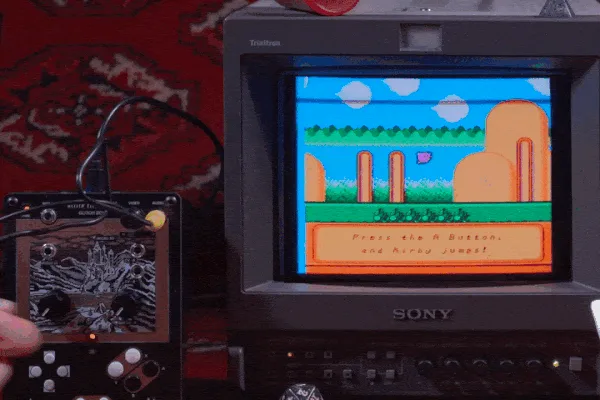
Melted Electronics has officially announced the launch of its latest hardware project, Glitch Boy, an innovative audiovisual instrument designed to bridge the gap between retro gaming aesthetics and modern modular synthesis. The device, which the developer describes as a "hacked retro console," has been introduced via a Kickstarter crowdfunding campaign, offering both a standalone desktop unit and a Eurorack-compatible module. This dual-format approach targets a wide demographic of creators, including glitch artists, chiptune musicians, and experimental videographers who seek to manipulate 8-bit digital environments in real-time. By leveraging the architecture of classic 8-bit hardware, Glitch Boy allows users to load Nintendo Entertainment System (NES) compatible ROMs via a microSD card, subsequently providing a suite of physical and digital controls to intentionally disrupt the data stream, resulting in unique visual artifacts and sonic textures.
The core functionality of Glitch Boy centers on its ability to function as both a visual processor and a four-voice chiptune synthesizer. Unlike traditional emulators that strive for accuracy, Glitch Boy is engineered for instability, encouraging "circuit-bending" style experimentation through a stable and controllable interface. The instrument features hands-on controls for real-time glitching, MIDI connectivity for external sequencing, and audio reactivity, allowing the visual output to respond dynamically to incoming sound signals. For modular synthesizer enthusiasts, the Eurorack version includes Control Voltage (CV) inputs, integrating the 8-bit aesthetic into the complex modulation ecosystems of modern hardware setups.
Technical Specifications and Hardware Architecture
At the heart of Glitch Boy is a processing engine capable of handling NES-compatible software, yet its primary purpose is the artistic deconstruction of that software. The hardware is equipped with a microSD card slot, which serves as the primary gateway for loading ROM files. Once a file is active, the user can utilize the onboard tactile interface—consisting of knobs and buttons—to interfere with the memory and graphics processing of the virtual console.
The visual output is delivered via a composite video connection, a choice that emphasizes the "lo-fi" and analog-adjacent nature of the instrument. While modern displays can utilize this signal through adapters, the use of composite video ensures compatibility with vintage Cathode Ray Tube (CRT) monitors, which are often favored by glitch artists for their unique phosphor bloom and lack of digital processing latency.
As a musical instrument, Glitch Boy operates as a four-voice chiptune synthesizer. This synthesis engine is modeled after the Programmable Sound Generators (PSG) found in early 1980s gaming hardware. It produces the characteristic square, triangle, and noise waves that defined the sound of the 8-bit era. The integration of MIDI support allows the device to be played like a standard synthesizer module, receiving note data, clock sync, and parameter changes from external hardware or Digital Audio Workstations (DAWs).
The Evolution of Glitch Art and Video Synthesis
The release of Glitch Boy arrives at a time of renewed interest in analog video synthesis and the "New Aesthetic," a movement that finds beauty in digital errors and machine-generated artifacts. Historically, glitch art required the physical modification of hardware—a process known as circuit bending—which often involved opening devices and soldering new connections to create short circuits. While effective, this method is inherently destructive and unpredictable.
Glitch Boy represents a shift toward "curated instability." By providing a dedicated platform for these effects, Melted Electronics offers artists a way to achieve the glitch aesthetic without the risk of destroying rare vintage hardware. The history of video synthesis dates back to the late 1960s and 1970s with pioneers like Nam June Paik and the development of the Sandin Image Processor. However, those early systems were massive and prohibitively expensive. The democratization of these tools through compact, affordable modules like Glitch Boy indicates a significant shift in the accessibility of multimedia performance tools.
The chiptune aspect of the device also taps into a deep-rooted subculture of electronic music. Since the early 2000s, artists have used modified Game Boys and NES consoles to compose complex musical works. Glitch Boy expands this workflow by making the "glitch" a performative element, where the destruction of the visual environment is inextricably linked to the generation of the sound.
Integration with Modern Workflows: MIDI and Eurorack
A key selling point for Glitch Boy is its versatility across different studio environments. The standalone desktop version is housed in a compact enclosure, making it suitable for live performers who require a portable, "plug-and-play" solution. In contrast, the Eurorack version is designed to fit into the standard 3U rack format used by modular synthesists.
The Eurorack implementation is particularly significant because it allows for "generative glitching." By connecting LFOs (Low-Frequency Oscillators), envelopes, or sequencers to the Glitch Boy’s CV inputs, users can automate the corruption of the video signal and the parameters of the synth engine. This allows for the creation of evolving, non-repeating visual and sonic patterns that would be difficult to achieve through manual manipulation alone.

The audio-reactive features further enhance its utility in a live setting. By feeding an external audio signal into the device, the visuals can be made to pulse, flicker, or distort in synchronization with a beat. This creates a cohesive audiovisual experience where the music literally shapes the environment the audience sees.
Production Timeline and Crowdfunding Strategy
Melted Electronics has opted for a Kickstarter campaign to fund the initial production run of Glitch Boy. The project has set a base price of approximately €150 (roughly $180 USD) for project backers. This pricing strategy positions Glitch Boy as an entry-level professional tool, significantly more affordable than many high-end video synthesis modules which can often cost upwards of $500 to $1,000.
The development timeline, as outlined by Melted Electronics, suggests a streamlined transition from the prototype phase to final assembly. Crowdfunding has become a standard vehicle for boutique hardware manufacturers to gauge market interest and secure the capital necessary for component bulk-buying. However, the company has included the standard industry caveat that crowdfunded projects involve inherent risks, including potential supply chain delays or manufacturing hurdles.
The campaign aims to finalize the hardware design and move into the manufacturing phase shortly after the funding window closes. If successful, the units are expected to ship to backers globally, with the developer providing regular updates on the progress of the assembly and software refinement.
Market Analysis and Industry Impact
The introduction of Glitch Boy highlights several growing trends in the music technology industry. First is the "hybridization" of instruments—devices that are no longer strictly for audio or strictly for video, but rather treat both as a singular, malleable medium. Second is the continued dominance of the Eurorack format, which has become the R&D lab for the music tech world, allowing small companies to release niche products that find a dedicated audience.
Industry analysts suggest that the "retro-tech" market is expanding beyond simple nostalgia. Modern creators are looking for "tactile" experiences that break away from the "in-the-box" software environment of modern computers. The physical feedback of turning a knob to "break" a digital image provides a level of performative engagement that a mouse click cannot replicate.
Furthermore, the affordability of Glitch Boy may disrupt the current video synthesis market. By utilizing 8-bit emulation and digital glitching rather than complex analog circuitry, Melted Electronics can offer a high level of visual complexity at a fraction of the cost of traditional analog video synths. This could lead to a surge in glitch-based visuals in independent music videos and live club performances.
Safety, Compliance, and Project Risks
As with all electronic hardware, Melted Electronics is expected to adhere to international standards for safety and electromagnetic interference, such as CE and FCC certifications, particularly for the desktop version. For the Eurorack module, power consumption and protection against reverse polarity are critical technical considerations that the developers must address to ensure compatibility with various modular power supplies.
Regarding the crowdfunding aspect, potential backers are encouraged to review the project’s "Risks and Challenges" section. While Melted Electronics has demonstrated a working prototype in promotional materials, the transition to mass production can be fraught with difficulties, ranging from chip shortages to shipping logistics. The transparency of the developer during the campaign will be a key factor in maintaining backer confidence.
Conclusion and Future Outlook
Glitch Boy represents a unique intersection of gaming history, experimental art, and electronic music. By repurposing the architecture of the 8-bit era for modern creative applications, Melted Electronics has created a tool that is both a tribute to the past and a functional instrument for the future. Whether used as a standalone synth for chiptune composition or as a visual centerpiece in a modular rack, Glitch Boy offers a distinct aesthetic that celebrates the beauty of the broken and the unexpected. As the Kickstarter campaign progresses, the industry will be watching closely to see how this "hacked console" influences the next wave of audiovisual performance.
