

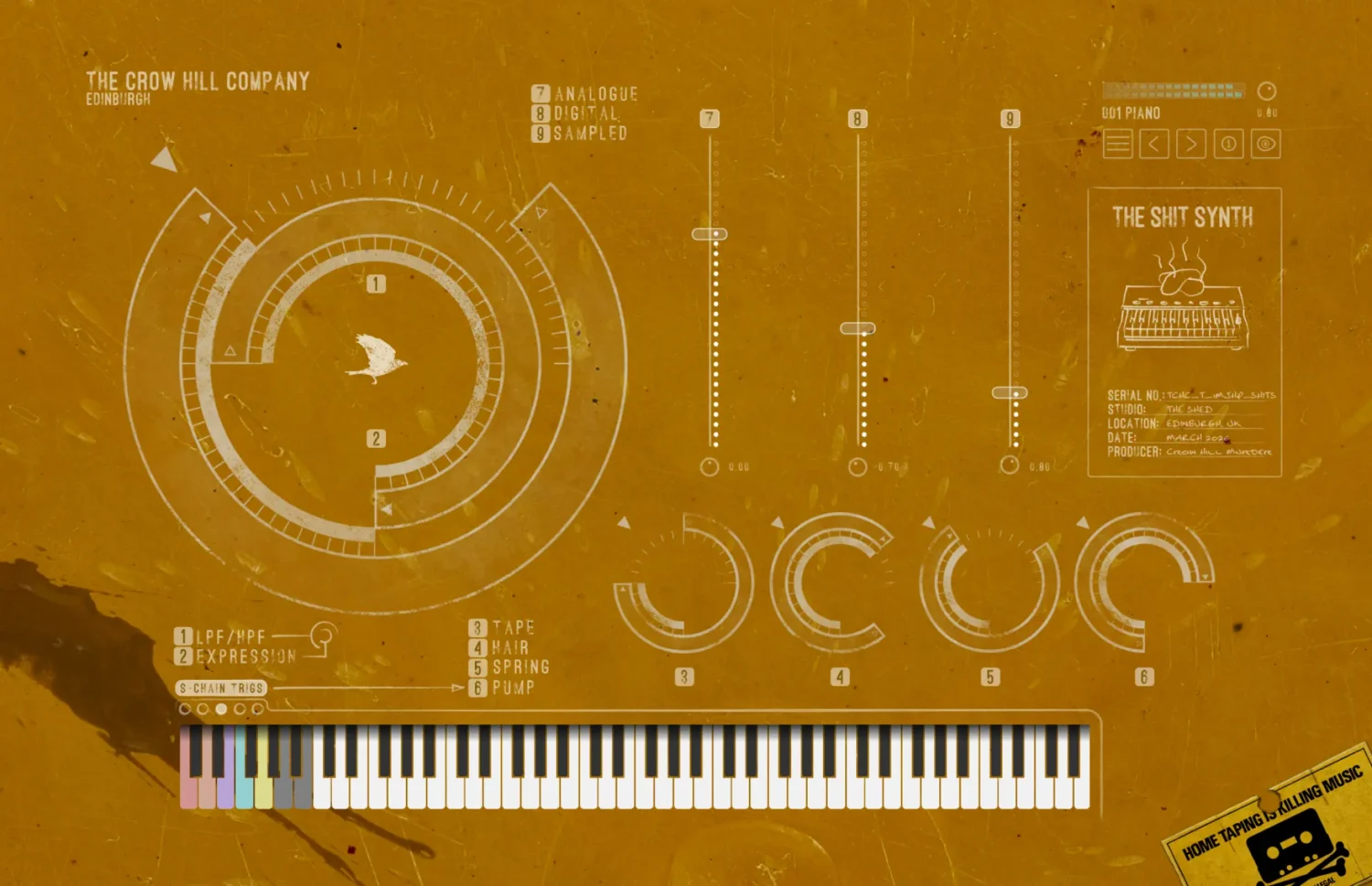
The Crow Hill Company, a developer known for its specialized approach to virtual instruments and boutique audio tools, has officially announced the release of The Shit Synth. Marketed as a curated collection of 48 individual instruments derived from circuit-bent, wave-bent, and sample-bent sources, the plugin represents a deliberate departure from the high-fidelity, pristine sonic standards that have dominated the digital audio workstation (DAW) landscape for the past two decades. By focusing on the aesthetic of "knackered" or malfunctioning hardware, the developer aims to provide composers and producers with a toolkit designed for character-heavy, lo-fi, and experimental music production.
Priced at $39 USD, the instrument enters a competitive market for virtual studio technology (VST) but distinguishes itself through its specific philosophical stance on sound design. Rather than utilizing digital signal processing (DSP) to degrade clean signals—a common practice in modern "lo-fi" plugins—The Shit Synth utilizes raw recordings of hardware that is inherently unstable, broken, or modified. This "source-first" approach ensures that the fundamental waveforms provided to the user carry the organic inconsistencies of physical electronic failure.
The Philosophy of Sonic Imperfection
The conceptual framework of The Shit Synth is rooted in the historical use of malfunctioning or low-quality equipment in professional music production. The Crow Hill Company cites a lineage of influential artists who have leveraged "broken" sounds to define their aesthetic identities. This includes the glitch-heavy electronica of Aphex Twin, the industrial textures of Throbbing Gristle, the nostalgic tape-saturated melodies of Boards of Canada, and the experimental art-rock transitions of Radiohead’s middle period.
In contemporary music production, there is a growing movement toward "imperfectionism." As digital tools have become more capable of producing mathematically perfect audio, many creators have found the results to be sterile or lacking in emotional resonance. The Shit Synth addresses this by providing "wonky" sounds—audio that suffers from pitch instability, harmonic distortion, and unpredictable frequency responses. This aligns with the "Wabi-sabi" philosophy in art, where beauty is found in the imperfect and the transient.
Technical Specifications and the 48-Instrument Architecture
At the heart of the plugin is a library of 48 distinct sound sources. These are categorized into three primary methodologies of sound degradation:
- Circuit-Bending: This involves the creative short-circuiting of low-voltage, battery-powered electronic devices, such as toys, small synthesizers, and digital sequencers. By bridging connections on a circuit board that were never intended to meet, the hardware produces erratic, often chaotic sounds. The Shit Synth captures these "happy accidents" in a playable format.
- Wave-Bending: This refers to the manipulation of digital or analog waveforms through extreme folding, clipping, or unconventional modulation. It results in aggressive timbres that often defy standard synthesis classifications.
- Sample-Bending: Utilizing old samplers with limited bit-depths or failing memory chips, this method highlights the artifacts of early digital audio, including aliasing, jitter, and quantization errors.
The user interface is designed to be streamlined, following The Crow Hill Company’s established "Gestures" design language. This allows users to manipulate complex internal parameters through a limited set of intuitive controls, focusing on the "vibe" of the sound rather than technical minutiae.
Contextualizing The Crow Hill Company
To understand the release of The Shit Synth, it is necessary to examine the background of its creators. The Crow Hill Company was founded by Christian Henson, a prominent film composer and the co-founder of Spitfire Audio. Henson’s departure from Spitfire Audio marked a shift in his creative output toward more experimental and personal projects. The Crow Hill Company has since carved out a niche for itself by releasing instruments that prioritize "human" qualities—breath, mechanical noise, and environmental textures—over the standard orchestral "perfection" found in traditional sample libraries.
The Shit Synth is the latest entry in a catalog that includes "The Vault," a series of free and low-cost "beta" instruments, and "String Murmurations." The company’s marketing strategy often emphasizes a rejection of the "AI-slop" or generative music trends, focusing instead on the tactile, physical origins of sound. The Shit Synth’s tagline as "AI-slop-free" serves as a meta-commentary on the current state of the industry, positioning the plugin as a tool for "human-centric" creative rebellion.
Chronology of Development and Market Release
The development of The Shit Synth follows a timeline of increasing interest in boutique, character-driven software. Over the last five years, the "lo-fi hip-hop" and "synthwave" genres have created a massive demand for tools that emulate the limitations of 1980s and 1990s hardware. While many developers responded with "bit-crushers" or "tape saturators," a smaller segment of the market began demanding actual sampled hardware.
- Initial Research (2023): The team at Crow Hill began sourcing various pieces of "shit gear"—damaged keyboards, forgotten children’s toys, and failing analog units.
- Recording and Curation (Early 2024): The 48 instruments were selected from hundreds of potential candidates based on their "playability" and unique harmonic profiles.
- Beta Testing (Mid 2024): Selected composers were given access to the tool to ensure the interface met the company’s standards for speed and inspiration.
- Official Launch (Late 2024): The instrument was released globally on the company’s web platform, accompanied by a walkthrough video demonstrating the "unusable" nature of the sounds becoming usable in a musical context.
Supporting Data: The Rise of the Boutique VST Market
The release of a $39 specialized synth highlights a significant trend in the music software industry. According to market analysis of the VST sector, there has been a 15% year-over-year increase in the consumption of "boutique" or "niche" plugins compared to "all-in-one" workstations. Users are increasingly looking for "signature" sounds that help them stand out in a saturated streaming market.
Furthermore, the "Lo-fi" aesthetic has moved beyond a sub-genre into a standard production technique. On platforms like Spotify, playlists featuring lo-fi or "study beats" garner millions of listeners monthly. This creates a secondary market for software developers who can provide the authentic "grit" required for these productions. The Shit Synth targets this demographic directly, offering a more curated and "authentic" alternative to standard synth presets.
Industry Implications and Impact
The introduction of The Shit Synth carries several implications for the future of music production:
The Counter-AI Movement
As generative AI becomes capable of creating polished, "perfect" musical compositions, human artists are increasingly turning to tools that produce sounds AI struggles to replicate convincingly: the unpredictable, the broken, and the physically grounded. By leaning into "shit" sounds, The Crow Hill Company provides a palette that feels inherently human and un-simulated.
Democratization of Boutique Sound
Historically, obtaining the sounds of circuit-bent gear required either the technical skill to modify hardware oneself or the financial means to purchase rare, modified units on the secondary market. At $39, The Shit Synth democratizes access to these textures, allowing bedroom producers to utilize sounds that were previously the domain of experimental studios.
Redefining Quality in Audio
The name of the product itself is a provocative challenge to traditional definitions of "quality." In the early 2000s, the goal of audio software was to eliminate noise and maximize clarity. In 2024, the goal has shifted for many toward reintroducing noise as a creative element. This reflects a broader cultural shift where "analog warmth" and "vintage character" are valued over digital precision.
Official Responses and User Reception
While formal reviews are still emerging, early feedback from the producer community has centered on the plugin’s utility in film scoring and "left-field" pop. Users have noted that the 48 instruments provide a "foundation of grit" that can be layered with cleaner synths to add depth and "history" to a track.
The Crow Hill Company has addressed the provocative name of the instrument in their promotional materials, stating that it is a tribute to the "underdogs" of the gear world. They argue that a "shit" instrument in the right hands is often more valuable than a "perfect" one in the wrong hands. This sentiment has resonated with a user base that often feels overwhelmed by the complexity of modern "super-synths" that come with thousands of presets.
Final Summary of Availability
The Shit Synth is currently available for purchase and download via The Crow Hill Company’s official website. It is compatible with major DAWs including Ableton Live, Logic Pro, Cubase, and FL Studio, supporting VST, VST3, AU, and AAX formats on both macOS and Windows. The $39 price point is positioned to make the tool an "impulse buy" for professional composers and an accessible entry point for students and hobbyists.
As the music industry continues to grapple with the balance between technological advancement and creative soul, instruments like The Shit Synth serve as a reminder that the most compelling art often comes from the cracks in the system—the broken circuits, the warped tapes, and the beautifully "knackered" sounds of the past.
