

The global broadcast and professional audiovisual industries are entering a new era of infrastructure flexibility with the introduction of Edge One, a compact and highly adaptable connectivity solution developed by Lawo. Designed to bridge the gap between traditional hardware constraints and the demands of modern, software-defined production environments, Edge One represents a significant shift in how signals are managed at the "edge" of the network. By integrating high-density audio and video I/O into a singular, extensible platform, Lawo aims to provide technicians and engineers with a tool that maximizes functionality while minimizing the physical footprint of hardware in the field and the data center.
A Comprehensive Approach to Modern Signal Management
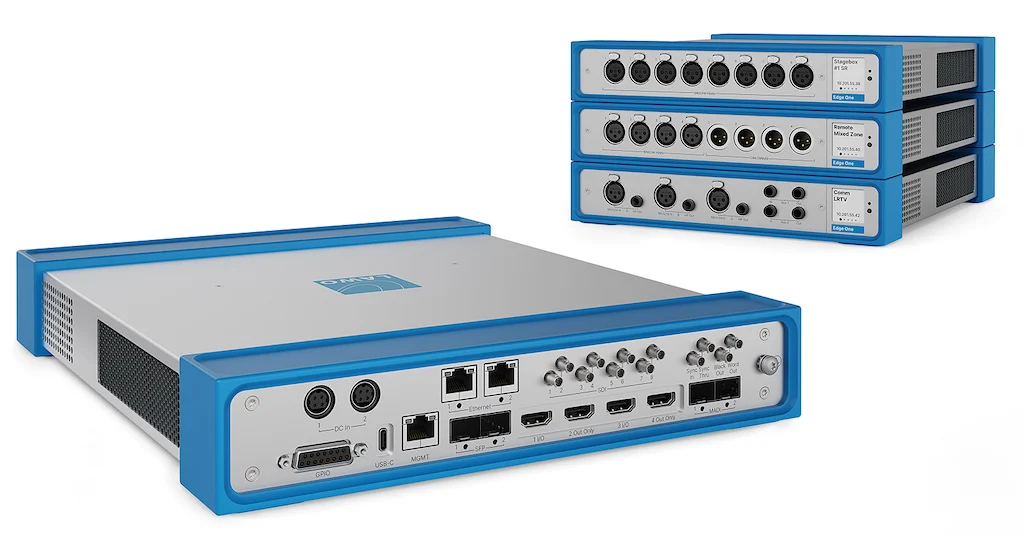
At its core, Edge One is engineered to handle the complexities of contemporary broadcast workflows, where the lines between audio, video, and data frequently blur. The device is housed in a compact 1RU chassis, making it suitable for both permanent rack installations and mobile production units where space is at a premium. The physical architecture of the unit is divided to accommodate diverse signal types simultaneously. One side of the device is dedicated to high-performance video and synchronization, featuring eight bidirectional HD-BNC ports. These ports offer unprecedented flexibility, as each can be independently configured as either an input or an output for SDI signals.
Complementing the SDI capabilities are four HDMI ports. In a move that highlights the device’s versatility for both broadcast and Pro-AV applications—such as corporate events or digital signage—two of these HDMI ports are designated as outputs, while the remaining two can function as either inputs or outputs. This configuration allows Edge One to serve as a bridge between professional broadcast cameras and consumer-grade monitoring or presentation equipment.
The connectivity suite is further rounded out by SFP ports for MADI (Multichannel Audio Digital Interface) I/O, General Purpose Input/Output (GPI/O) terminals, and a specialized audio interface via USB-C. For timing and synchronization, which remain critical in synchronized IP and baseband environments, the unit includes dedicated ports for Sync, Reference, and Wordclock.
Modular Audio Interfacing and the Commentary Evolution
Recognizing that audio requirements vary wildly between a live sporting event and a studio talk show, Lawo has implemented a modular approach to the audio section of Edge One. On the opposite side of the video interface, the device features slots for three distinct audio interface modules. These modules are designed to be easily swappable, allowing users to reconfigure the hardware based on the specific needs of a production.
The available modules include a high-density Mic/Line input card, a balanced Mic/Line input and Line output card, and a specialized module tailored for commentary applications. The commentary module is particularly significant for remote production (REMI) setups, as it provides the necessary preamps and monitoring paths required for on-site announcers while maintaining a direct link to the central production hub via IP. This modularity ensures that the hardware does not become obsolete as production requirements change, providing a sustainable return on investment for media organizations.
The Lawo FLEX Model: Software-Defined Functionality
One of the most innovative aspects of Edge One is its alignment with the Lawo FLEX licensing system. In an industry moving away from fixed-function hardware, Edge One allows users to pay only for the features they currently require. The device is offered in three base packages: Audio, Video, and a combined Audio + Video bundle. Beyond these initial configurations, a wide array of advanced features can be unlocked via software licenses.
This "as-needed" model covers several high-value functions. For video, users can license additional signal instances, frame synchronizers for aligning asynchronous feeds, and JPEG XS encoding and decoding. JPEG XS has become a cornerstone of modern high-quality, low-latency transmission, allowing for visually lossless video compression that is essential for transporting 4K and UHD signals over managed networks.
On the audio side, licensing options include MADI I/O with integrated Sample Rate Conversion (SRC) and the integration of mc² audio DSP. The latter is a particularly powerful addition, as it enables low-latency local mixing directly within the Edge One unit, effectively turning the stagebox into a decentralized processing node. This capability reduces the burden on central mixing engines and minimizes round-trip latency for local monitoring feeds.
Technical Foundations and SMPTE ST 2110 Integration
As the broadcast industry continues its transition toward All-IP infrastructures, Edge One has been built as a native SMPTE ST 2110 device. It supports high-bandwidth networking of up to 25 Gbit/s, providing ample headroom for uncompressed HD and compressed UHD workflows. The networking interface includes both traditional RJ45 ports with PoE++ (Power over Ethernet) support and high-speed SFP ports for fiber optic connectivity.
The inclusion of PoE++ is a strategic design choice, allowing the device to be powered through the same cable used for data in smaller setups, thereby simplifying cabling and reducing the need for localized power sources in difficult-to-reach areas of a venue. For environments that are not yet ready for a full IP transition, or for "island" setups operating without a network backbone, Edge One maintains a robust feature set that matches or exceeds Lawo’s established standalone solutions for audio de-embedding, shuffling, and embedding.
Industry Perspectives: Purpose-Built Agility
The leadership at Lawo emphasizes that Edge One is not merely a collection of ports, but a strategic response to the evolving nature of live production. Lucas Zwicker, Senior Director of Workflow and Integration at Lawo’s CTO Office, noted that the device is defined by its "purposefulness and agility." According to Zwicker, the goal was to create a single stagebox capable of acting as the central nervous system for a localized production area, connecting everything from microphones and speakers to cameras and projectors.
Christian Struck, Senior Product Manager for Audio Infrastructure at Lawo, expanded on this by highlighting the efficiency of decentralized architectures. Struck observed that most modern productions do not require massive, centralized I/O blocks but rather a manageable number of connections placed as close to the source or destination as possible. By placing Edge One units at various "edges" of a stadium or studio, engineers can reduce cable runs and improve signal integrity while maintaining full control through Lawo’s HOME management platform.

Chronology and Global Debut
The unveiling of Edge One is part of a broader roadmap for Lawo as it prepares for the mid-2020s broadcast cycle. The official public debut of the hardware is scheduled for the NAB Show 2026, held from April 19 to 22 at the Las Vegas Convention Center. Lawo will be showcasing the unit at Stand C2108, where it will be integrated into a larger ecosystem featuring the company’s latest mixing consoles and IP routing solutions.
Following its North American debut, Edge One will be featured at LEaT con 2026 in Hamburg, Germany, from October 6 to 8. These appearances are expected to draw significant interest from OB (Outside Broadcast) van operators and system integrators who are currently looking for migration paths that support both legacy SDI and modern IP standards.
Market Implications and Analysis
The introduction of Edge One is likely to have a ripple effect across several sectors of the media industry. For the Outside Broadcast market, the reduction in hardware weight and power consumption is a critical factor. As production companies face increasing pressure to reduce their carbon footprint and logistics costs, the ability to replace multiple specialized converters and interfaces with a few multi-purpose Edge One units is a compelling proposition.
In the Pro-AV sector, the inclusion of HDMI and USB-C audio connectivity positions Lawo to compete in high-end corporate and educational environments. These sectors are increasingly adopting broadcast-grade standards like ST 2110 to manage large-scale campus networks. Edge One provides these users with a professional-grade gateway that is more robust than typical AV-over-IP solutions while remaining accessible through its modular licensing.
Furthermore, the "software-defined" nature of the device reflects a broader trend in technology where hardware serves as a generic host for specialized applications. This approach allows Lawo to push firmware updates that could potentially add entirely new protocols or processing capabilities to Edge One long after the physical unit has been installed. This future-proofing is essential in an era where technical standards for HDR, 8K, and immersive audio continue to evolve rapidly.
Conclusion: The Future of the "Edge"
As media production becomes increasingly distributed and virtualized, the physical hardware that remains on-site must become more intelligent and flexible. Lawo’s Edge One appears to meet this challenge by offering a hybrid solution that respects the legacy of SDI while fully embracing the possibilities of 25G IP networking. By combining modular physical I/O with a flexible software licensing model, Lawo is providing a blueprint for the next generation of broadcast infrastructure—one where the "edge" of the network is no longer a limitation, but a source of creative and operational strength. The industry will be watching closely as the first units are deployed following the NAB Show, marking a significant milestone in the journey toward fully agile, software-defined media environments.
