

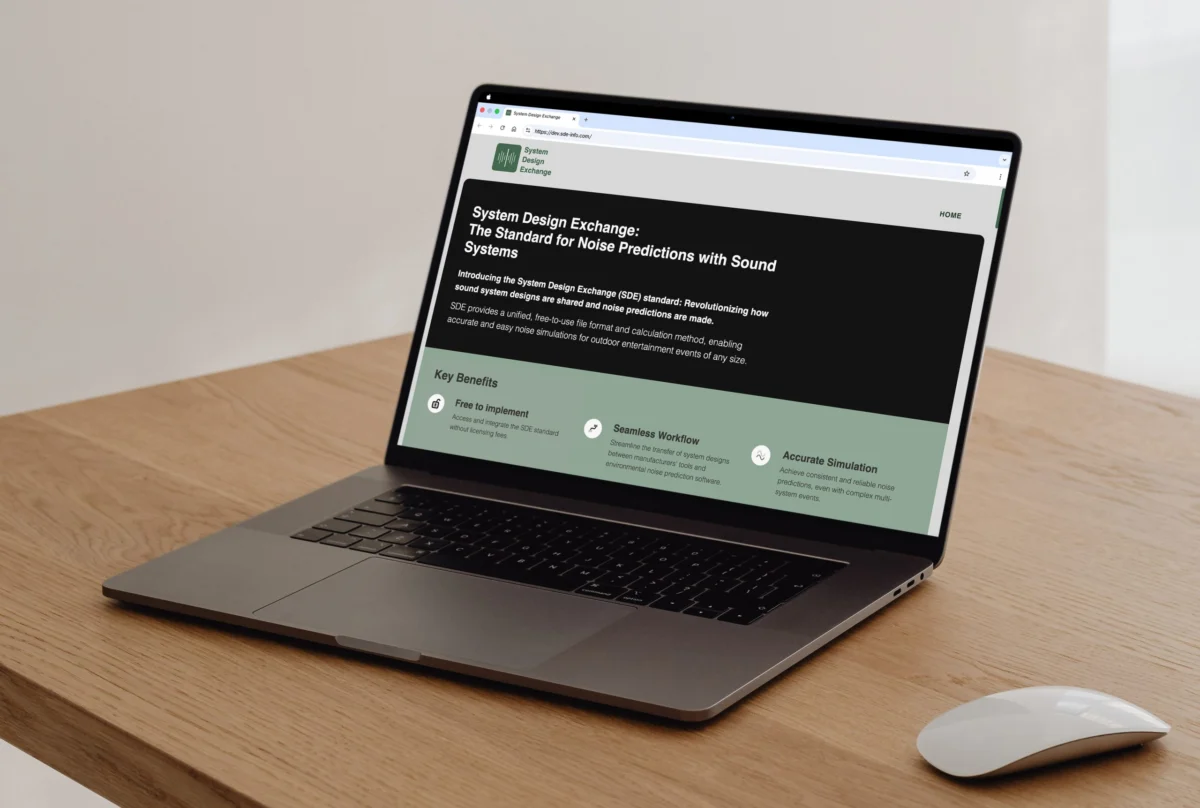
The global live entertainment industry has reached a pivotal juncture where the demand for high-fidelity, high-SPL (Sound Pressure Level) outdoor performances frequently clashes with the increasingly stringent noise pollution regulations of modern urban environments. In a landmark collaboration that bridges the gap between sound reinforcement manufacturers and environmental acoustics experts, L-Acoustics and d&b audiotechnik have partnered with SoundPLAN to introduce the SDE (Sound Design Exchange) standard. This new protocol serves as a neutral, unified format for noise prediction, designed to provide a reliable and consistent methodology for calculating the environmental impact of various sound reinforcement systems. By standardizing the way acoustic data is exported and analyzed, the SDE standard addresses a long-standing challenge in the professional audio sector: the lack of interoperability between proprietary system design tools and independent environmental noise calculation software.
The Evolution of Noise Management in the Live Event Sector
The necessity for a standard like SDE is rooted in the shifting landscape of global tourism and urban development. Over the past two decades, large-scale music festivals and open-air concerts have migrated from remote rural locations into the heart of metropolitan centers. While this move has increased accessibility and economic revenue for cities, it has also led to a surge in noise complaints and legal challenges from local residents. Historically, the burden of proof for noise compliance fell upon event organizers and acoustic consultants, who often struggled with disparate data sets.
Until the introduction of SDE, system technicians relied on manufacturer-specific software—such as d&b audiotechnik’s ArrayCalc or L-Acoustics’ Soundvision—to design their sound systems. While these tools are highly accurate for predicting sound distribution within a defined audience area, they were not originally designed to account for the complex atmospheric variables, topographical reflections, and long-distance propagation required for environmental noise impact studies. Conversely, environmental noise software like SoundPLAN excelled at calculating how sound travels over kilometers and through city streets but lacked the granular data regarding the specific radiation patterns and phase relationships of modern line array systems.
This "data silo" effect meant that noise predictions were often inconsistent. A prediction made using one manufacturer’s export might yield different results than another, leading to friction between event producers and municipal authorities. The SDE standard effectively breaks down these silos by creating a common language that both the audio engineer and the environmental consultant can speak.
Technical Architecture and Methodology of SDE
At its core, the SDE standard defines a rigorous methodology for the exchange of complex acoustic data. It is not merely a file format but a comprehensive set of rules for how sound sources are represented in a digital environment. One of the most significant technical hurdles in environmental noise prediction is the transition from "near-field" to "far-field" acoustics. In the near-field (the audience area), the interaction between individual speakers in an array is highly coherent, meaning their sound waves add together in a specific, phase-aligned way. As sound travels into the far-field (the surrounding neighborhood), atmospheric turbulence and distance cause a degree of "decoherence."

The SDE standard introduces specific calibration and decoherence factors that allow environmental software to account for these physical realities. By including phase information and complex acoustic summation, SDE ensures that the "complex interactions" between multiple sound sources are calculated with a level of precision previously thought impossible for large-scale outdoor deployments. This includes the ability to accurately predict how low-frequency energy—often the primary source of residential noise complaints—will sum and propagate across a landscape.
The workflow facilitated by SDE is streamlined for maximum efficiency and security. System designers can now export their finalized configurations from ArrayCalc or Soundvision as a standardized .sde file. This file contains all the necessary architectural and acoustic data required by environmental consultants. When imported into SoundPLAN, the software can immediately begin calculating the noise footprint across a 3D map of the surrounding area, taking into account terrain, buildings, and prevailing weather conditions. This speed is crucial for festivals with multiple stages, where the interaction between different sound systems must be managed in real-time to stay within legal limits.
A Rare Convergence of Industry Leaders
The collaboration between L-Acoustics and d&b audiotechnik is particularly noteworthy given their positions as the two most prominent competitors in the professional loudspeaker market. Their decision to join forces with SoundPLAN, a leader in environmental noise software, signals a shift in the industry toward collective responsibility. By prioritizing a "neutral" standard, these companies are acknowledging that the long-term sustainability of the live event industry depends on being a "good neighbor" to urban communities.
Florian Hahn, Product Manager for Application Software at d&b audiotechnik, emphasized the social dimensions of this technical achievement. He noted that the SDE standard is a major step forward in ensuring that audiences can enjoy the high-energy experience of live music without infringing upon the peace of residents or the integrity of natural habitats. This sentiment was echoed by Yann Gaël Gicquel, Head of Product Management for Spatial Systems at L-Acoustics, who described the modern festival as a "balancing act." Gicquel pointed out that SDE provides a "reliable source of truth" that can be used to mediate discussions between organizers, consultants, and local authorities, replacing guesswork with data-driven certainty.
Jochen Schaal, Managing Director at SoundPLAN, highlighted the innovative nature of this cooperative approach. He asserted that SDE will likely become the de facto industry standard, as it simplifies workflows that were previously cumbersome and prone to error. By providing the most accurate predictions of noise emissions from diverse sound reinforcement systems, SDE allows for a more scientific approach to event permitting and urban planning.
Chronology of Development and Availability
The development of the SDE standard did not happen overnight; it is the result of several years of cross-industry dialogue and technical validation. The timeline of this initiative can be traced through the following phases:

- Identification of the Gap (Pre-2020): Acoustic consultants frequently report difficulties in reconciling manufacturer data with environmental models, leading to a call for a unified export format.
- Conceptual Framework (2021-2022): Engineers from L-Acoustics and d&b audiotechnik begin informal discussions on standardizing data exports to improve the accuracy of their respective systems in "off-site" scenarios.
- The SoundPLAN Partnership (2023): SoundPLAN joins the initiative to provide the necessary environmental modeling expertise, ensuring the SDE format is compatible with the needs of noise control officers and urban planners.
- Validation and Testing (2024-2025): Field tests are conducted at various European festivals to compare SDE-based predictions with real-world SPL measurements taken at residential perimeters.
- Official Launch (April 2026): The SDE standard is officially released to the public, with immediate integration into d&b’s ArrayCalc and a specialized service-based rollout for L-Acoustics users.
Currently, d&b audiotechnik users can access SDE functionality directly within the ArrayCalc software suite. L-Acoustics has taken a slightly more controlled approach, initially making SDE available to consultants who have undergone specific training and certification through the company. This ensures that the high level of precision offered by the standard is maintained through expert application. Furthermore, L-Acoustics offers an Environmental System Design service to assist with complex projects.
Broader Implications for the Global Live Event Industry
The implications of the SDE standard extend far beyond the technical sphere of acoustic engineering. For event promoters, the ability to provide municipal authorities with a highly accurate, manufacturer-neutral noise prediction can significantly ease the permitting process. In many jurisdictions, securing a permit for an outdoor concert requires an Environmental Impact Assessment (EIA). Historically, these assessments were expensive and time-consuming. SDE reduces the friction in this process, potentially lowering the administrative costs of hosting large events.
Furthermore, SDE has the potential to transform the way festivals are designed. If a promoter knows—with mathematical certainty—that a specific stage orientation or subwoofer array configuration will result in a 5dB reduction in noise at a nearby apartment complex, they can make informed decisions during the site planning phase. This proactive approach to noise management can prevent the "emergency" volume reductions that often occur mid-concert when noise limits are breached, which can lead to a diminished experience for the ticket-paying audience.
Looking ahead, the SDE standard is designed to be an open ecosystem. While L-Acoustics and d&b audiotechnik were the founding partners, the format is being made available to other loudspeaker manufacturers and developers of noise calculation software. This openness is intended to prevent the fragmentation of the market and ensure that SDE remains the universal benchmark for the industry. As more manufacturers adopt the standard, the "source of truth" for environmental noise will become increasingly robust, fostering a more sustainable relationship between the vibrant world of live music and the quietude of the communities that host it.
In conclusion, the SDE standard represents more than just a technical update; it is a manifestation of a maturing industry. By embracing transparency, interoperability, and scientific rigor, the leaders of the professional audio world are ensuring that the show can go on, while respecting the boundaries of the environment in which it takes place. Information regarding the technical specifications and implementation of the standard can be found at the dedicated portal, www.sde-info.com.
