

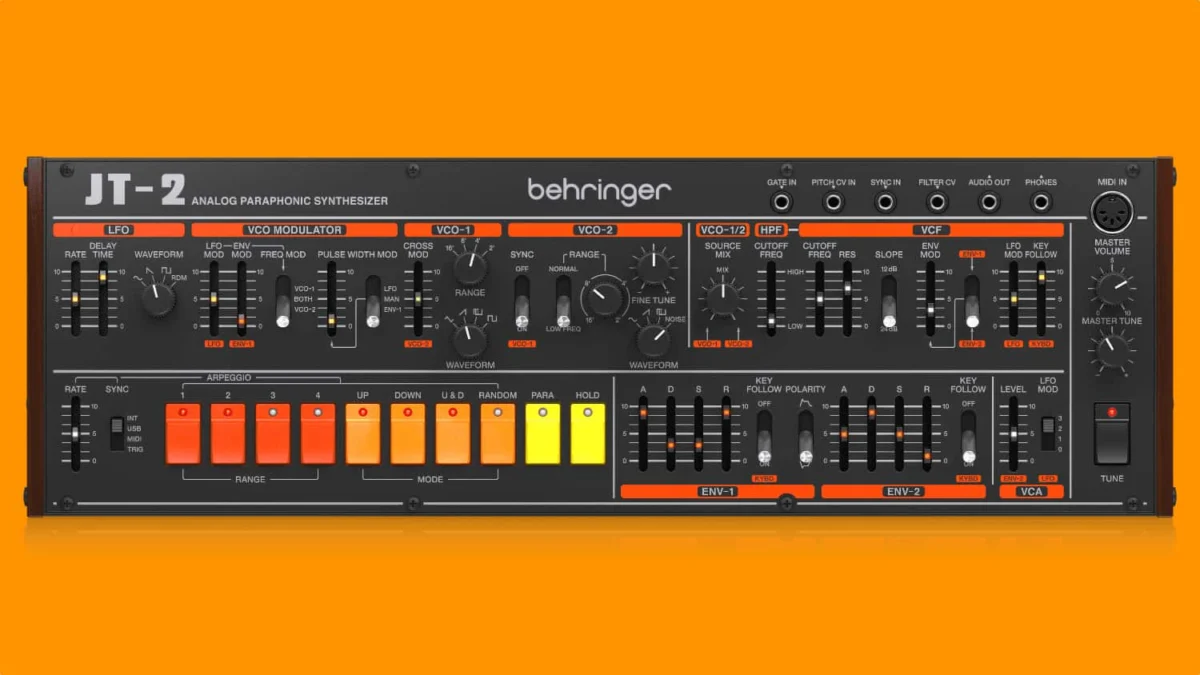
The Emergence of the JT-2 Analog Monosynth
The Behringer JT-2 is a desktop synthesizer designed within the standardized Eurorack format. This design choice provides users with dual functionality: the unit can operate as a standalone desktop instrument within its factory-supplied chassis, or it can be removed and integrated directly into a larger Eurorack modular system. However, unlike Behringer’s previous offerings such as the Neutron or the Crave, the JT-2 is not designed to be semi-modular or patchable. It functions as a fixed-architecture synthesizer, prioritizing a streamlined user interface that mirrors the layout of the classic instrument it seeks to emulate.
The decision to focus on the "Jupiter" sound profile is a strategic move by Behringer. The original Roland Jupiter-8, released in 1981, is widely considered one of the most iconic polyphonic synthesizers in music history. By distilling the essence of this eight-voice powerhouse into a monophonic Eurorack module, Behringer is providing musicians with access to the specific filter characteristics and oscillator behavior of the Jupiter series at a fraction of the cost of vintage hardware.
Architectural Design and Eurorack Compatibility
The physical footprint of the JT-2 follows the established 80HP (Horizontal Pitch) standard common in Behringer’s line of "Model D" and "PRO-1" clones. The front panel features a combination of sliders and rotary knobs, closely mimicking the ergonomic flow of the original Jupiter-8. The inclusion of color-coded buttons and the specific typeface used on the panel are direct nods to the 1980s aesthetic of the Roland flagship.
While the JT-2 lacks the patch points typical of Eurorack modules, it maintains connectivity through MIDI (both 5-pin DIN and USB-MIDI) and basic CV (Control Voltage) inputs for gate and pitch. This allows it to be sequenced by external hardware or software DAWs with ease. The primary draw of the JT-2’s architecture is its simplified signal path, which is optimized for "warm pads, punchy leads, and huge analog tone," as emphasized in the company’s promotional materials.
Historical Context: The Roland Jupiter-8 Influence
To understand the market positioning of the JT-2, one must look at the legacy of the Roland Jupiter-8. The original JP-8 was Roland’s first truly professional polyphonic synthesizer, featuring two oscillators per voice and a highly regarded four-pole resonant low-pass filter. It became the centerpiece of studios for artists such as Duran Duran, Depeche Mode, and Michael Jackson.
The Jupiter-8 was known for its "lush" and "creamy" sound, largely attributed to the IR3109 filter chip and the discrete oscillator design. In the decades since its discontinuation, the price of original units has skyrocketed, often exceeding $30,000 on the secondary market. This has created a vacuum in the industry for affordable alternatives. While Roland has released digital "Boutique" versions and software emulations (using their Analog Circuit Behavior or ACB technology), Behringer’s approach with the JT-2 is strictly analog, aiming to capture the physical voltage fluctuations and harmonic saturation that digital models sometimes struggle to replicate.
Technical Analysis of the Sound Engine
The JT-2 is built around a purely analog signal path. While the original Jupiter-8 was polyphonic, the JT-2 is a monosynth, meaning it plays one note at a time. This limitation is reflected in its lower price point but does not necessarily diminish its utility in a studio environment. Monosynths are often preferred for basslines, lead melodies, and percussive sequences where clarity and "punch" are more important than harmonic complexity.
Key features of the JT-2 sound engine include:
- Dual Oscillators: Two voltage-controlled oscillators (VCOs) that provide the core thickness of the sound. These oscillators offer multiple waveforms, including saw, square, and triangle, which can be mixed to create complex timbres.
- Filter Characteristics: The JT-2 utilizes a recreation of the classic Jupiter filter, known for its ability to maintain low-end presence even when resonance is high.
- Envelope Generators: Dual ADSR (Attack, Decay, Sustain, Release) envelopes allow for precise shaping of the volume (VCA) and filter (VCF) over time.
- LFO Modulation: A dedicated Low-Frequency Oscillator provides movement, allowing for vibrato, tremolo, or filter sweeps.
The sound demo released by Behringer highlights the instrument’s ability to produce "warm pads"—though monophonic, these can be layered in a DAW to create the illusion of polyphony—and "punchy leads" that cut through a mix.

Chronology of Development and Public Teasers
The journey of the JT-2 from concept to reality has been tracked closely by the synthesizer community. Behringer first hinted at a "Jupiter-style" project several years ago as part of their broader initiative to clone the "Big Three" of the 1980s: the Sequential Circuits Prophet-5, the Moog Memorymoog, and the Roland Jupiter-8.
- Initial Teasers (2021-2022): Behringer shared renders of various Jupiter-inspired designs, including the JT-4000 Micro (a hybrid four-voice paraphonic synth) and a full-scale polyphonic version known as the JT-16.
- Prototype Phase (2023): Photos of the JT-2 circuit boards and faceplates began appearing on social media, confirming that a Eurorack monosynth version was in active development.
- Video Introduction (Present Day): The release of the official sound demo signifies that the product has moved from the development phase into production and marketing. This typically indicates that a commercial release is imminent, pending global shipping and logistics.
Market Positioning and Economic Impact
The JT-2 is priced at $189 USD for international markets. This aggressive pricing strategy is a hallmark of Behringer’s parent company, Music Tribe. By manufacturing at scale in their "Behringer City" facility in Zhongshan, China, the company is able to offer analog hardware at prices that were previously unthinkable.
At $189, the JT-2 competes directly with:
- Korg Volca Series: Small, battery-powered synths that offer great sound but limited physical controls.
- Roland Boutique Series: Digital recreations of Roland classics that are more expensive (typically $350–$450) and smaller in scale.
- IK Multimedia Uno Synth: A portable analog monosynth with a different aesthetic and interface.
The JT-2’s advantage lies in its full-sized sliders and its ability to fit into standard Eurorack cases, appealing to both beginners looking for their first "real" synth and modular enthusiasts seeking a dedicated Jupiter-style voice.
Industry Reception and Synthesis Trends
The reaction to the JT-2 has been polarized, reflecting a long-standing divide in the electronic music community. On one side, enthusiasts praise Behringer for "democratizing" synthesis, making the sounds of legendary instruments accessible to people regardless of their financial status. On the other side, critics point to the ethical implications of cloning designs from other manufacturers, even if those designs are no longer under patent protection.
From a technical standpoint, the JT-2 arrives at a time when there is a resurgence of interest in "hands-on" hardware. As musicians experience "screen fatigue" from using software plugins, tactile instruments like the JT-2 provide a more immediate and creative experience. The JT-2’s lack of presets—a consequence of its purely analog design—forces users to learn the fundamentals of synthesis, a trend that has seen a massive uptick in the "DAW-less" jam community.
Broader Impact and Implications
The release of the JT-2 is part of a larger ecosystem Behringer is building. It sits alongside the JT-4000 (the budget hybrid entry) and the highly anticipated JT-16 (the flagship polyphonic version). By releasing the JT-2 now, Behringer is effectively "priming the pump," establishing the sonic identity of their Jupiter clones before the more expensive models hit the shelves.
Furthermore, the JT-2’s Eurorack format reinforces the standard’s dominance in the hardware market. Even though the JT-2 isn’t patchable, its physical compatibility with Eurorack rails ensures it can be part of a professional studio rack, rather than just a "toy" sitting on a desk. This elevates the perceived value of the instrument.
Future Outlook and Availability
While the international price of $189 has been confirmed, Behringer has yet to announce specific US pricing or a definitive shipping date. Historically, there is often a three-to-six-month gap between the "official video intro" and the product appearing in major retail outlets like Sweetwater or Thomann.
The JT-2 represents a pivot in Behringer’s strategy toward smaller, more specialized modules that focus on specific "flavors" of synthesis. As the company continues to fill out its "JT" line, the JT-2 will likely serve as the entry-point for those seeking the authentic analog "Jupiter" filter sound without the complexity or cost of a full polyphonic system. For the modern producer, the JT-2 offers a specialized tool for bass and lead duties that carries the DNA of one of the most respected instruments ever built.
