

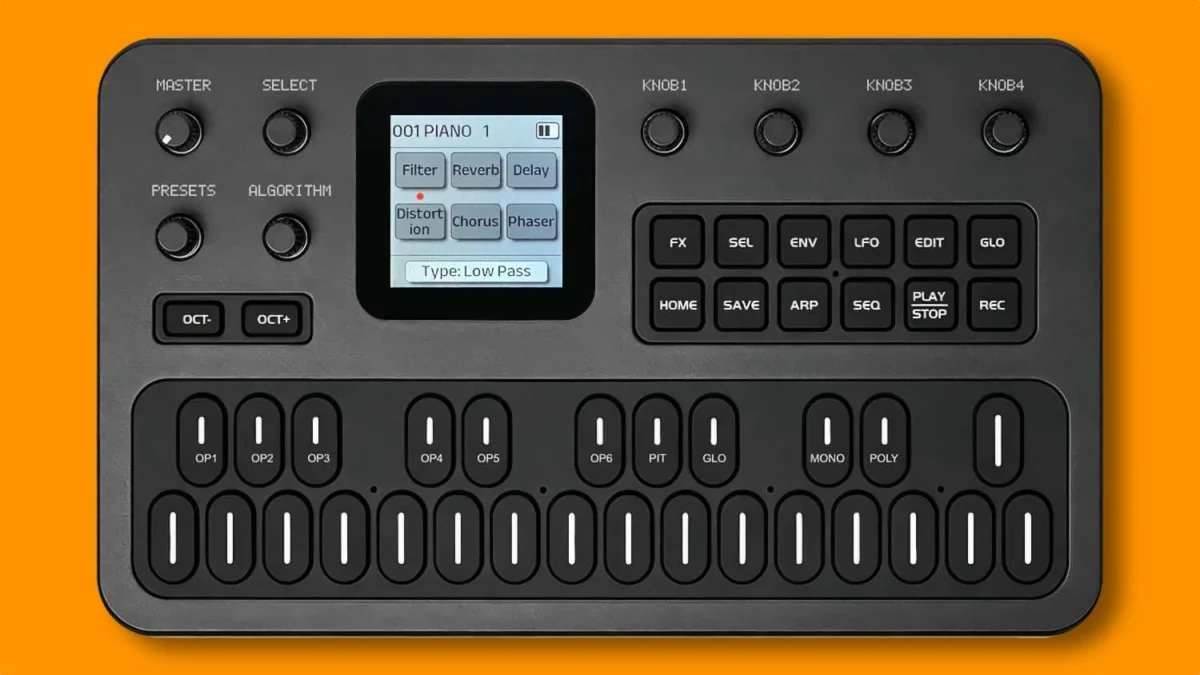
The global musical instrument market has witnessed a significant shift toward miniaturization and affordability, a trend further solidified by the recent release of the M-VAVE FM-1. This new portable digital FM synthesizer represents a strategic move by M-VAVE, a brand increasingly recognized for its budget-friendly yet feature-rich audio electronics, to capture the growing segment of mobile producers and sound designers. Built around a sophisticated six-operator frequency modulation (FM) synthesis engine, the FM-1 offers a level of sonic complexity typically reserved for much larger and more expensive hardware. By integrating 32 distinct algorithms, a 27-key silicone keyboard, and versatile connectivity options including wireless MIDI, the FM-1 aims to bridge the gap between entry-level toys and professional-grade studio equipment.
Technical Architecture and the Six-Operator Engine
At the core of the M-VAVE FM-1 lies a digital synthesis engine that pays homage to the legendary FM synthesizers of the 1980s, most notably the Yamaha DX7. However, unlike many modern budget synthesizers that utilize a simplified three-operator or four-operator structure, the FM-1 employs a full six-operator architecture. In FM synthesis, "operators" act as the fundamental building blocks—essentially digital oscillators that can function as either carriers (which produce audible sound) or modulators (which change the frequency of the carriers to create complex harmonic overtones).
The inclusion of 32 algorithms allows users to arrange these six operators in various configurations. These configurations dictate the harmonic character of the resulting sound, ranging from pure, bell-like tones and metallic textures to aggressive, distorted leads and deep, percussive basses. Historically, programming six-operator FM has been considered a daunting task for beginners due to its mathematical complexity. M-VAVE has addressed this by pairing the engine with a streamlined interface that allows for real-time manipulation of parameters, making the synthesis process more tactile and accessible for contemporary performers.
While the specific bit-depth and sampling rate of the internal DAC (Digital-to-Analog Converter) have not been exhaustively detailed in the initial release notes, the device is designed to replicate the "glassy" and "crisp" fidelity associated with high-end digital synthesis. This ensures that the FM-1 can hold its own in a modern production environment where digital clarity is often preferred for cutting through dense mixes.
Design, Ergonomics, and Portability
The physical design of the FM-1 emphasizes the "desktop" and "mobile" ethos. The chassis is compact, making it an ideal companion for traveling musicians or those with limited studio real estate. One of the most distinctive physical features is the 27-key silicone keyboard. Unlike traditional plastic "clicky" buttons or full-sized piano keys, the silicone interface provides a silent, tactile experience. This choice of material is particularly beneficial for musicians working in public spaces or quiet environments, such as airplanes or libraries, where the mechanical noise of a standard keyboard might be disruptive.
Beyond the keyboard, the FM-1 is equipped with a series of onboard controls, including knobs and buttons for navigating its internal menus and adjusting parameters on the fly. This hands-on approach is a departure from the "menu-diving" often required by vintage FM hardware. The inclusion of a built-in rechargeable battery further enhances its portability, eliminating the need for constant tethering to a power outlet or the use of disposable AA batteries. This move aligns with the broader industry shift toward sustainable and convenient power solutions for portable gear.
Connectivity and Integration into Modern Workflows
In an era where the boundary between hardware and software is increasingly blurred, the FM-1 offers a robust suite of connectivity options. It supports both wired and wireless MIDI workflows, a feature that distinguishes it from many competitors in the sub-$100 price bracket. The wireless MIDI capability, likely utilizing Bluetooth Low Energy (BLE) MIDI standards, allows the FM-1 to connect seamlessly to iPads, smartphones, and laptops. This enables users to use the FM-1 as a sound module triggered by an external sequencer or, conversely, to use its silicone keys to control software instruments within a Digital Audio Workstation (DAW).
For traditionalists, the device includes standard wired MIDI ports (likely via 3.5mm TRS Type-A or Type-B adapters, given its size) and USB connectivity. This dual-purpose nature—operating as a standalone instrument with its own internal sounds and as a compact controller for other gear—makes it a versatile tool for various setups. Whether it is being used as the primary sound source in a "DAWless" jam or as a secondary oscillator in a complex MIDI chain, the FM-1 is designed to be highly adaptable.
Contextual History: The Evolution of FM Synthesis
To understand the significance of the M-VAVE FM-1, one must look at the historical trajectory of FM synthesis. Developed by John Chowning at Stanford University in the late 1960s and later licensed to Yamaha, FM synthesis revolutionized the music industry in the 1980s. The Yamaha DX7 became the defining sound of the decade, appearing on countless hit records. However, as the 1990s progressed, the industry shifted toward sample-based synthesis and eventually virtual analog.
In the last decade, there has been a significant resurgence of interest in FM synthesis. Modern producers have rediscovered its unique ability to create sounds that analog subtractive synthesis simply cannot replicate. This "FM Renaissance" was spearheaded by instruments like the Korg Volca FM and the Elektron Digitone. The M-VAVE FM-1 enters this market as a highly competitive alternative, offering the full six-operator experience—something the original Korg Volca FM lacked (it was limited to three operators until the release of its second version)—at a fraction of the cost of higher-end boutique hardware.
Market Positioning and Pricing Strategy
The FM-1 is positioned within the "ultra-budget" tier of the synthesizer market, with a retail price ranging between $75 and $100 USD. This pricing strategy is aggressive, placing it in direct competition with entry-level devices from established brands like Korg, Sonicware, and Behringer. By offering a six-operator engine at this price point, M-VAVE is targeting a demographic that includes:
- Students and Beginners: Those who want to learn FM synthesis without committing to a $500+ investment.
- Mobile Producers: Musicians who prioritize weight and size for "on-the-go" sketching.
- Studio Professionals: Producers looking for a specific "lo-fi" or "digital" character to add to their sonic palette without taking up significant desk space.
Industry analysts suggest that the success of the FM-1 will likely depend on its build quality and the "sweetness" of its presets. While budget synthesizers are often criticized for poor user interfaces, the inclusion of a screen and dedicated knobs on the FM-1 suggests that M-VAVE has prioritized usability.
Industry Implications and Future Outlook
The release of the M-VAVE FM-1 is a symptom of a larger shift in the manufacturing of musical electronics. The rise of companies based in Shenzhen and other Chinese tech hubs has democratized access to complex synthesis technologies. Components that were once prohibitively expensive are now mass-produced, allowing for the creation of sophisticated digital instruments at consumer-electronics prices.
Furthermore, the integration of wireless MIDI in a budget device signals a move toward a "cable-free" future for small-scale music production. As mobile operating systems like iOS and Android continue to improve their low-latency audio handling, devices like the FM-1 become essential peripherals for the modern tablet-based musician.
While some purists may argue that a $75 synthesizer cannot match the "soul" or build of a vintage Japanese instrument, the FM-1 is not necessarily trying to replace the classics. Instead, it is expanding the ecosystem, making the complex world of frequency modulation accessible to a global audience that previously found the barrier to entry—both in terms of cost and complexity—too high.
Summary of Specifications
For prospective buyers and industry observers, the key specifications of the M-VAVE FM-1 are summarized as follows:
- Synthesis Type: 6-Operator Digital FM Synthesis.
- Algorithms: 32 user-selectable configurations.
- Keyboard: 27-key silicone capacitive/tactile interface.
- Power: Internal rechargeable battery with USB-C charging.
- Connectivity: Bluetooth MIDI (Wireless), TRS MIDI (Wired), and USB-MIDI.
- Sequencing: Integrated onboard sequencing and modulation functions.
- Form Factor: Compact desktop/portable.
- Price Point: Approximately $75–$100 USD.
As the FM-1 reaches the hands of consumers and reviewers, its impact on the "micro-synth" market will become clearer. However, on paper, it represents a formidable challenge to the status quo, offering professional-level synthesis architecture in a package that is accessible to almost any aspiring musician. The FM-1 is currently available through major online retailers and the official Cuvave/M-VAVE distribution channels, marking a new chapter in the brand’s evolution from a producer of guitar pedals to a serious contender in the digital synthesizer arena.
