

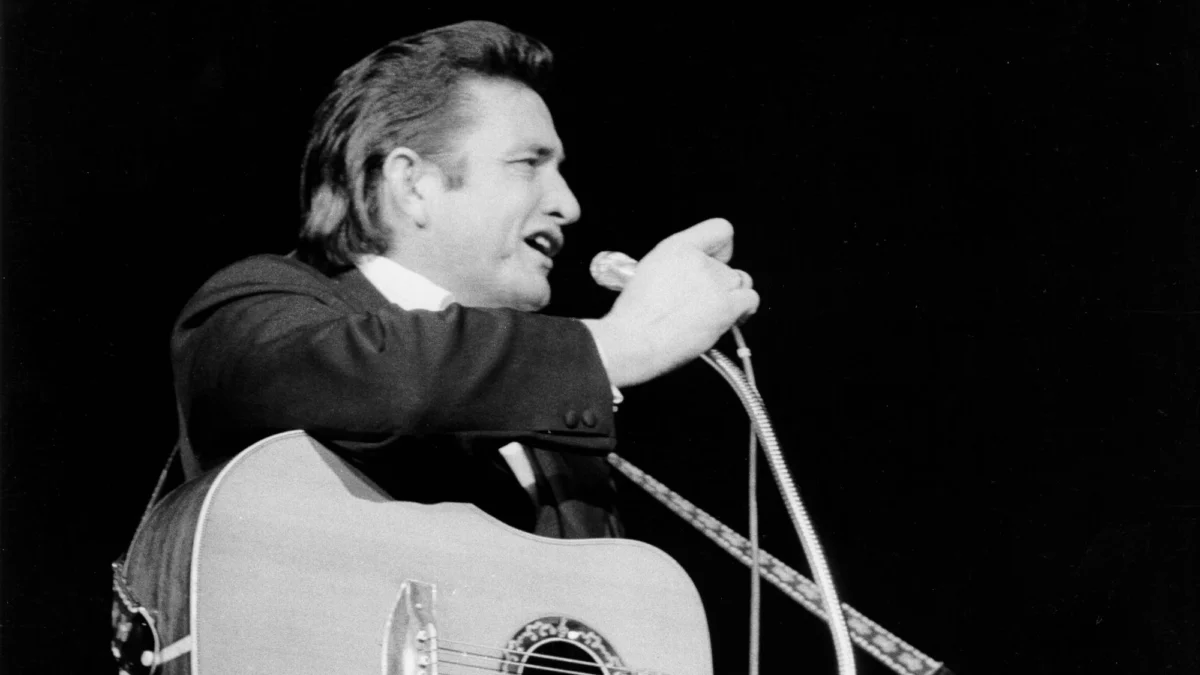
On July 20, 1968, the live version of Johnny Cash’s "Folsom Prison Blues" ascended to the number one spot on the Billboard U.S. Hot Country Singles chart, marking a definitive moment in the career of the "Man in Black" and the broader landscape of American music. This achievement was not merely a commercial success; it represented a profound cultural shift, as Cash’s raw, empathetic portrayal of life behind bars resonated with a nation grappling with social upheaval. By replacing Tammy Wynette’s "D-I-V-O-R-C-E" at the top of the charts, Cash signaled a move toward a grittier, more socially conscious brand of country music that would eventually be categorized as the "outlaw" movement. The song held its position for four weeks before eventually being succeeded by Sonny James’s "Heaven Says Hello," but the impact of that month at the summit of the charts would echo for decades.
The Genesis of an Outlaw Anthem: West Germany 1951
The origins of "Folsom Prison Blues" date back nearly two decades before its 1968 chart-topping success. While serving in the United States Air Force and stationed in Landsberg, West Germany, a young J.R. Cash found himself profoundly affected by the 1951 crime drama Inside the Walls of Folsom Prison. The film, which starred Steve Cochran and David Brian, depicted the harsh realities of the California penal system and sparked a creative fire in the young airman.
Cash, who had no personal history of incarceration at the time, sought to inhabit the psyche of a man who had lost his freedom. In a 1994 interview with Guitar Player magazine, Cash recalled his mindset during the writing process: "I thought, I’m going to write this song as if I’m a criminal. What could be the worst thing a criminal could do? Shoot a man just to watch him die." This chilling line became the centerpiece of the song, establishing an uncompromising tone that differentiated Cash from the more polished, sentimental country artists of the era.
Musically, the song drew heavy inspiration from "Crescent City Blues," a track by Gordon Jenkins featuring vocalist Beverly Mahr. Cash famously adapted the melody and several lyrics from Jenkins’ work, a move that later resulted in a legal settlement in the 1970s. Despite the controversy regarding its structural origins, Cash’s delivery and the "boom-chicka-boom" rhythm provided by his backing band, the Tennessee Two (guitarist Luther Perkins and bassist Marshall Grant), transformed the material into something uniquely his own.
The Sun Records Era and Early Success
The original studio version of "Folsom Prison Blues" was recorded at the legendary Sun Records in Memphis, Tennessee, in late 1955. Produced by Sam Phillips, the man who famously discovered Elvis Presley, the track was released as a single in early 1956. It reached number four on the Billboard country charts, establishing Cash as a rising star.
During this period, the song found a particularly devoted audience among the incarcerated. Cash began receiving a steady stream of letters from inmates across the United States, many of whom felt that he was the first artist to truly capture the crushing boredom, regret, and longing associated with prison life. This connection was ironic, given that Cash’s own brushes with the law were relatively minor, mostly involving drug possession and public intoxication that resulted in overnight stays in local jails rather than long-term prison sentences. However, his ability to project a sense of shared struggle forged a bond with the marginalized that would define his public persona.
The Mid-1960s Slump and the Path to Redemption
By the mid-1960s, Johnny Cash’s career was in a state of precipitous decline. Battling severe addictions to amphetamines and barbiturates, his live performances became erratic, and his chart presence faded. Between 1964 and 1967, Cash struggled to maintain the momentum that had made him a household name in the late 1950s.
The turning point came through a combination of personal and professional shifts. With the support of June Carter and her family, Cash began the difficult process of sobriety. Simultaneously, he sought to revitalize his recording career by pursuing a project he had long envisioned: a live album recorded inside a prison.
While the idea was initially met with skepticism from record executives who feared it would be too controversial or unmarketable, producer Bob Johnston championed the concept. Johnston, who had worked with Bob Dylan and Simon & Garfunkel, recognized the raw energy and authenticity Cash could bring to such an environment. After reaching out to several facilities, Folsom State Prison in California was the first to agree to the recording.
The Folsom State Prison Concert: January 13, 1968
On January 13, 1968, Johnny Cash, along with June Carter, the Tennessee Three, and the Statler Brothers, performed two shows at Folsom State Prison. The atmosphere was electric and tense. Cash opened both sets with "Folsom Prison Blues," immediately commanding the attention of the inmates.
The resulting album, At Folsom Prison, captured a visceral energy that was unprecedented in popular music. One of the most famous moments on the record—the inmates’ loud cheering following the line "I shot a man in Reno just to watch him die"—was actually an artifact of post-production. The inmates had been instructed not to cheer at any mentions of the prison itself to avoid retribution from the guards; the cheers were added later to emphasize the outlaw spirit of the performance.
The live version of the song was faster, more aggressive, and carried the weight of Cash’s own recent struggles. It was released as a single and quickly began climbing the charts. By May 1968, the album had reached number one on the Billboard Top Country Albums chart, and the single followed suit on the Hot Country Singles chart in July.
Chart Performance and Industry Recognition
The success of the live version of "Folsom Prison Blues" in the summer of 1968 was a statistical anomaly in an era dominated by the "Nashville Sound"—a subgenre characterized by smooth strings and background choirs. Cash’s stripped-down, gritty sound proved that there was a massive market for authenticity.
Key Data Points from 1968:
- Billboard Peak: Number one on the U.S. Hot Country Singles chart for four weeks (July 20 – August 10).
- Cross-over Success: Reached number 32 on the Billboard Hot 100, a rare feat for a country song about prison life.
- Album Sales: At Folsom Prison was certified Gold by the RIAA in 1968 and would eventually achieve Triple Platinum status.
- Grammy Awards: At the 11th Annual Grammy Awards in 1969, "Folsom Prison Blues" won Cash his first-ever Grammy for Best Country Vocal Performance, Male.
The song’s rise to the top of the charts was a victory for Cash’s vision of country music as a "people’s music" that did not shy away from the darker aspects of the human condition.
Broader Implications: Advocacy and Prison Reform
The success of "Folsom Prison Blues" and the At Folsom Prison album transformed Johnny Cash from a country singer into a social icon. He used his newfound platform to become a vocal advocate for prison reform. Cash argued that the penal system should focus more on rehabilitation than punishment, and he became a regular visitor to prisons across the country, performing for inmates and listening to their grievances.
In 1972, Cash took his advocacy to the highest levels of government, testifying before a U.S. Senate subcommittee on prison reform. He spoke candidly about the "inhumane" conditions he had witnessed and urged lawmakers to provide better education and mental health resources for the incarcerated. Over the course of his life, he met with six sitting U.S. presidents to discuss social justice and the rights of the marginalized.
His commitment to this cause was not a publicity stunt; it was a core component of his identity. He recorded three more live albums in prisons: At San Quentin (1969), Pa Osteraker (1972) in Sweden, and A Concert Behind Prison Walls (1976) at Tennessee State Prison.
Legacy and Cultural Impact
The legacy of "Folsom Prison Blues" extends far beyond its 1968 chart run. It serves as the foundational text for the "Outlaw Country" movement of the 1970s, influencing artists like Waylon Jennings, Willie Nelson, and Kris Kristofferson. The song’s blend of folk, country, and early rockabilly elements created a template for a more rebellious, independent spirit in American music.
In the decades following its release, the song has been covered by hundreds of artists across various genres, from Jerry Lee Lewis to the Reverend Horton Heat, and even the German industrial band Die Toten Hosen. It remains a staple of American culture, frequently appearing in films, television shows, and documentaries as a shorthand for rebellion and redemption.
The 2005 biopic Walk the Line, starring Joaquin Phoenix, brought the story of the Folsom concert to a new generation, further cementing the song’s place in the pantheon of great American works. Johnny Cash’s ability to bridge the gap between the free world and the incarcerated world remains his most significant achievement. Through "Folsom Prison Blues," he didn’t just tell a story; he gave a voice to those who had been forgotten by society, proving that even in the darkest corners of human experience, there is room for music, empathy, and change.
