

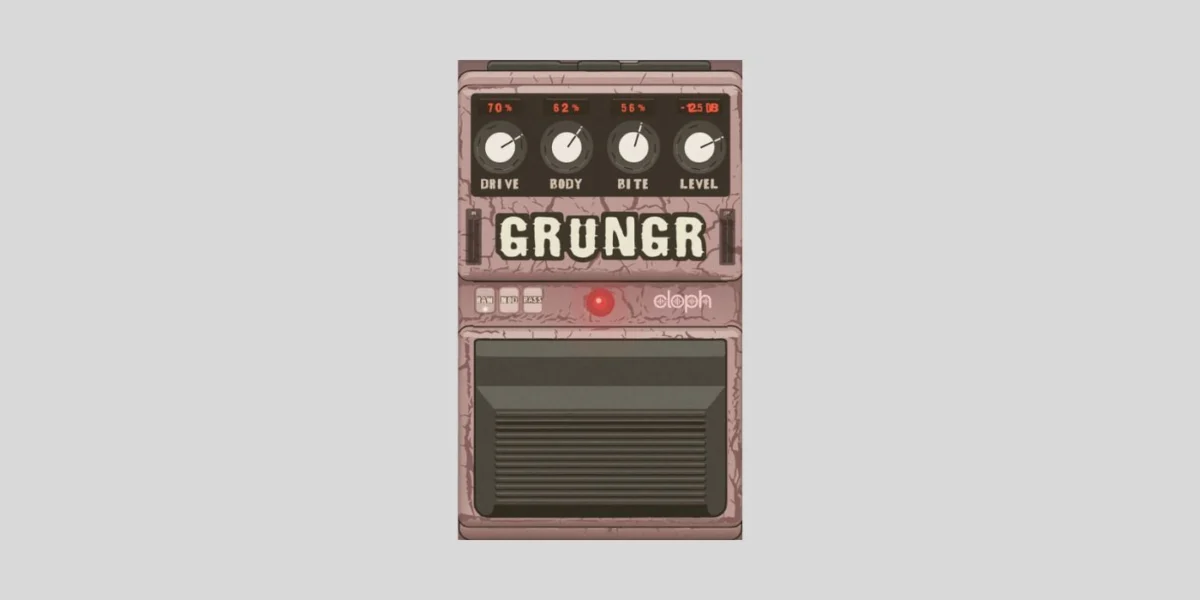
cloph-dsp, a burgeoning name in audio software development, has officially released Grungr, a versatile drive pedal emulation designed to inject aggressive character and "bite" into guitar, bass, and a wide array of other audio sources. The new plugin, available under a free/pay-what-you-want model, marks another significant contribution from developer Pedro Castro, following the positive reception of his earlier stochastic stutter and freeze effect, Freeze95, earlier this year. Grungr’s release signals cloph-dsp’s continued commitment to providing accessible, high-quality audio tools that prioritize intuitive design and powerful sonic capabilities, drawing inspiration from the tactile and immediate experience of physical guitar pedals.
The Genesis of Grungr: From Physical Pedals to Digital Precision
The development of Grungr stems from a clear philosophy evident in cloph-dsp’s previous offerings: to distill complex audio processing into user-friendly, performance-oriented tools. Pedro Castro, the creative force behind cloph-dsp, has expressed a long-standing affinity for simple, pedal-style effects, a preference rooted in his own history as a guitarist. This personal connection to the format transcends mere nostalgia, evolving into a deliberate design choice that informs Grungr’s streamlined interface and direct workflow.
The appeal of pedal-style effects extends far beyond guitarists, resonating with sound designers and music producers across genres. Their modular nature allows for easy stacking and experimentation, transforming mundane sounds—whether synths, basses, drums, or even vocals—into something textured, unique, and more engaging. Grungr is meticulously crafted to fit seamlessly into this modern production workflow, eschewing the complexity of multi-effect workstations in favor of a focused, singular purpose: delivering high-quality drive and distortion with an immediate, hands-on feel.
Dissecting Grungr’s Sonic Architecture and Controls
Grungr is not merely a generic distortion unit; it is an emulation built with specific tonal characteristics in mind, offering three distinct voicing modes that cater to diverse sonic needs. These modes provide fundamental tonal shifts, allowing users to sculpt the drive character before engaging the primary controls:
- RAW: This mode represents the plugin’s most open and direct crunch. It offers the closest route to the core drive sound, characterized by an unadulterated, aggressive saturation. RAW is ideal for moments when a transparent yet powerful drive is required, preserving the natural frequency response of the input signal while adding significant harmonic richness and grit. It’s akin to pushing a tube amplifier into its natural breaking point, providing a responsive and dynamic distortion.
- MOD: Shifting the focus, the MOD mode provides a more concentrated and forward-sounding drive. It tightens the mid-range frequencies, pushing the sound to the front of a mix. This characteristic makes MOD particularly effective for lead instruments, cutting basslines, or any element that needs to assert its presence without becoming muddy or indistinct. The tighter mids enhance clarity and projection, ensuring the driven sound retains definition even in dense arrangements.
- BASS: As its name suggests, the BASS mode is engineered to provide enhanced body and weight, specifically optimized for bass guitars and other heavier, low-frequency sources. A common challenge with drive effects on bass is the tendency for the low-end to become flabby or lose definition. Grungr’s BASS mode actively counteracts this, adding significant low-frequency girth and sustain while maintaining clarity and tightness, preventing the dreaded "low-end flub" that can plague bass-heavy distortion.
Beyond these foundational voicing modes, Grungr features four intuitive main controls: Grunge, Body, Bite, and Level. This minimalist control set is a deliberate design choice, reflecting the simplicity of classic hardware pedals and ensuring an immediate, performance-oriented user experience. There are no hidden menus, complex sub-parameters, or intricate setups. The process is straightforward: select a voicing mode, turn the knobs, and listen to the sonic transformation.
- Grunge: This is the primary drive control, dictating the intensity and saturation of the distortion. Turning this knob clockwise increases the amount of gain applied to the signal, progressively moving from a subtle crunch to a full-blown, aggressive roar. It’s the core of Grungr’s character, defining the degree of harmonic excitement and compression.
- Body: The Body control primarily influences the low-mid frequencies, adding fullness and weight to the sound. This knob allows users to dial in the desired thickness and presence, particularly useful for making instruments sound more robust and impactful without overwhelming the mix with excessive low-end. It works in conjunction with the BASS voicing mode to sculpt a powerful, defined bottom-end.
- Bite: This control focuses on the upper-mid and high frequencies, introducing a sharper, more piercing edge to the sound. Increasing the Bite can enhance clarity, articulation, and aggression, making instruments cut through a mix with greater intensity. It’s crucial for dialing in that characteristic "gritty" texture and ensuring the driven sound has enough presence and attack.
- Level: As with most drive pedals, the Level control manages the output volume of the plugin. This allows users to compensate for any perceived volume changes introduced by the drive circuit, ensuring a consistent signal level in their mix or preventing clipping downstream. It’s essential for proper gain staging and balancing the driven sound against other elements in a track.
Under the Hood: Technical Refinements for Optimal Performance
Grungr’s simple interface belies a sophisticated internal architecture designed for robust performance and sonic fidelity. The plugin employs hard clipping, a distortion method known for its aggressive and often harmonically rich character, central to achieving the desired "grunge" aesthetic. To ensure this aggression is musically useful and doesn’t devolve into unwanted mud, Grungr integrates subsonic filtering, effectively removing extreme low frequencies that can contribute to muddiness and consume headroom without adding musical value. Limiting is also employed to control peaks, ensuring a consistent and manageable output level even under heavy drive.
Beyond its core distortion engine, Grungr boasts several features crucial for modern production environments. It supports stereo processing, allowing users to apply its drive characteristics to stereo tracks like drum buses, synth pads, or entire mixes, adding width and texture. The inclusion of true bypass ensures that when the effect is disengaged, the signal passes through the plugin unaltered, preserving the integrity of the original sound. Furthermore, Grungr operates with zero latency, a critical feature for real-time applications such as tracking instruments in a DAW or live monitoring during a performance, eliminating any perceptible delay between input and output.
A Nod to History: The DigiTech Grunge Pedal and Its Legacy
Pedro Castro openly acknowledges that Grungr draws significant inspiration from a classic grunge pedal he extensively used and owned, particularly on bass. While the developer maintains that Grungr is an independent plugin and is not affiliated with or endorsed by DOD or DigiTech, the clues strongly point to the iconic DigiTech Grunge pedal.
The DigiTech Grunge pedal, originally released in the 1990s, became synonymous with a particular era of alternative and grunge music. Its distinctive, often harsh, and aggressively saturated distortion character captured the raw, rebellious spirit of the genre. Unlike many boutique or transparent overdrive pedals, the DigiTech Grunge was designed for an extreme, scooped-mid distortion that was instantly recognizable. It wasn’t always subtle, but its unique voice found favor with countless musicians seeking to emulate the sounds of bands like Nirvana, Pearl Jam, and Soundgarden, or simply to forge their own path with a distinctively aggressive tone.
The original pedal’s controls often included "Loud," "Low," "High," and "Grunge," allowing for broad tone sculpting alongside the distortion intensity. Grungr’s "Body" and "Bite" controls mirror this philosophy, offering intuitive tone shaping that complements the core "Grunge" drive. The decision to draw inspiration from such a specific and influential pedal highlights cloph-dsp’s commitment to capturing authentic, recognized sonic palettes while evolving them for the digital domain. This approach allows modern producers to access the character of a classic without the challenges of sourcing vintage hardware, its maintenance, or its inherent limitations.
Availability and Accessibility: A Model for the Modern Developer
Grungr is offered in widely compatible plugin formats, ensuring broad accessibility across various digital audio workstations (DAWs). It is available as a VST3, CLAP, and AUv2 plugin. VST3 (Virtual Studio Technology 3) is a prevalent standard for Windows-based DAWs, offering features like improved resource management. CLAP (Clever Audio Plugin API) is a newer, open-source plugin format gaining traction for its efficiency and modern design. AUv2 (Audio Unit v2) is the standard for macOS, ensuring seamless integration with Apple’s ecosystem, including Logic Pro and GarageBand.
The plugin supports both Windows 10/11 and macOS operating systems. For macOS users, a Universal build is provided, ensuring compatibility with both Intel-based Macs and the newer Apple Silicon (M1/M2/M3) processors, though the Apple Silicon version is currently marked as beta, indicating ongoing optimization and refinement.
A significant aspect of cloph-dsp’s distribution model is its user-centric approach: Grungr comes with no installer and no DRM (Digital Rights Management). This simplifies the installation process to a mere drag-and-drop, making it exceptionally user-friendly. The absence of DRM reflects a trust in the user community and removes common frustrations associated with software activation and copy protection, reinforcing the developer’s commitment to accessibility and ease of use.
The "FREE / Pay What You Want" model further underscores this philosophy. While users can acquire Grungr at no cost, the option to contribute financially provides a direct way to support the developer’s work. This model has become increasingly popular among independent plugin developers, fostering a symbiotic relationship with their user base, where quality tools are made accessible to everyone, and those who can afford to contribute help sustain future development.
Broader Implications: The Role of Pedal Emulations in Modern Sound Design
The release of Grungr highlights several ongoing trends in music production and sound design. The enduring appeal of simple, character-driven effects, particularly those inspired by classic hardware, remains strong. In an era of increasingly complex software, there is a clear demand for tools that prioritize immediate gratification and intuitive sound sculpting.
For sound designers, pedal-style effects like Grungr are invaluable. They offer distinct sonic personalities that can transform generic samples, add aggression to cinematic soundscapes, or imbue synthetic textures with an organic, "broken" quality. The ability to stack multiple instances of Grungr, or combine it with other virtual pedals, opens up a vast landscape of tonal possibilities, allowing for nuanced control over distortion, saturation, and tonal shaping.
Furthermore, the rise of high-quality freeware and "pay-what-you-want" plugins democratizes access to professional-grade tools. This empowers bedroom producers, students, and those with limited budgets to experiment with sophisticated effects without financial barriers, fostering creativity and innovation across the music production community. cloph-dsp, through releases like Grungr, is actively contributing to this accessible ecosystem, providing powerful, characterful tools that punch well above their price point.
Conclusion: A Grungy Future for Digital Audio
Grungr from cloph-dsp is more than just another distortion plugin; it is a meticulously crafted emulation that blends historical inspiration with modern functionality. By channeling the aggressive spirit of a classic grunge pedal into a versatile, low-latency, and user-friendly digital format, Pedro Castro has delivered a powerful tool for guitarists, bassists, and sound designers alike. Its intuitive interface, distinct voicing modes, and robust technical underpinnings make it a compelling addition to any producer’s arsenal. As cloph-dsp continues to carve out its niche in the competitive audio software market, Grungr stands as a testament to the enduring power of simple, effective design and the exciting potential of accessible, character-driven audio tools for the modern era. The plugin’s ability to infuse "more bite" into any sound source ensures its relevance across a multitude of genres and applications, cementing its place as a notable release in the digital audio landscape of 2026.
