

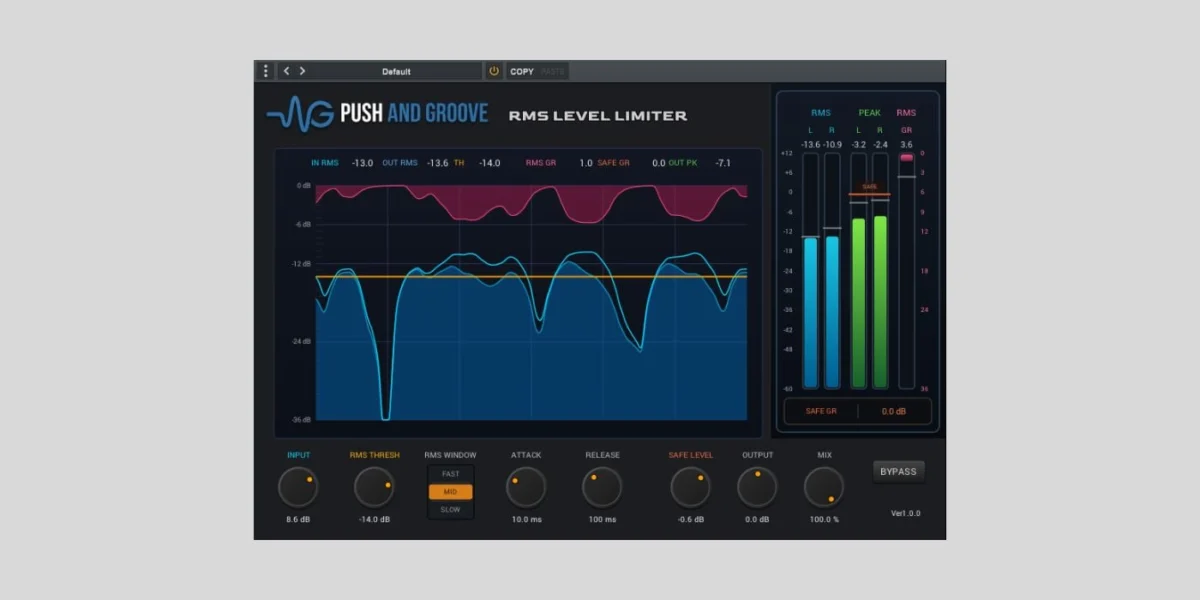
Push and Groove has announced the immediate release of RMS LEVEL LIMITER, a sophisticated new stereo dynamics plugin freely available for both Windows and macOS platforms. This latest offering distinguishes itself by employing an RMS-based detection algorithm for level control, marking a strategic departure from conventional peak limiting methodologies and promising a smoother, more transparent approach to dynamic processing. The plugin is presented as a crucial tool for a wide array of audio applications, particularly those demanding consistent perceived loudness without the aggressive artifacts often associated with traditional peak-centric processors.
The Evolution of Dynamic Control: RMS Limiting Explained
Dynamic range, the difference between the loudest and quietest parts of an audio signal, is a fundamental characteristic of sound. Managing this range effectively is paramount in audio production to ensure clarity, impact, and compliance with various playback and broadcast standards. Limiters are a class of dynamics processors designed to prevent audio signals from exceeding a predetermined amplitude ceiling, thereby controlling peaks and increasing overall loudness.
Traditional peak limiters operate by reacting instantaneously to the absolute highest points (peaks) in an audio waveform. While highly effective at preventing clipping and achieving maximum loudness, this immediate response can sometimes lead to audible pumping, distortion, or a reduction in the natural dynamics of the sound, especially when applied aggressively. The gain reduction curve of a peak limiter is dictated by every transient, regardless of its duration or contribution to the overall perceived loudness.
In contrast, RMS (Root Mean Square) limiting, as implemented in Push and Groove’s RMS LEVEL LIMITER, functions by analyzing the average signal energy over a defined period, rather than individual instantaneous peaks. The RMS value of an audio signal correlates more closely with human perception of loudness than peak amplitude does. This approach means that the gain reduction mechanism responds to the "body" of the sound, the sustained energy, rather than chasing every fleeting transient. The result is typically a more natural, less fatiguing form of level control, where the processing moves in sync with the perceived loudness envelope of the audio. This method is particularly advantageous when the goal is to achieve a consistent perceived volume without sacrificing the musicality or natural ebb and flow of the source material. The psychoacoustic implications are significant; by aligning processing with how the human ear perceives volume, RMS limiting can deliver a more sonically pleasing and transparent outcome, making it an invaluable addition to the audio engineer’s toolkit.
The historical trajectory of dynamics processing began with analog hardware compressors and limiters, which utilized various detection circuits, some inherently RMS-like in their response due to component limitations. With the advent of digital audio, the precision of peak detection became absolute, leading to the proliferation of fast, brickwall peak limiters. However, the sonic characteristics of analog gear, often lauded for its "glue" and musicality, highlighted the desirability of slower, more averaged detection methods. Modern digital plugins like the RMS LEVEL LIMITER bridge this gap, offering the precision of digital control with the nuanced response characteristic of RMS detection.
Takahiro Oishi’s Trajectory: A Legacy of Accessible Audio Tools
The release of RMS LEVEL LIMITER is part of a continuing pattern from developer Takahiro Oishi, known for his commitment to providing high-quality, specialized audio tools to the production community at no cost. Oishi’s contributions have consistently garnered attention within enthusiast and professional circles, often featured on platforms dedicated to audio production resources. His work underscores a philosophy of democratizing advanced audio engineering capabilities through accessible software.
Filtronix: A Precedent in Free Filtering
One notable precursor to the RMS LEVEL LIMITER was Filtronix, a free filter plugin released on May 12, 2026. Filtronix quickly established itself as a versatile and high-performance tool for shaping frequencies. Its robust architecture and intuitive controls allowed users to implement precise filtering operations, from subtle tonal adjustments to dramatic sound design manipulations. The positive reception of Filtronix within the audio production community served as an early indicator of Oishi’s ability to develop professional-grade software that competes favorably with commercial alternatives, despite its free availability. This release set a benchmark for the quality and utility that users could expect from Push and Groove.
GROOVE60: Innovating MIDI Timing Processing
Following Filtronix, Oishi broadened his scope with the release of GROOVE60 on July 1, 2026. This plugin ventured into the realm of MIDI timing processing, a niche but critical area for producers focused on rhythmic precision and musical feel. GROOVE60 offered unique functionalities for adjusting and refining the timing of MIDI events, allowing for subtle humanization or precise quantization beyond what standard DAW features might offer. This release demonstrated Oishi’s diverse approach to plugin development, not limiting himself to common effects but instead addressing specific, often overlooked, aspects of the audio production workflow. It highlighted a developer unafraid to innovate in areas that directly impact the musicality and rhythmic integrity of a track.
The trajectory from Filtronix to GROOVE60, and now to RMS LEVEL LIMITER, reveals a consistent developer philosophy: to identify specific technical challenges or creative needs within audio production and address them with focused, high-quality, and freely available software. Takahiro Oishi’s commitment to this model has solidified Push and Groove’s reputation as a valuable resource for audio professionals and hobbyists alike, continually pushing the boundaries of what can be expected from freeware plugins.
RMS LEVEL LIMITER: Features and Functionality in Detail
The RMS LEVEL LIMITER is engineered with a clear objective: to provide transparent and musical level control. Its core mechanics revolve around the RMS-based detection, which is complemented by a secondary "Safe Level" stage designed to catch any sudden peaks that might remain after the primary RMS processing. This dual-stage approach ensures robust level management without compromising the audio’s natural dynamics.
The plugin features a comprehensive set of control parameters, each meticulously designed to offer precise command over the limiting process:
- Input/Output: Standard gain staging controls allow users to adjust the signal level entering and exiting the plugin. Proper gain staging is crucial for optimal performance and to prevent digital clipping at any stage of the signal chain.
- RMS Threshold: This parameter dictates the average signal level at which the RMS-based gain reduction begins. Lowering the threshold means the limiter will engage earlier and more often, providing more substantial level control. The interaction between the input level and the RMS Threshold is fundamental to how aggressively the limiter operates.
- RMS Window: This crucial setting defines the time window over which the RMS value is calculated, directly influencing the responsiveness of the limiter to changes in average signal energy. The RMS LEVEL LIMITER offers three distinct window settings:
- FAST (50 ms): Designed for highly dynamic and percussive material such as drums, bass, and other rhythmic elements. A shorter window allows the limiter to react more quickly to the average energy fluctuations in fast-moving audio, making it suitable for taming the dynamics of individual hits or grooves.
- MID (300 ms): This is the suggested general starting point for a wide range of sources including vocals, guitars, and most regular music programs. A 300 ms window offers a balanced response, providing smooth level control that tracks the perceived loudness without being overly reactive to minor fluctuations or too slow to respond to significant changes. It strikes an optimal balance for maintaining natural dynamics while achieving consistency.
- SLOW (600 ms): Ideal for sustained sounds like pads, synth washes, and for processing entire buses or the master output. A longer window ensures the limiter responds to broader, slower changes in average energy, resulting in very transparent and subtle level management that helps glue elements together or provide gentle master bus compression without squashing transients.
- Attack/Release: These controls shape how quickly the gain reduction engages (Attack) and disengages (Release) in response to the RMS detector. They are critical for fine-tuning the dynamic envelope and preserving the natural movement of the source material. Slower attack times allow initial transients to pass through, while faster attack times will catch them. Similarly, release times dictate how smoothly the gain reduction returns to zero, influencing the "breathing" or "pumping" characteristics of the processing.
- Safe Level: This parameter acts as a secondary, peak-based limiter, catching any residual peaks that might exceed the desired maximum level after the primary RMS processing. It serves as a safety net, ensuring that even with the smooth operation of the RMS detector, the absolute peak ceiling is maintained. It is important to note, however, that Safe Level does not necessarily guarantee true-peak compliance, a critical distinction for broadcast and streaming standards.
- Mix/Bypass: The Mix control allows for parallel processing, blending the processed (limited) signal with the original dry signal. This technique can preserve more of the original dynamics and transients while still benefiting from the level control. The Bypass function allows for immediate A/B comparison of the processed and unprocessed audio, crucial for making informed mixing decisions.
The plugin also boasts a comprehensive metering section, providing invaluable visual feedback on the processing. Users can monitor RMS L/R levels, Peak L/R levels, RMS Gain Reduction (GR), Safe GR, and the overall output peak. This detailed metering allows engineers to understand precisely what each stage of the limiter is doing. For instance, if the Safe GR meter consistently remains at zero, it indicates that the primary RMS processing is effectively managing levels, and the remaining peaks are not exceeding the Safe Level setting. This level of transparency empowers users to make precise adjustments and achieve optimal results.
Targeted Applications: Optimizing Audio Across Diverse Media
The unique characteristics of RMS LEVEL LIMITER make it particularly well-suited for specific audio production tasks, offering solutions where traditional peak limiting might prove too aggressive or sonically detrimental.
Voice Work: The Primary Focus
Push and Groove explicitly highlights voice work as a prime application for the RMS LEVEL LIMITER. This includes content for:
- Podcasting & YouTube: In these mediums, consistent perceived loudness is paramount for listener engagement and reducing fatigue. Voices often contain dynamic fluctuations, from soft whispers to loud exclamations, and also include sharp consonants (plosives, sibilance) that can trigger peak limiters harshly. An RMS limiter can gently even out the overall level of dialogue, ensuring that the speaker’s voice remains clear and present without the processing reacting aggressively to every "P" sound or sudden vocal transient. This results in a professional, broadcast-ready sound that is pleasant to listen to over extended periods. Industry best practices often involve targeting specific integrated loudness units (LUFS) for podcasts and YouTube videos (e.g., -16 LUFS for podcasts, -14 LUFS for YouTube), and an RMS limiter can be instrumental in achieving these targets while maintaining natural vocal dynamics.
- Narration & Interviews: Similar benefits apply here. Whether it’s a documentary narration, an audiobook, or a conversational interview, maintaining a steady perceived level is crucial for intelligibility and flow. The RMS LEVEL LIMITER can smooth out the dynamic range of speech, ensuring that quieter segments are brought up and louder segments are gently controlled, all without the obvious pumping or breathing artifacts that can distract listeners. This approach prioritizes the natural cadence and emotional delivery of the speaker, making the audio more engaging and less fatiguing for the audience.
Music Production: Secondary Applications
While particularly effective for voice, the RMS LEVEL LIMITER also finds valuable applications within music production:
- Master Output (Light Control): When applied subtly to a master output, an RMS limiter can provide a gentle "glue" to a mix, helping to even out the overall loudness without imposing the aggressive brickwall effect of a traditional peak limiter. This can be beneficial for achieving a sense of cohesion and increasing the perceived density of a track, especially when aiming for a more dynamic master rather than maximum loudness.
- Drum Bus Leveling: Drums are inherently dynamic, with sharp transients and varying sustain. Applying RMS limiting to a drum bus can help to smooth out the overall level of the drum mix, bringing up the body of the drums while gently controlling the louder hits. This can result in a more cohesive and powerful drum sound that sits better within the overall mix, without squashing the impact of individual drum elements.
- Smoothing Synths, Loops, Pads, and Other Material: Many musical elements, such as evolving synthesizers, sustained pads, or atmospheric loops, have dynamic envelopes that change over time. An RMS limiter can effectively manage these gradual energy shifts, ensuring that these elements maintain a consistent presence in the mix without suddenly jumping out or disappearing. This makes them easier to integrate into a broader arrangement and ensures their intended emotional impact is consistently delivered.
These diverse applications underscore the versatility of the RMS LEVEL LIMITER, positioning it as a valuable tool for producers across various audio disciplines seeking nuanced and transparent dynamic control.
Workflow and Best Practices for RMS LEVEL LIMITER
Effective utilization of the RMS LEVEL LIMITER hinges on understanding its unique characteristics and adopting a systematic workflow. The developer suggests a pragmatic approach to achieve optimal results:
- Start with the MID Window: For most general applications, particularly vocals, guitars, and full music mixes, selecting the "MID" (300 ms) RMS Window setting is recommended as an initial starting point. This setting provides a balanced response, allowing for smooth level control without being overly aggressive or too sluggish.
- Adjust RMS Threshold: Gradually lower the RMS Threshold until the RMS gain reduction meter begins to move gently and consistently. The goal is for the gain reduction to react to the body of the sound, not just fleeting peaks. Observe the RMS GR meter to ensure the processing is smooth and proportional to the perceived loudness changes.
- Fine-tune Attack and Release: Once the threshold is set, adjust the Attack and Release parameters to ensure the source material retains its natural movement and character.
- Attack: A faster attack might be desired to quickly tame the onset of sustained sounds, while a slower attack will allow the initial transient of a sound to pass through before gain reduction begins, preserving more punch.
- Release: A shorter release time can make the limiter respond more quickly, potentially leading to a more "energetic" sound, but risks pumping if too fast. A longer release time will result in smoother, less noticeable gain reduction, but might cause the signal to sound "held down" if too slow. The key is to find the sweet spot where the limiter breathes with the music or speech.
- Monitor with Metering Section: Continuously refer to the comprehensive metering section. Pay close attention to the RMS L/R, Peak L/R, RMS GR, Safe GR, and output peak meters. This visual feedback is crucial for understanding how both the average-level stage and the safety stage are interacting with your audio. If the Safe GR meter consistently reads zero, it indicates that the RMS processing is effectively managing levels, and any remaining peaks are not exceeding your Safe Level setting. If Safe GR is frequently active, it suggests that the Safe Level stage is engaging often, indicating that either the RMS processing needs to be more aggressive, or the Safe Level itself needs adjustment.
Critical Caveat: True Peak Compliance
One critically important note from Push and Groove is that the Safe Level stage of the RMS LEVEL LIMITER does not necessarily guarantee true-peak compliance. This distinction is vital for professionals preparing audio for strict streaming, broadcast, or mastering targets.
True Peak refers to the actual peak level of a signal after digital-to-analog conversion, which can sometimes exceed the sample peak level due to inter-sample peaks. Many digital audio workstations and conventional peak meters only display sample peaks. Modern loudness standards, such as those defined by ITU-R BS.1770, EBU R128, and AES TD1004.1.15-10, mandate specific true-peak limits (e.g., -1 dBTP for many streaming services) to prevent clipping during playback on consumer devices.
Therefore, if you are preparing audio for platforms with strict true-peak and loudness requirements, it is imperative to check the final output with a dedicated true-peak and loudness meter after using the RMS LEVEL LIMITER. Tools like Youlean Loudness Meter, iZotope Insight, or Nugen VisLM are designed to accurately measure integrated loudness (LUFS) and true peak levels, ensuring your audio meets the necessary specifications for platforms like Spotify, Apple Music, YouTube, and various broadcast networks. Relying solely on the RMS LEVEL LIMITER’s Safe Level for true-peak compliance could lead to rejection or re-encoding issues with your delivered audio.
Availability and Technical Considerations
The RMS LEVEL LIMITER is accessible to a broad user base, available as a Windows VST3 plugin and a macOS AU plugin. This ensures compatibility with the vast majority of digital audio workstations (DAWs) across both major operating systems.
For macOS users, a specific technical consideration has been highlighted: some macOS builds of the plugin may not be notarized by Apple. Notarization is a security measure introduced by Apple to verify that software is free from malicious components. If a plugin is not notarized, macOS’s Gatekeeper security feature may prevent it from running automatically. In such cases, users may need to manually approve the plugin in their macOS Security & Privacy settings before rescanning Audio Units in their DAW. This typically involves navigating to System Settings (or System Preferences on older macOS versions), then Security & Privacy, and clicking "Open Anyway" or "Allow" for the Push and Groove developer. A subsequent rescan of Audio Units within the DAW should then make the plugin available for use. This is a common procedure for many independent plugin developers and is generally straightforward to resolve.
Broader Implications: The Democratization of Audio Production
The release of the RMS LEVEL LIMITER, following in the footsteps of Filtronix and GROOVE60, carries significant broader implications for the audio production landscape, particularly concerning the democratization of professional-grade tools.
Impact on Independent Creators
For independent producers, podcasters, YouTubers, and musicians operating on limited budgets, access to high-quality, specialized plugins can be a game-changer. Historically, tools offering nuanced dynamic control were often expensive, placing them out of reach for many emerging creators. Push and Groove’s commitment to providing such an essential and technically sophisticated plugin for free significantly lowers the barrier to entry for achieving professional audio quality. This empowers bedroom producers to compete more effectively with larger studios, allowing them to produce content with a polished, broadcast-ready sound that enhances listener engagement and overall production value. The ability to manage vocal levels smoothly and transparently, for instance, is critical for podcasters who want their content to sound as professional as major network broadcasts.
Market Dynamics
The existence of high-quality free plugins like the RMS LEVEL LIMITER also influences the dynamics of the commercial plugin market. It raises the bar for what users expect from paid software, encouraging commercial developers to innovate further and justify their pricing with even more advanced features, unique algorithms, or extensive support. Developers like Takahiro Oishi contribute to a thriving ecosystem where innovation is rewarded, and users benefit from a wider range of choices, both free and commercial. This competitive environment ultimately drives progress and ensures that audio engineers and creators have access to increasingly powerful and accessible tools.
Future Outlook
The trend towards specialized, high-quality free tools suggests a positive future for audio production accessibility. As software development becomes more streamlined and communities of developers share knowledge, it is plausible to expect more sophisticated plugins addressing niche needs to become available without cost. This not only benefits individual creators but also fosters a culture of experimentation and creativity, as users can freely explore new processing techniques without financial commitment. The RMS LEVEL LIMITER stands as a testament to this ongoing evolution, providing a valuable, unique solution for transparent level control that will undoubtedly find a permanent place in many audio production workflows.
In conclusion, Push and Groove’s RMS LEVEL LIMITER is a significant addition to the free plugin market. Its RMS-based detection, combined with a robust feature set and clear application guidance, positions it as an invaluable tool for achieving transparent and musical level control, particularly for voice work and nuanced music production tasks. Takahiro Oishi’s continued contribution of high-quality, specialized tools reinforces Push and Groove’s commitment to innovation and accessibility, further empowering a new generation of audio creators. While not a substitute for dedicated true-peak metering, its core functionality provides a powerful and accessible means for optimizing audio dynamics across a diverse range of media.
