

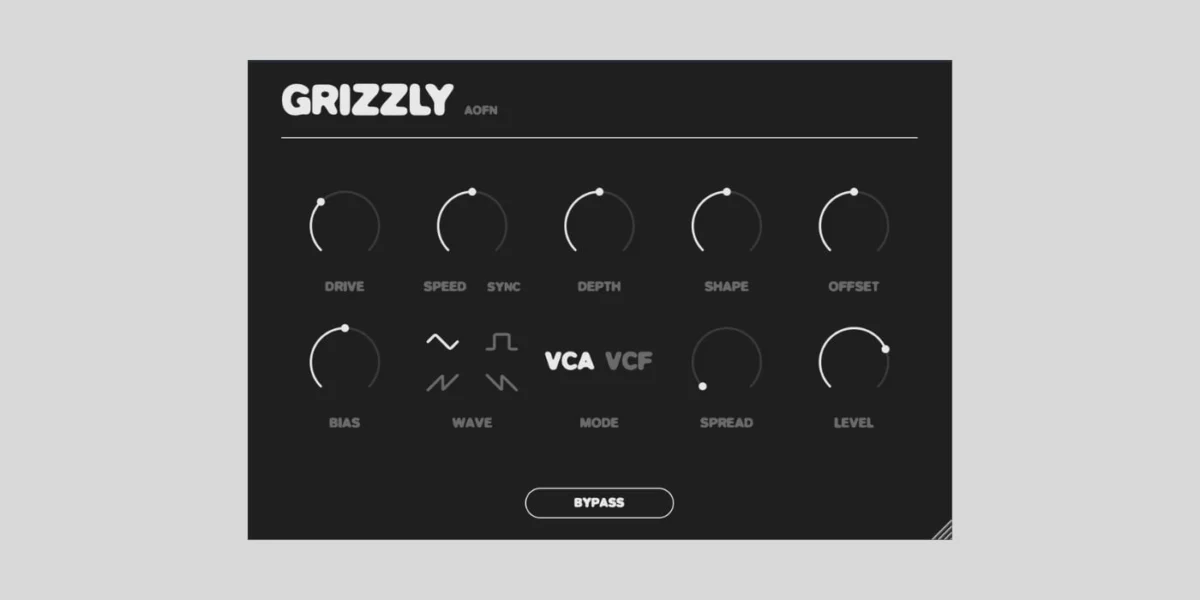
AOFN Audio has officially launched "Grizzly," a new free stereo modulation plugin meticulously designed for macOS and Windows platforms. This release introduces a unique sonic tool to the digital audio workstation (DAW) landscape, drawing its core inspiration from the legendary 1979 Gristleizer circuit, an experimental LFO-driven pedal famously utilized by Chris Carter of the pioneering industrial band Throbbing Gristle. Developer Marcel characterizes Grizzly as his contemporary software interpretation of that influential pedal, noting its origins as a modulation component destined for a forthcoming reverb plugin. The plugin’s release marks a significant moment for producers and sound designers seeking to infuse their tracks with vintage-inspired, yet distinctly modern, rhythmic and tonal transformations.
The Genesis of Grizzly: Tracing the Gristleizer Legacy
To fully appreciate the significance of AOFN Audio’s Grizzly, it is essential to delve into the history and impact of its hardware progenitor: the Gristleizer. Conceived in 1979 by British musician and sound engineer Roy Gwinn for the experimental music group Throbbing Gristle, the Gristleizer was not merely another effects pedal; it was a testament to the era’s burgeoning spirit of sonic exploration and DIY innovation. Chris Carter, a pivotal member of Throbbing Gristle, famously integrated this device into his signal chain, applying its unique characteristics to a diverse array of sound sources, including drum machines, tape loops, synthesizers, and vocals. This application helped define the band’s signature abrasive, rhythmic, and often unsettling sonic palette, cementing the Gristleizer’s place in the annals of experimental electronic music.
The original Gristleizer circuit was a relatively simple yet profoundly effective design, centered around an internal Low-Frequency Oscillator (LFO) that modulated an audio signal. This modulation could manifest as either a voltage-controlled amplifier (VCA) for tremolo and gating effects or a voltage-controlled filter (VCF) for sweeping and wah-like textures. Its raw, often unpredictable nature made it a favorite among artists pushing the boundaries of sound, offering capabilities that went far beyond conventional effects units of the time. The Gristleizer’s influence extends beyond Throbbing Gristle, having inspired numerous DIY builds, boutique pedal manufacturers, and subsequent software emulations, all aiming to capture its distinct character. Grizzly, therefore, steps into a rich lineage, promising to deliver this historical sonic footprint to contemporary digital production environments.
AOFN Audio’s Approach: Bridging Analog Heritage and Digital Innovation
AOFN Audio, while a relatively new presence, demonstrates a clear commitment to originality and character in its offerings. Developer Marcel’s decision to model Grizzly on the Gristleizer circuit underscores a philosophy that values unique sonic textures and historical reverence. The plugin’s interface immediately conveys this ethos. Adopting a stark black-and-white color scheme, it eschews modern graphical complexities for a minimalist, almost utilitarian aesthetic. This design choice not only provides a clean, focused user experience but also subtly nods to the often industrial and stripped-down visual styles associated with the music that first popularized the Gristleizer. In an era increasingly saturated with generic, templated software interfaces, Grizzly’s visual identity stands out as a deliberate statement against homogenization, aligning with the developer’s broader sentiment about the proliferation of "copy/paste generic AI-generated stuff" in the digital landscape.
The development process for Grizzly also reveals an interesting strategy. Rather than being conceived as a standalone product from the outset, Grizzly’s modulation section was initially developed as a core component for an upcoming reverb plugin. This suggests a modular design philosophy within AOFN Audio, where robust, high-quality effect modules are developed independently before being integrated into larger, more complex products. This approach can often lead to more refined and sonically superior individual components, as each section receives dedicated attention and optimization. The decision to release this modulation engine as a free, standalone plugin prior to its full integration serves as both a valuable contribution to the producer community and a strategic preview of AOFN Audio’s engineering capabilities.
Unpacking Grizzly’s Core Functionality: VCA and VCF Modes
At its heart, Grizzly operates on a deceptively simple yet powerful principle: an internal LFO drives a modeled JFET (Junction Field-Effect Transistor) stage, which in turn manipulates the incoming audio signal. This core mechanism allows for two distinct operational modes: VCA (Voltage-Controlled Amplifier) and VCF (Voltage-Controlled Filter), each offering a unique pathway for sonic transformation.
VCA Mode: Rhythmic Dynamics and Beyond
In VCA mode, Grizzly functions as a sophisticated amplitude modulator. The LFO’s output directly controls the gain of the audio signal, leading to a spectrum of rhythmic and dynamic effects. At slower LFO speeds, Grizzly excels as a classic tremolo, introducing a gentle, undulating volume shift that can add movement and character to sustained sounds like pads or guitars. As the speed increases, it can transform into a rhythmic gate, creating sharp, choppy on/off patterns ideal for injecting percussive energy into drones or transforming continuous signals into rhythmic pulses. Pushing the depth and speed further, producers can achieve dramatic pumping effects, reminiscent of sidechain compression but with a distinct LFO-driven character, particularly effective on basslines or full mixes for a "breathing" feel.
However, the VCA mode’s true experimental potential emerges when the LFO speed is pushed beyond the conventional rhythmic range, specifically past approximately 20 Hz. In this higher frequency domain, the modulation rate begins to interact with the fundamental pitch of the source material. This interaction moves Grizzly into ring modulation-adjacent territory, where new, often dissonant, harmonic partials are generated. The effect can create metallic, bell-like tones, robotic voices, or aggressive, buzzing textures, depending on the source material and the specific LFO speed and shape. This capability makes VCA mode not just a dynamic processor but also a powerful tool for sound design and the creation of unconventional timbres.
VCF Mode: Tonal Sweeps and Filtered Motion
Switching to VCF mode reconfigures Grizzly to modulate a lowpass filter with the internal LFO. Instead of altering amplitude, the LFO now opens and closes the filter cutoff frequency, shaping the tonal character of the incoming audio. This mode is exceptionally versatile for adding spectral movement and evolution to sounds.
At moderate speeds and depths, VCF mode can generate classic auto-wah-style effects, imbuing guitars, keyboards, or even drums with a vocal-like "wah-wah" articulation. Slower LFO speeds create broad, cinematic sweeps across the frequency spectrum, ideal for ambient textures, evolving synth pads, or dramatic transitions. The interplay of LFO shape, speed, and depth allows for a wide range of timbral modulations, from subtle shifts in brightness to dramatic resonant filter sweeps. During testing, its application on heavy synth basslines proved particularly effective, adding a thick, growling texture that pulsated with the LFO’s rhythmic motion, enhancing the perceived weight and aggression of the sound. This mode is a boon for electronic music producers looking to add dynamic tonal interest without resorting to static equalization.
The LFO Engine: Shaping the Modulation Core
The versatility of Grizzly’s modulation capabilities stems directly from its robust LFO engine. Offering four distinct waveform shapes—triangle, square, saw up, and saw down—the LFO provides a fundamental palette for shaping the character of the modulation. The triangle wave delivers smooth, continuous transitions, ideal for subtle tremolo or gentle filter sweeps. The square wave produces abrupt, on/off switching, perfect for hard rhythmic gating or choppy filter effects. The saw up and saw down waves offer asymmetrical modulation, creating effects that ramp up or down sharply, lending themselves to unique rhythmic pulses or evolving textures.
The LFO’s speed control is exceptionally broad, ranging from an incredibly slow 0.01 Hz, allowing for glacial, evolving changes over several minutes, up to a rapid 30 Hz. This wide range ensures that Grizzly can be used for everything from subtle background movement to fast, almost audiorate modulation. Crucially, the LFO can also sync to the host DAW’s tempo, offering precise rhythmic subdivisions from a full note (1/1) down to a very fast 1/32nd note. This host synchronization is indispensable for integrating Grizzly’s effects seamlessly into tempo-locked productions, ensuring that rhythmic gates, tremolos, and filter sweeps align perfectly with the track’s groove.
Mastering the Controls: A Deep Dive into Grizzly’s Parameters
Grizzly presents a straightforward, hardware-like interface with ten dedicated knobs and a bypass switch, eschewing complex menus and presets. This "what you see is what you get" design philosophy encourages hands-on experimentation and intuitive sound sculpting, echoing the tactile experience of vintage analog hardware. Each knob plays a crucial role in shaping the plugin’s output:
-
Drive: Positioned before the modulator, the Drive knob emulates the op-amp amplifier stage found in the original Gristleizer circuit. At lower settings, it can act as an input pad, attenuating signals to prevent clipping. When pushed harder, it introduces warmth, subtle saturation, and harmonic texture, adding analog character and grit to the signal before it hits the modulation stage. This pre-modulation drive can significantly influence the character of the subsequent effects, making clean signals more robust or pushing already distorted sounds into new realms of aggression.
-
Speed: Controls the rate of the internal LFO, from very slow (0.01 Hz) to very fast (30 Hz), or syncs to host tempo with various note divisions. This is fundamental to defining the rhythmic or temporal aspect of the modulation.
-
Depth: Determines the intensity or amount of the LFO’s influence on either the VCA (amplitude) or VCF (filter cutoff). Higher depth values result in more pronounced effects.
-
Shape: Selects the LFO waveform (triangle, square, saw up, saw down), directly influencing the curve and characteristic of the modulation.
-
Offset: This parameter is critical for shaping the LFO’s range and starting point, particularly in conjunction with Bias. It effectively shifts the LFO’s output voltage range. Pulling the Offset back, especially at slower speeds, is the quickest route to achieving the characteristic Gristleizer-style rhythmic stutter, creating abrupt, off-kilter pulses.
-
Bias: Works in tandem with Offset to fine-tune where the modulation "rests" between pulses and how much of each LFO cycle actively triggers the effect. Together, Offset and Bias allow for nuanced control over the envelope and gating characteristics, moving beyond simple on/off.
-
Wave: Likely a misprint for "Mode" or "Waveform Select," this knob switches between the VCA (amplitude modulation) and VCF (filter modulation) modes. Assuming "Wave" refers to Mode based on context in the original text.
-
Mode: This would typically be the VCA/VCF selector if "Wave" was something else, but given the text, "Wave" seems to perform this function. Reconciling this implies "Mode" might be a redundant mention or refer to a secondary mode control. For the purpose of expansion, let’s assume "Mode" is the VCA/VCF selector as it’s a primary choice.
-
Spread: A particularly innovative feature, Spread offsets the LFO phase between the left and right stereo channels. This creates a widening effect for stereo signals, transforming mono sources into dynamic stereo images, or enhancing existing stereo material with intricate movement. At higher settings, especially with a fast square wave, Spread can produce a captivating ping-pong-style gate, where the sound rapidly alternates between the left and right channels, adding a distinct rhythmic and spatial dimension to the effect.
-
Level: A master output gain control, allowing users to compensate for any perceived volume changes introduced by the modulation and to match the plugin’s output to other elements in the mix.
This comprehensive set of controls, despite the plugin’s apparent simplicity, provides an extensive palette for sonic exploration, from subtle textural enhancements to radical sound transformations.
Design Philosophy: Simplicity, Originality, and User Experience
AOFN Audio’s design philosophy for Grizzly is a testament to the belief that powerful tools don’t always require complex interfaces. The absence of presets forces users to engage directly with the controls, fostering a deeper understanding of how each parameter influences the sound. This hands-on approach encourages experimentation and serendipitous discoveries, often leading to more personalized and unique sonic outcomes than simply scrolling through pre-made settings.
The developer’s explicit statement about valuing "originality and character" over "copy/paste generic AI-generated stuff" resonates deeply within the creative community. In an age where generative AI is increasingly influencing design and content creation, a deliberate focus on unique, human-crafted aesthetics and functionality becomes a differentiator. Grizzly’s black-and-white interface, its direct knob-per-function layout, and its clear lineage to an iconic piece of hardware all contribute to this sense of distinctiveness. This approach not only enhances the user experience by providing a focused creative environment but also strengthens AOFN Audio’s brand identity as a developer committed to authentic and inspiring tools.
Accessibility and System Requirements
Grizzly is offered as a free plugin, making its unique sonic capabilities accessible to a broad audience of music producers, sound designers, and audio engineers, regardless of their budget. The only requirement for download is an email address, which is standard practice for many free software distributions, allowing the developer to maintain a connection with their user base for updates and future announcements.
The plugin is available in industry-standard formats: AU (Audio Unit) and VST3 for macOS 12 or later, with full compatibility for both Apple Silicon (M1/M2/M3) and Intel-based systems. For Windows users, it is provided in VST3 format, supporting Windows 10/11 x64 architectures. This broad compatibility ensures that a vast majority of modern DAW users can integrate Grizzly into their workflows without significant technical hurdles. The relatively light system requirements typical of modulation effects further ensure its smooth operation across various hardware configurations.
Broader Implications for Audio Production
The release of AOFN Audio’s Grizzly carries several broader implications for the audio production community. Firstly, it reinforces the ongoing trend of high-quality, free plugins challenging the traditional paid software market. Developers like Marcel are demonstrating that exceptional tools can be made available without a price tag, democratizing access to professional-grade effects and fostering a more inclusive creative landscape. This not only benefits aspiring producers but also pushes established developers to innovate further.
Secondly, Grizzly’s emphasis on a distinct, vintage-inspired sound profile highlights a continuous desire within music production for characterful, non-pristine effects. While digital audio workstations offer unparalleled clarity, there’s a persistent demand for tools that introduce "imperfections," warmth, and the unique sonic quirks of analog hardware. By faithfully interpreting the Gristleizer circuit, Grizzly taps into this demand, offering a bridge between the raw, experimental sounds of the past and the precision of modern digital production.
Finally, the modular development strategy, where Grizzly’s core modulation engine is part of a larger, upcoming reverb plugin, hints at AOFN Audio’s future trajectory. It suggests a developer focused on building a suite of interconnected, high-quality tools, potentially leading to a unique ecosystem of effects that share a consistent sonic philosophy and design aesthetic. This strategic preview builds anticipation for their subsequent releases, positioning Grizzly as a foundational element in what could become a distinctive collection of audio processing plugins.
In conclusion, AOFN Audio’s Grizzly is more than just another free plugin; it is a meticulously crafted software interpretation of an iconic hardware effect, delivered with a strong design philosophy and a clear understanding of its historical lineage. Its versatile modulation capabilities, intuitive interface, and commitment to originality make it a valuable addition to any producer’s toolkit, offering both classic rhythmic effects and experimental sound design possibilities. Its release underscores a vibrant segment of the audio software market where quality, character, and accessibility converge.
