

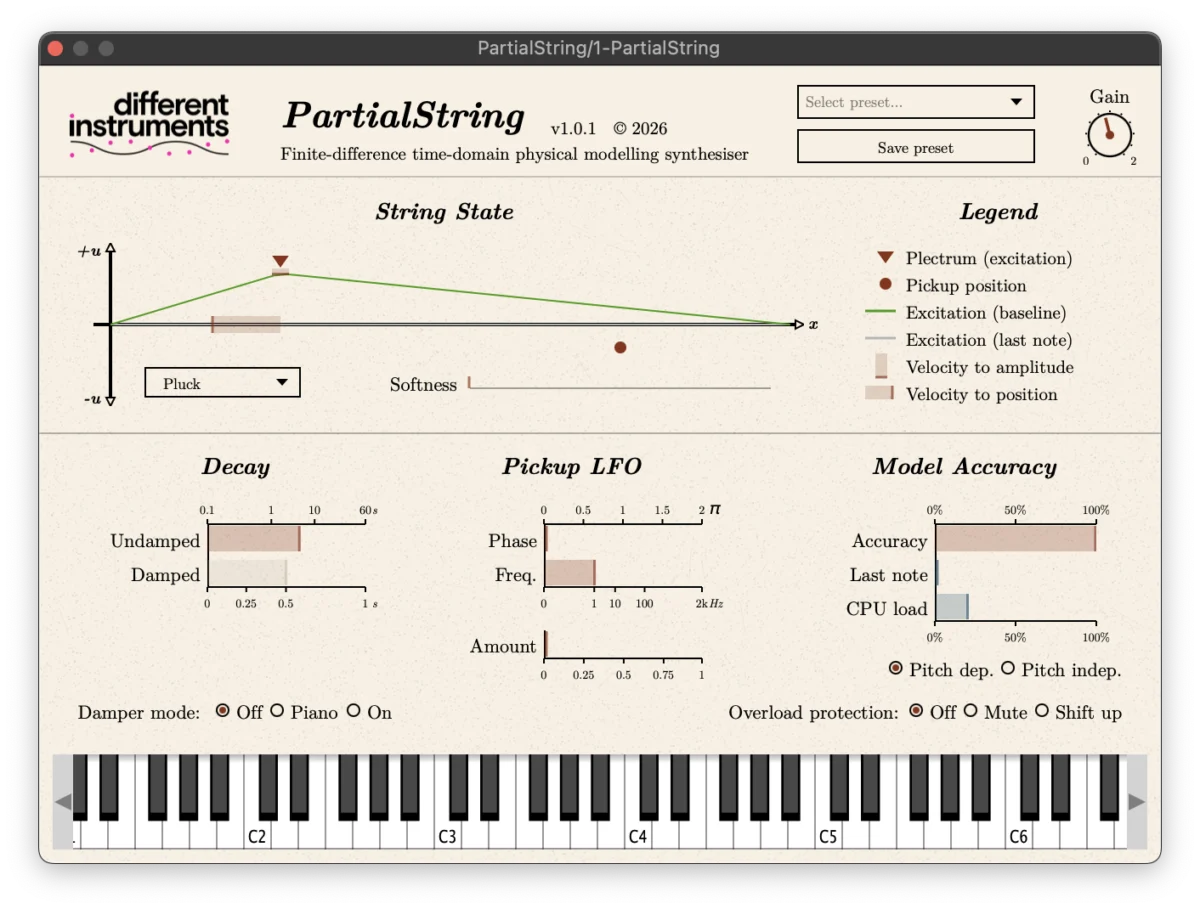
Different Instruments has officially launched PartialString, a sophisticated physical modeling synthesizer that distinguishes itself by utilizing a real-time numerical solver for the one-dimensional wave equation. Unlike traditional synthesizers that rely on pre-recorded samples or virtual analog oscillators to generate sound, PartialString functions as a digital laboratory for acoustic physics. It simulates the behavior of a vibrating string by calculating the displacement of specific points along its length in real time, offering a level of organic variation and expressive potential that is often unattainable through conventional synthesis methods.
The instrument is designed to bridge the gap between scientific simulation and musical performance. By representing a vibrating string as a series of discrete displacement points, PartialString computes the propagation of energy across the medium, accounting for the physical laws that govern tension, mass, and damping. This approach allows the synthesizer to produce harmonically rich tones that evolve naturally, mimicking the complex decay and resonance characteristics of acoustic instruments such as guitars, harps, and pianos.
The Mechanics of Real-Time Numerical Simulation
At the core of PartialString is a computational engine that solves the partial differential equations governing string vibration. In physics, the one-dimensional wave equation describes how a disturbance moves through a medium over time. By solving this equation numerically, Different Instruments enables users to interact with a virtual string that responds to input with the same logic as a physical object.
The synthesis process begins with the "excitation" of the virtual string. When a note is triggered, the system calculates the initial displacement and the subsequent movement of energy. To convert these mathematical vibrations into audible sound, PartialString employs a virtual pickup. This component functions similarly to an electromagnetic pickup on an electric guitar or a microphone placed near a string. It measures the displacement of the string at a specific point, translating the physical movement into a digital audio signal. This method ensures that the resulting sound contains the intricate phase relationships and non-linearities found in the physical world, which are difficult to replicate using standard digital signal processing (DSP) techniques.
A Chronology of Physical Modeling Synthesis
The release of PartialString represents a significant milestone in the evolution of physical modeling, a field that has transitioned from academic research to mainstream music production over several decades.
- The 1970s: Theoretical Foundations: The conceptual groundwork for physical modeling was laid by researchers such as Lejaren Hiller and Pierre Ruiz, who explored the use of finite difference methods to simulate string vibrations. However, the lack of sufficient computing power relegated these experiments to non-real-time environments.
- 1983: The Karplus-Strong Algorithm: Kevin Karplus and Alex Strong developed a simplified method for plucked string synthesis using a short delay line and a low-pass filter. While not a full physical simulation, it provided a computationally efficient way to mimic string sounds, leading to the development of the "Digital Waveguide" technique by Julius O. Smith III at Stanford’s CCRMA.
- The 1990s: Hardware Implementation: The Yamaha VL1, released in 1994, was one of the first commercial synthesizers to utilize physical modeling. It required specialized hardware to handle the intensive calculations needed for real-time performance.
- The 2000s and 2010s: VST Integration: As CPU power increased, software synthesizers like Applied Acoustics Systems’ Tassman and Chromaphone brought physical modeling to the Digital Audio Workstation (DAW). These instruments focused on resonators and modal synthesis.
- 2024: The Arrival of PartialString: PartialString leverages modern multi-core processing to perform direct numerical solving of the wave equation. This allows for a more granular simulation than the waveguide methods of the past, providing a higher degree of physical accuracy and sonic detail.
Technical Specifications and Voice Management
One of the primary challenges of physical modeling is the high computational cost associated with solving differential equations in real time. Different Instruments has addressed this through a dynamic voice allocation system. PartialString supports up to 10 voices of polyphony, but the actual number of available voices is not fixed. Instead, the instrument monitors CPU performance and the complexity of the simulated strings.
Because longer virtual strings require more displacement points to be calculated, they demand more processing power than shorter, high-pitched strings. PartialString’s engine intelligently scales the voice count to ensure stability and prevent audio artifacts. This adaptive approach allows users to push the boundaries of complex sound design while maintaining the integrity of the real-time performance.
The instrument is built for modern production environments, supporting a wide range of platforms. It is available in the following formats:
- macOS: Audio Unit (AU) and VST3.
- Windows: VST3.
- Linux: VST3.
The inclusion of Linux support is particularly notable, as it caters to a growing community of open-source music producers and developers who utilize specialized distributions for low-latency audio processing.
The Virtual Pickup and Sonic Versatility
A critical feature of PartialString is the ability to manipulate the virtual pickup. In a physical instrument, the placement of a pickup or the position of a listener’s ear significantly alters the perceived timbre. A pickup placed near the bridge of a string captures a brighter, thinner sound with prominent high-frequency harmonics, while a pickup placed toward the center captures a warmer, fundamental-heavy tone.
In PartialString, the user can adjust the position of the virtual pickup to reshape the sound without the need for traditional filters. This provides a more natural method of tone shaping, as the changes in frequency response are a direct result of the string’s physical geometry rather than an artificial EQ curve. This feature, combined with the real-time numerical solver, allows for the creation of sounds ranging from metallic, bell-like textures to soft, organic plucks.
Market Positioning and Accessibility
Different Instruments has adopted a "pay-what-you-want" contribution model for PartialString. While the instrument is available as a free download, users have the option to support the developers through financial contributions. This model has become increasingly popular in the boutique plugin industry, as seen with developers like Valhalla DSP or Tokyo Dawn Labs, who prioritize accessibility and community-driven growth.
By offering the tool for free, Different Instruments is lowering the barrier to entry for high-end physical modeling. Historically, advanced modeling synthesizers have been priced as premium products due to the complexity of their development. The availability of PartialString as a free or low-cost resource allows students, independent sound designers, and hobbyists to explore the nuances of acoustic simulation without a significant financial investment.
Comparative Analysis: Modeling vs. Sampling
The release of PartialString highlights a broader shift in the music technology industry away from massive sample libraries toward procedural and modeled instruments. While sample-based instruments (such as those found in Kontakt) offer high fidelity by playing back recordings of real instruments, they are inherently static. A sample of a guitar string is a snapshot of a single performance; it cannot truly account for the infinite ways a string might interact with subsequent notes or changes in tension.
Physical modeling, as implemented in PartialString, offers several advantages over sampling:
- Storage Efficiency: PartialString occupies a fraction of the disk space required by a high-end sample library, as the sound is generated mathematically rather than stored as audio files.
- Infinite Articulation: Because the sound is calculated in real time, every note is slightly different. The simulation reacts to velocity, pitch changes, and damping in a fluid, continuous manner.
- Malleability: Users can alter the "physics" of the virtual string—changing its material properties or tension—to create sounds that do not exist in the physical world but still possess "physical" believability.
Broader Impact and Industry Implications
The introduction of PartialString is expected to have a notable impact on sound design for film, television, and video games. In these industries, there is a constant demand for "organic" sounds that feel grounded in reality but are sufficiently unique to support fantastical or futuristic settings. The ability of PartialString to simulate the mechanical behavior of a string while allowing for impossible physical parameters makes it a valuable tool for creating otherworldly textures that still resonate with the human ear’s expectation of how objects vibrate.
Furthermore, the academic and educational implications are significant. PartialString serves as a practical demonstration of wave physics. By interacting with the synthesizer, students can visualize and hear the relationship between mathematical equations and acoustic phenomena. This reinforces the interdisciplinary link between STEM (Science, Technology, Engineering, and Mathematics) and the arts.
As Different Instruments continues to refine the PartialString engine, the industry may see further expansions into two-dimensional and three-dimensional modeling, such as the simulation of drum membranes or acoustic chambers. For now, PartialString stands as a powerful testament to the capabilities of modern software synthesis, offering a sophisticated, physics-based approach to sound generation that is both technically impressive and musically inspiring.
