

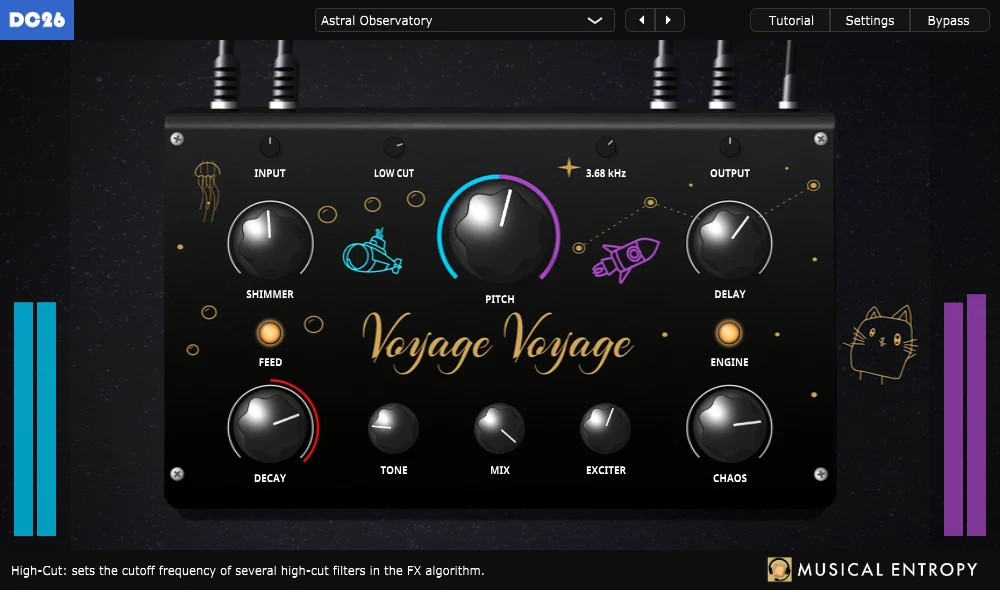
Technical Architecture and Signal Path
At its core, Voyage Voyage utilizes a complex algorithmic reverb engine designed to produce dense, ethereal tails. The primary "shimmer" effect is achieved through a feedback loop where the reverberated signal is pitch-shifted—typically by one octave—before being fed back into the input. This creates the characteristic rising harmonic "bloom" popularized by ambient pioneers in the 1980s. However, Voyage Voyage distinguishes itself by routing these pitch-shifted tails through a dedicated BBD-style delay circuit.
Bucket-brigade devices, originally analog integrated circuits used in the 1970s and 80s, are known for their distinct signal degradation, which includes high-frequency loss and harmonic distortion as delay times increase. By emulating this hardware, Voyage Voyage introduces a layer of "grain" and instability to the otherwise pristine digital shimmer. The dedicated time control for the BBD section allows users to decouple the delay rhythm from the reverb decay, enabling complex polyrhythmic textures and "smearing" effects that are difficult to achieve with standard algorithmic reverbs.
The Evolution of the KVR Developer Challenge
The KVR Developer Challenge, established in the mid-2000s, has historically been a launching pad for some of the most respected names in the audio software industry. The 2026 edition marks a milestone in the competition’s history, showcasing a level of DSP (Digital Signal Processing) sophistication that was previously reserved for high-end commercial products. The challenge mandates that all entries be original and provided to the community for free, fostering a unique environment of altruistic innovation.
Historically, the challenge has produced industry staples such as the TDR Nova equalizer and various high-quality synthesizers. Voyage Voyage enters this lineage during a period where the boundary between "utility" plugins and "creative" plugins is increasingly blurred. Industry analysts note that the 2026 entries reflect a move toward non-linear processing and "unpredictable" algorithms, catering to a market that is currently favoring organic, "lo-fi," and generative soundscapes over static, perfect digital reproductions.
Advanced Control Parameters: Chaos and Exciter
Beyond its primary reverb and delay functions, Voyage Voyage incorporates two specialized controls that expand its utility into the realm of synthesis: the Chaos knob and the Exciter knob. These parameters allow the plugin to operate independently of external audio input, a feature that has garnered attention from sound designers and film composers.
The Chaos knob serves as a multi-parameter modulator. When engaged, it introduces variable diffusion patterns and internal resonators into the signal path. This creates a "bending" effect on the reverb tails, introducing organic fluctuations that mimic the behavior of physical acoustic spaces under extreme conditions. Technically, the Chaos circuit utilizes random-walk generators and jitter algorithms to ensure that the modulation never repeats perfectly, providing a sense of lifelike motion to the sound.
The Exciter knob functions as an internal trigger mechanism. In a traditional reverb, sound is only produced when an input signal is present. The Exciter, however, generates internal impulses and low-level noise bursts that re-trigger the BBD delay lines and the shimmer feedback loop. When the decay parameter is set to its maximum, these internal triggers keep the sound engine active indefinitely. This transforms Voyage Voyage into a parametric drone generator, capable of creating evolving textures, pad sounds, and atmospheric backdrops without the need for an external synthesizer or instrument track.
Historical Context of Shimmer and BBD Technology
To understand the impact of Voyage Voyage, one must look at the history of its two primary components. Shimmer reverb was famously pioneered by producers Brian Eno and Daniel Lanois, often using the Eventide H3000 and Lexicon 224 processors. By shifting the pitch of the reverb’s return, they could simulate the sound of a "heavenly" choir or a string section accompanying a single guitar note. In the decades since, shimmer has become a staple of cinematic scores and shoegaze music.

Simultaneously, BBD technology represented the first portable way to achieve delay without using magnetic tape. Units like the Boss DM-2 or the Memory Man became legendary for their "dark" repeats. Voyage Voyage’s decision to pair the "heavenly" shimmer with the "earthy" grit of a BBD emulation is a deliberate stylistic choice. It addresses a common criticism of digital shimmer reverbs—that they can sound too "metallic" or "sterile"—by introducing the warmth and unpredictability of analog-style saturation and filtering.
Impact on the Freeware Ecosystem
The release of a tool with this level of complexity for free has significant implications for the audio software market. As commercial developers often charge upwards of $100 for specialized shimmer or "texture" plugins, the availability of Voyage Voyage via the KVR Developer Challenge 2026 pressures the industry to maintain high standards of innovation.
Furthermore, the plugin’s cross-platform compatibility and efficient CPU usage make it accessible to a wide range of users, from hobbyists in home studios to professional engineers. Early feedback from the KVR community suggests that the "instrument" aspect of the plugin—the ability to generate drones—is its most disruptive feature. By providing a self-contained sound source, it reduces the friction in the creative process for ambient and experimental music production.
Chronology of Development and Release
The development of Voyage Voyage followed the strict timeline set by the KVR Developer Challenge 2026. The submission period, which opened in early 2026, saw dozens of developers from around the globe submitting entries ranging from virtual analog synthesizers to advanced metering tools.
- January 2026: Announcement of the KVR Developer Challenge 2026 rules and categories.
- March-June 2026: Development phase, during which the creator of Voyage Voyage refined the integration of the BBD delay and the Exciter circuit.
- July 2026: Official release of the plugin to the public for testing and voting.
- August 2026: The voting period, where KVR members evaluate entries based on original innovation, sound quality, and stability.
The "Voyage Voyage" project was reportedly inspired by the desire to create a "traveling" sound—one that moves both in frequency (via the shimmer) and in time (via the BBD), hence the name.
Analysis of Implications for Modern Production
Voyage Voyage arrives at a time when "generative" music is seeing a resurgence. With the rise of modular synthesis and AI-assisted composition, producers are looking for tools that offer a degree of autonomy. The plugin’s ability to sustain a sound indefinitely via the Exciter knob aligns with this trend. It allows a producer to set up a "sound bed" that evolves over time, providing a foundation for a track that feels alive rather than programmed.
From a technical standpoint, the integration of resonators within the Chaos control suggests a sophisticated use of physical modeling synthesis principles within a spatial effect. This suggests that the developer has prioritized the "tactile" feel of the sound—how it responds to parameter changes—over simple static processing.
Conclusion and Future Outlook
As the KVR Developer Challenge 2026 progresses toward its conclusion, Voyage Voyage stands as a testament to the power of community-driven software development. It successfully combines historical audio processing techniques with modern generative features, offering a versatile tool for a variety of musical genres. Whether used as a subtle spatial enhancer or as a primary sound source for avant-garde textures, the plugin provides a level of depth rarely found in the freeware market.
The success of such entries often leads to further development, with many "Challenge" plugins eventually becoming the foundation for more expansive commercial suites. Regardless of its final standing in the competition, Voyage Voyage has already made an impact by providing musicians with a high-quality, "free-to-play" instrument that encourages exploration and sonic boundary-pushing. In an era where digital tools are ubiquitous, Voyage Voyage reminds the industry that there is still significant room for character, "chaos," and organic instability in the virtual realm.
