

The Barcelona-based synthesizer manufacturer Jasmine & Olive Trees has officially announced the release of Doppler, a compact Eurorack module designed to bridge the gap between dedicated percussion synthesis and multi-functional signal processing. This new entry into the modular synthesizer market distinguishes itself not only through its unique delay-line pitch processing engine but also through a pioneering hardware interface that allows users to switch firmware and control layouts instantaneously using physical panel overlays. By integrating high-fidelity Digital Signal Processing (DSP) with a tactile, swappable interface, Doppler aims to provide a solution for musicians seeking diverse rhythmic textures without the traditional friction associated with multi-functional digital modules.
Technical Architecture and Percussive Synthesis
At its core, Doppler is a percussion processor that utilizes a specialized delay-line pitch processor to transform incoming audio signals into rhythmic elements. Unlike traditional drum machines that rely on dedicated oscillators or noise generators, Doppler is designed to accept any external audio source—including oscillators, samples, or complex textures—and reshape them into familiar percussive forms such as kick drums, snares, and hi-hats.
The synthesis engine operates by utilizing a trigger input to reset a read head within the delay line. Upon receiving a trigger, the module initiates a pitch sweep toward a target depth, effectively creating the "falling pitch" characteristic essential for kick drum synthesis. This mechanism allows the module to maintain a relationship with the frequency content of the input signal while applying the envelope and pitch characteristics of a drum voice.
A central "Mod" knob serves as the primary interface for timbral exploration. As the knob is rotated, the module sweeps through a continuous range of processing states. At lower settings, it functions as a pitch-shifter capable of producing chords and harmonic intervals. In its middle range, it enters the "Doppler zone," where it excels at creating percussive hits with significant movement. At higher settings, the module pushes into frequency modulation (FM) and cross-modulation territory, yielding the metallic, industrial, and "noisy" timbres required for snares and cymbals.
Furthermore, the module is designed for high-intensity modulation. Every Control Voltage (CV) input on the front panel is capable of handling audio-rate modulation. This allows users to patch oscillators back into the control inputs to achieve chaotic, non-linear behaviors, further expanding the module’s palette beyond standard percussion into the realm of experimental sound design.
The Overlay System: A New Paradigm in Interface Design
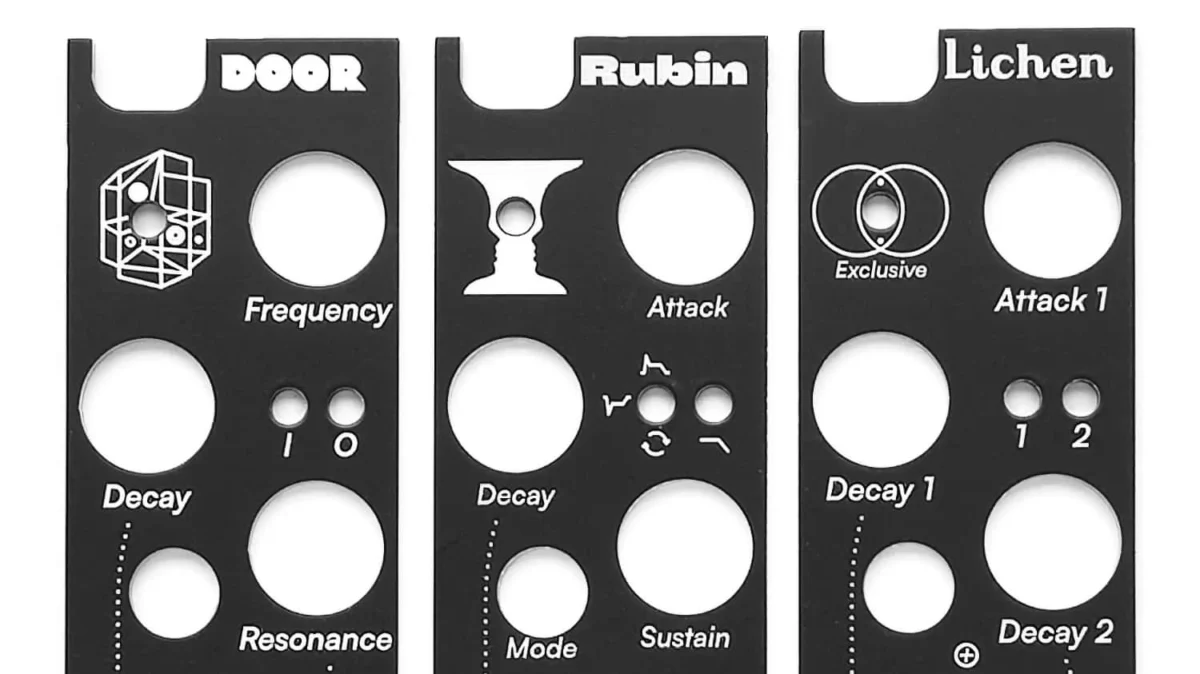
The most significant innovation introduced with the Doppler module is its "One Weird Trick"—a hardware-based firmware switching system that utilizes physical panel overlays. In the contemporary Eurorack market, multi-functional modules often require users to navigate complex menus, reflash firmware via USB or SD cards, or memorize "hidden" button combinations to change the module’s primary function.
Jasmine & Olive Trees has bypassed these hurdles by developing a system where laying a different physical overlay on top of the module instantly changes its internal firmware. This system requires no computer connection, no tools, and no downtime. When a new overlay is placed, the module detects the change and reconfigures its internal logic to match the labels and functions printed on the new panel. This ensures that the user interface is always accurate to the module’s current state, a common pain point in the modular community where multi-function modules often have confusing or irrelevant labeling.
The Doppler module ships with three overlays included at no additional cost. These overlays allow the single piece of hardware to function as:
- A Low Pass Gate (LPG): Providing classic West Coast-style organic plucks and filtered decays.
- A Dedicated Drum Voice: Optimized for the core percussion synthesis engine.
- A Stereo ADSR Envelope Generator: Offering precise control over temporal dynamics.
- A Pair of Envelope VCAs: Combining amplification with envelope shaping for streamlined signal paths.
By offering these diverse functional modes, Doppler effectively occupies the space of four or five separate modules within a compact footprint, making it an attractive option for "small-format" or travel-friendly Eurorack systems where space (HP) is at a premium.
Chronology of Development and Market Context
The development of Doppler reflects a broader trend in the music technology industry toward "software-defined hardware." This movement, which has seen significant growth over the last decade, involves creating standardized hardware platforms that can be radically transformed by software updates. Notable predecessors in this space include the Expert Sleepers Disting series and the Electro-Smith Daisy platform.
However, the history of the Eurorack format has often been defined by a tension between the flexibility of digital modules and the immediacy of analog "one-knob-per-function" designs. Jasmine & Olive Trees began the Doppler project with the intent to solve the "menu-diving" problem that often plagues digital Eurorack units.

The timeline of the module’s release follows a period of intense research into DSP-based percussion. By utilizing a delay-line approach rather than simple wavetable or subtractive synthesis, the developers sought to create a module that felt "alive" and responsive to the nuances of the input signal. The introduction of the overlay system represents the final stage of this development, moving the product from a specialized drum module to a versatile utility platform.
Impact on the Eurorack Ecosystem
Industry analysts and modular synthesis enthusiasts have noted that the Doppler’s overlay system could signal a shift in how manufacturers approach multi-functional design. The modular synthesizer market, currently valued at hundreds of millions of dollars globally, is increasingly driven by users who prioritize tactile feedback and "playable" interfaces.
The implications of the Doppler system are twofold. First, it lowers the barrier to entry for complex digital synthesis by providing a clear, physical map of functions. Second, it offers a sustainable hardware model. Because the Doppler is built on a robust DSP platform, the manufacturer has indicated that future "family firmwares" can be developed and released. This means that as new synthesis algorithms or utility functions are created, users can simply acquire a new overlay and update their module, effectively gaining a new instrument without purchasing new hardware.
This "future-proof" aspect is particularly relevant in an era of global supply chain fluctuations, where the cost of specialized components can make traditional hardware manufacturing unpredictable. By focusing on a single, high-quality hardware base that can be reconfigured, Jasmine & Olive Trees is positioning itself within a more sustainable and flexible manufacturing framework.
Pricing, Availability, and Specifications
The Doppler module is currently available through the Jasmine & Olive Trees website and authorized modular synthesizer retailers. It is priced at $265 USD, a competitive price point considering its multi-functional capabilities and the inclusion of three physical overlays.
Key Specifications Include:
- Format: Eurorack (3U).
- Width: Compact HP footprint (specific measurements vary by regional distributor).
- Input/Output: Audio input for processing, Trigger input, Mod CV, and various outputs depending on the active overlay.
- Architecture: High-speed DSP platform capable of audio-rate modulation across all CV inputs.
- Included Accessories: Three firmware-switching overlays.
The module has already garnered attention from prominent figures in the modular community. A video demonstration by "Cinematic Laboratory" showcased the module’s ability to turn basic sine waves from a Make Noise DPO into complex, industrial percussion sequences, highlighting the module’s ability to act as a "timbral bridge" between simple oscillators and finished drum sounds.
Professional Reception and Future Outlook
Early reactions from the synthesizer community suggest that the "no-reflash" firmware switching is the module’s most disruptive feature. Professional sound designers have pointed out that in a live performance context, the ability to switch a module from a drum voice to a stereo envelope generator in seconds—without touching a screen or a computer—is a significant advantage.
"The challenge with digital modules has always been the cognitive load of remembering what a knob does in a specific sub-menu," noted one independent reviewer. "By using physical overlays, Jasmine & Olive Trees has returned the ‘modular’ feel to digital processing. It feels like hardware again."
Looking forward, the success of Doppler may encourage other manufacturers to adopt similar tactile switching methods. As DSP chips become more powerful and affordable, the distinction between a "module" and a "platform" continues to blur. Jasmine & Olive Trees has positioned Doppler at the forefront of this evolution, offering a product that respects the traditional tactile values of the Eurorack format while embracing the limitless possibilities of digital sound processing.
As of its launch, the Doppler stands as a testament to the innovation occurring in the European synthesizer scene, particularly in hubs like Barcelona. It represents a move toward more thoughtful, user-centric design in an increasingly crowded and complex market. For the modular musician, the Doppler offers a promise of versatility without the usual complexity, wrapped in a package that is as much a physical tool as it is a digital instrument.
