

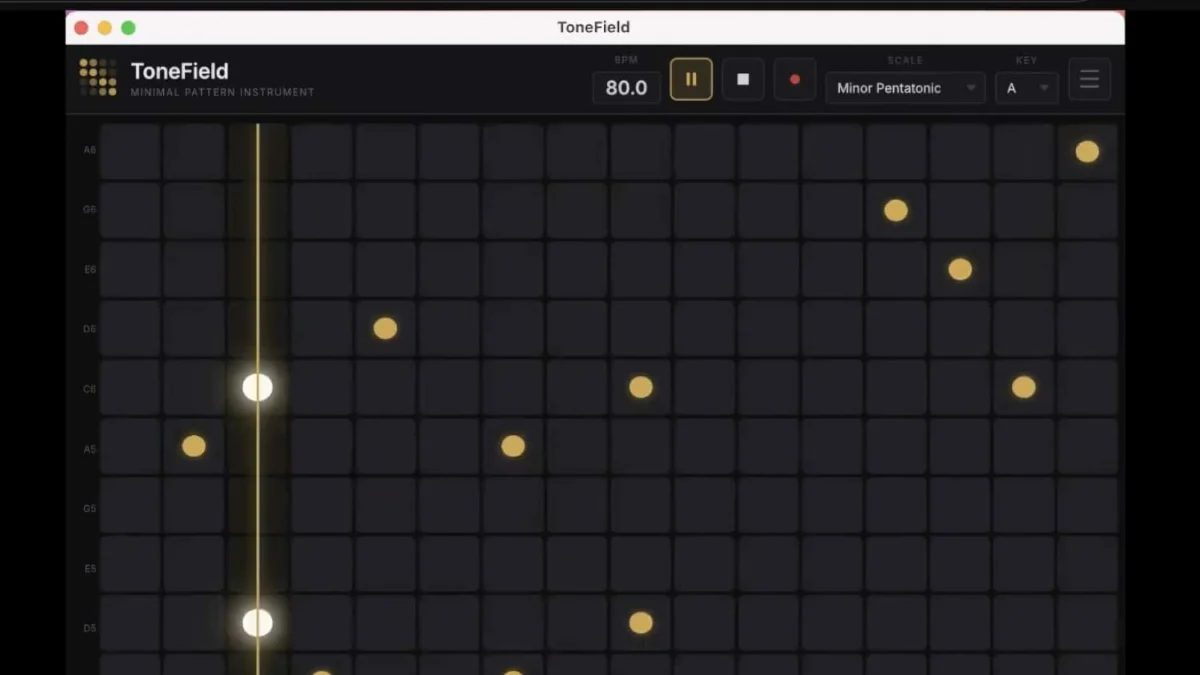
The landscape of digital music production has witnessed a significant revival of minimalist design principles with the official release of ToneField, a new software instrument developed by musician and programmer Matt Goodluck. Designed as a spiritual and functional successor to the now-defunct but historically significant application TonePad Pro, ToneField represents a concerted effort to modernize the "grid-based" sequencing experience for a new generation of composers and hobbyists. The instrument aims to bridge the gap between casual musical exploration and professional-grade generative composition, offering a streamlined interface that prioritizes intuition over complex menu-diving.
Matt Goodluck, the primary architect behind the project, identified a persistent void in the market following the disappearance of TonePad Pro from modern app ecosystems. By rebuilding the core concept from the ground up, Goodluck has integrated contemporary features such as probability-based sequencing, advanced scale management, and robust export options that were absent in earlier iterations of this design philosophy. ToneField is currently positioned as an accessible yet deep creative tool, retailing for $14.99 USD, targeting users who seek an "addictive" and "evolving" musical workflow.
The Legacy of Grid-Based Sequencing and the Path to ToneField
The conceptual foundation of ToneField traces back to the early 21st-century fascination with visual music interfaces. In 2009, the release of TonePad Pro by developer Eric Mika (Pandav) captured the attention of the burgeoning mobile music community. It utilized a simple 16×16 grid where users could place "dots" that triggered notes as a playhead scanned horizontally. This interface was heavily influenced by the Yamaha Tenori-on, a hardware instrument designed by Toshio Iwai, which emphasized the visual representation of sound patterns.
However, as mobile and desktop operating systems evolved—specifically with the transition to 64-bit architecture and more stringent API requirements—many of these pioneering "minimalist" apps fell into obsolescence. Users who relied on TonePad for quick melodic ideation were left without a modern equivalent that maintained the original’s simplicity while offering the file-handling capabilities required by modern digital audio workstations (DAWs).
Recognizing this shift, Matt Goodluck began the development of ToneField with the intent to preserve the "musical crack" quality—a term often used by the community to describe the addictive nature of grid sequencers—while addressing the technical limitations of the past. The timeline of ToneField’s development reflects a broader trend in the software industry where "abandonware" concepts are being revitalized by independent developers who value user experience over feature bloat.
Technical Specifications and Core Functionalities
ToneField operates on a pattern-based workflow that is both deterministic and generative. At its heart is a grid-based canvas where users interact with the interface to create melodic and rhythmic structures. Unlike traditional piano rolls found in software like FL Studio or Logic Pro, ToneField’s grid is inherently tied to a mathematical relationship between visual space and tonal frequency.
Generative Probability and Evolution
One of the most significant additions to the ToneField architecture is the inclusion of probability controls. In traditional sequencing, a note placed on a grid will play every time the playhead passes over it. In ToneField, users can assign a percentage of likelihood to any given "dot." This introduces a stochastic element to the music, allowing a pattern to sound different with every loop. This feature aligns ToneField with the "generative music" movement championed by figures like Brian Eno, where the composer sets a series of rules and allows the software to navigate the permutations.
Scale and Mode Selection
To ensure musicality across different genres, Goodluck has implemented a comprehensive suite of selectable scales and modes. In earlier iterations of grid sequencers, users were often locked into a pentatonic or major scale to prevent dissonance. ToneField allows for greater harmonic complexity, enabling users to switch between Dorian, Phrygian, Lydian, and other modal structures. This ensures that the instrument can be used for everything from ethereal ambient soundscapes to more tension-heavy cinematic scoring.
Recording and Export Capabilities
A critical critique of early grid-based apps was their "walled garden" nature, where music created within the app could not easily be transferred to other professional environments. ToneField addresses this by providing:
- Live Performance Recording: Users can capture their interactions with the grid in real-time, preserving the spontaneous changes made during a session.
- MIDI Export: This allows the mathematical data of the patterns to be moved into a DAW, where they can trigger high-end virtual instruments or hardware synthesizers.
- Audio Export: For quick sharing or sampling, users can export high-quality audio files directly from the application.
Supporting Data: The Rise of Minimalist Creative Tools
The release of ToneField coincides with a documented increase in the demand for "distraction-free" creative software. According to market analysis of the independent music software sector, there has been a 15% year-over-year growth in the "utility and creative sequencer" niche. Producers are increasingly moving away from "all-in-one" solutions in favor of small, specialized tools that solve specific creative blocks.
Data from user forums and software repositories indicate that the "grid sequencer" remains one of the most searched-for legacy interfaces. The simplicity of a 16×16 or 32×32 grid reduces the "paradox of choice," a psychological state where an abundance of options leads to creative paralysis. By limiting the user to a specific set of visual and tonal parameters, ToneField facilitates a "flow state" that is often cited as the primary appeal of the original TonePad Pro.
Industry Response and User Reception
While formal reviews from major publications are pending, the initial response from the independent electronic music community has been largely positive. Beta testers have noted that ToneField feels "familiar yet expansive." The consensus among early adopters is that the addition of pattern management—allowing users to save and recall different grid states—transforms the tool from a toy into a legitimate compositional aid.
Musicians working in the ambient and "lo-fi" genres have expressed particular interest in the probability features. In these genres, subtle variations over long periods are essential to maintaining listener interest without being overly repetitive. The ability to export MIDI has also been highlighted as a "game-changer" for producers who want to use the unique "visual logic" of the ToneField grid to drive complex FM synthesizers or orchestral libraries.
Broader Impact and Implications for Digital Composition
The launch of ToneField signifies a broader shift in the philosophy of software development for the arts. It highlights the importance of "software heritage," where the best ideas of the early digital era are not lost to time but are instead refined and re-released with modern infrastructure.
For the educational sector, ToneField offers a low-barrier entry point for students to learn about rhythm, melody, and the concept of "aleatoric" (chance-based) music. Because it does not require a deep understanding of music theory to produce a pleasing result, it functions as an egalitarian tool that democratizes the act of composition.
From a professional standpoint, ToneField challenges the dominance of the "linear timeline" in music production. By forcing the composer to think in terms of cycles, grids, and probabilities, it encourages a non-linear approach to songwriting. This can lead to the discovery of melodic motifs that would be unlikely to occur in a traditional keyboard-based environment.
Pricing and Availability in the Current Market
ToneField is available via the developer’s official website for a flat fee of $14.99 USD. This pricing strategy avoids the controversial "subscription model" that has become prevalent in the software industry, a move that has been praised by the user community. By offering a perpetual license for a modest price, Goodluck positions ToneField as an essential "utility" for any producer’s digital toolkit.
As the software matures, the developer has hinted at potential updates, including further expansion of the grid size and deeper integration with external hardware controllers. For now, ToneField stands as a testament to the enduring power of simple, well-executed design in an increasingly complex digital world. It serves as both a nostalgic nod to the early days of touch-screen music and a forward-looking instrument that embraces the unpredictable beauty of generative algorithms.
