

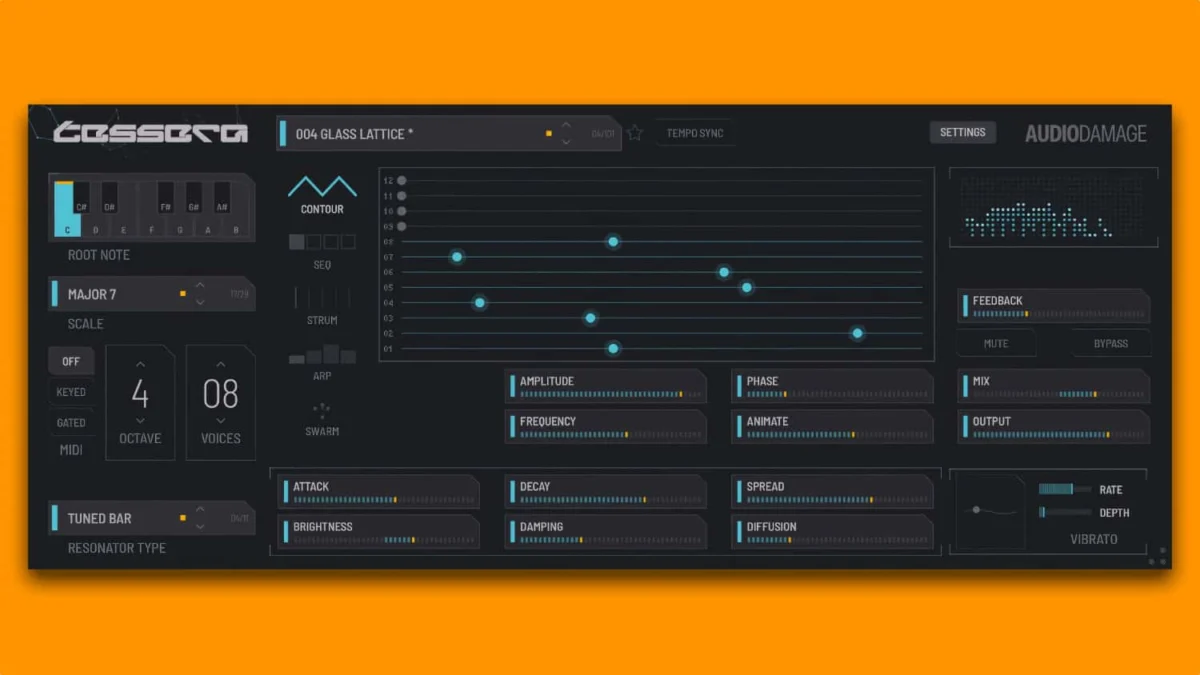
Audio Damage, a veteran developer in the digital signal processing arena, has officially released Tessera, a sophisticated effects plugin designed around a bank of twelve parallel resonator voices. This release represents a significant expansion of the company’s portfolio of creative processors, moving away from traditional subtractive filtering and standard time-based effects toward a more complex, physically modeled approach to sound manipulation. By utilizing a multi-voice resonator architecture, Tessera allows users to transform incoming audio signals—ranging from simple percussive clicks to complex melodic phrases—into rich, harmonically resonant textures that adhere to specific musical scales and chord structures.
The core functionality of Tessera centers on the excitation of twelve independent resonator voices. Unlike a traditional synthesizer where an internal oscillator provides the sound source, Tessera relies on "excitation" from external audio. When an audio signal enters the plugin, it triggers the resonators, which are tuned to specific frequencies corresponding to a user-defined musical framework. This mechanism enables a unique form of sound design: transient-heavy material such as drum loops can be transformed into ethereal melodic sequences, while sustained pads can be imbued with metallic, string-like, or wood-like tonal characteristics.
Technical Architecture and Physical Modeling Engines
At the heart of Tessera’s processing power is a suite of eleven distinct physical-model resonator types. Physical modeling synthesis differs from traditional sampling or wavetable synthesis by using mathematical equations to simulate the physical properties of real-world objects, such as the vibration of a string, the resonance of a hollow tube, or the strike of a metal plate. By incorporating these models into an effects plugin, Audio Damage provides a tool that responds dynamically to the input signal’s amplitude and frequency content.
The twelve parallel voices can be configured to follow specific chords or scales, ensuring that the resulting resonance is always musically coherent with the rest of a production. The plugin’s internal logic manages the distribution of these voices across the stereo field, providing a sense of width and spatial depth that is often difficult to achieve with standard equalization. To further refine the output, the engine includes comprehensive controls for decay, damping, and brightness. These parameters allow the user to dictate how long the resonance persists and how much high-frequency energy is absorbed over time, mimicking the acoustic properties of different environments and materials.
Furthermore, Tessera features a sophisticated "motion" section consisting of five tempo-syncable engines. These modulation sources are designed to add movement to the resonator parameters, preventing the output from sounding static. By syncing these engines to the host digital audio workstation (DAW) tempo, producers can create rhythmic harmonic patterns that evolve in lockstep with the beat of a track. This level of control positions Tessera not just as a "set-and-forget" effect, but as a performative tool capable of generating complex, shifting soundscapes.
Chronology of Development and Release
The development of Tessera follows a long line of innovative DSP tools from Audio Damage, a company founded by Chris Randall and Adam Schabtach. For over two decades, the firm has been known for pushing the boundaries of what is expected from audio plugins, often favoring experimental and "glitch" aesthetics over emulations of vintage hardware. The conceptual roots of Tessera can be traced back to the company’s previous explorations in granular synthesis and physical modeling, seen in products like Quanta and the legacy of their "Mod" series.
The official launch of Tessera occurred in mid-2024, following a period of internal beta testing aimed at refining the user interface and ensuring stability across multiple operating systems. Audio Damage has historically been an early adopter of cross-platform compatibility, and the release of Tessera continues this trend. Upon launch, the plugin was made available for macOS, Windows, and notably, Linux. The inclusion of Linux support highlights a growing trend in the professional audio industry to cater to a niche but dedicated community of developers and musicians using open-source platforms.
The company has also confirmed that an iOS version of Tessera is currently in development. This follows Audio Damage’s established strategy of bringing their desktop-class algorithms to mobile platforms, utilizing Apple’s AUv3 format to allow mobile producers to access the same high-end processing power available in a studio environment.

Supporting Data and Market Context
In the current landscape of the music software industry, the "creative effects" market has seen a surge in demand for tools that offer more than simple utility. According to industry analysis, the rise of ambient, cinematic, and experimental electronic music has driven a 15% increase in the adoption of physical modeling and spectral processing tools over the last three years. Tessera enters this market at a competitive price point, initially offered at an introductory rate of $39 USD, with a standard retail price of $49 USD.
This pricing strategy places Tessera in a unique position. It is more affordable than many high-end "boutique" resonators, which can retail for over $100, yet it offers a feature set that rivals more expensive counterparts. The decision to offer twelve voices—as opposed to the three or four found in more basic resonator plugins—provides a significant technical advantage for users looking to create full-bodied harmonic structures.
The plugin also addresses a common pain point in digital production: the "sterile" nature of digital audio. By introducing physical modeling characteristics, Tessera adds "jitter," non-linearities, and organic decay patterns that help digital sounds feel more "real" or acoustic. This is particularly relevant for film composers and sound designers who require tools that can bridge the gap between synthetic sound design and organic instrumentation.
Official Statements and Industry Reaction
While formal press releases from Audio Damage tend to be focused on technical specifications, founder Chris Randall has frequently discussed the design philosophy behind the company’s recent output on social media and industry forums. The consensus from the development team suggests that Tessera was designed to be "unapologetically digital yet organically responsive." The goal was to create a tool that could turn "boring" sounds into something "unexpected and beautiful" without requiring the user to have a deep understanding of acoustic physics.
Initial reactions from the sound design community have been overwhelmingly positive. Early adopters have praised the plugin’s ability to generate "instant atmosphere" and its low CPU overhead despite the complexity of the twelve-voice modeling engine. Professional sound designers working in the gaming industry have noted that the plugin’s ability to tune resonators to specific scales is a "game-changer" for creating melodic UI sounds and ambient backgrounds that remain in key with a game’s soundtrack.
Broader Impact and Implications for Music Production
The release of Tessera reflects a broader shift in the music production workflow. As traditional mixing tools like compressors and EQs become increasingly standardized and often automated by AI-driven assistants, the role of the "creative effect" has become the primary site for artistic differentiation. Tools like Tessera allow producers to find a "signature sound" by manipulating audio in ways that were previously only possible through complex modular synthesizer setups or expensive hardware resonators.
Furthermore, the cross-platform availability of Tessera (Windows, macOS, Linux, and soon iOS) underscores the democratization of high-end sound design. By making these tools accessible and affordable, Audio Damage is contributing to a landscape where the quality of one’s tools is no longer a barrier to entry for professional-grade production.
Looking ahead, the implications of Tessera’s physical modeling engine suggest a future where effects are not just static processors but active participants in the composition. As more developers move toward reactive, intelligent effects that respond to the nuances of a performance, the line between "instrument" and "effect" continues to blur. Tessera stands as a prime example of this evolution, offering a glimpse into a future where any sound can be the seed for an entire harmonic universe.
In conclusion, Audio Damage’s Tessera is a significant addition to the modern producer’s toolkit. By combining twelve-voice parallel resonance with sophisticated physical modeling and a flexible modulation system, it provides a powerful platform for harmonic exploration. Its competitive pricing and broad platform support ensure that it will likely become a staple for electronic musicians, film composers, and sound designers seeking to push the boundaries of conventional audio processing.
