

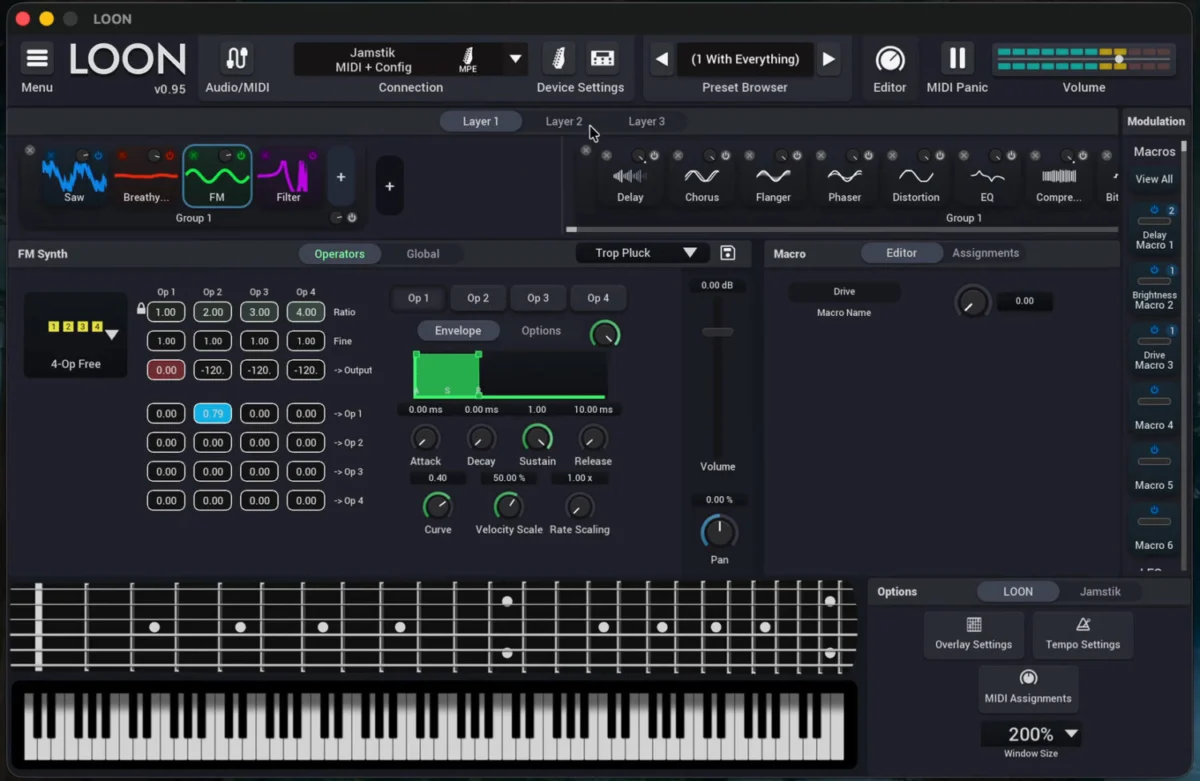
The music technology landscape has witnessed a significant expansion with the official release of LOON, a sophisticated software instrument developed by Jamstik. Known primarily for their innovative MIDI guitar hardware, Jamstik has pivoted toward a more integrated ecosystem by launching a versatile synthesizer that bridges the gap between traditional sampling and modern synthesis techniques. LOON is engineered as a multi-layered hybrid instrument, allowing users to construct complex sonic textures by blending oscillators, sampled instruments, Frequency Modulation (FM) synthesis, and high-fidelity effects within a singular, streamlined interface.
The introduction of LOON marks a strategic milestone for the company, which has spent the last decade refining the intersection of string-based performance and digital sound generation. By offering LOON as both a standalone application and a plugin for major Digital Audio Workstations (DAWs), Jamstik is positioning itself to compete in a crowded market currently dominated by established giants like Spectrasonics, Arturia, and Native Instruments.
The Architecture of LOON: A Three-Layered Approach
At the core of LOON’s design philosophy is its three-layer architecture. Unlike traditional synthesizers that often limit the user to a single sound engine per instance, LOON provides three independent layers, each capable of hosting its own distinct instrument groups and signal chains. This modular approach allows for the creation of "massive" sounds that retain clarity and definition, as each layer can be processed and modulated independently before being summed at the master output.
Each of the three layers functions as a self-contained synthesis environment. Users can assign a diverse array of sound sources to these layers, including:
- Virtual Analog Oscillators: Providing the classic warmth and grit associated with subtractive synthesis.
- Sampled Instruments: High-quality digital recordings of acoustic and electronic instruments, offering a realistic foundation for hybrid patches.
- FM Synthesis Engines: Allowing for the complex, metallic, and percussive timbres that are hallmarks of frequency modulation.
To manage this complexity, Jamstik has implemented a robust macro control system. This feature allows producers to map multiple parameters across all three layers to a single performance control. For example, a single macro knob could simultaneously increase the filter cutoff of Layer 1, the FM index of Layer 2, and the reverb tail of Layer 3, enabling dynamic, evolving soundscapes that respond intuitively to live performance or automation.
MIDI Polyphonic Expression (MPE) and Modern Connectivity
One of the standout features of LOON is its comprehensive support for MIDI Polyphonic Expression (MPE). In the traditional MIDI standard, messages like pitch bend or modulation affect every note being played simultaneously. MPE revolutionizes this by allowing each individual note within a chord to have its own independent expression data.
LOON’s integration of MPE is a direct nod to the evolving needs of modern performers who utilize controllers such as the Roli Seaboard, the LinnStrument, or Jamstik’s own line of MIDI guitars. With MPE enabled, a musician can slide a single note in a chord upward while the other notes remain static, or apply pressure-sensitive vibrato to individual voices. This level of granular control transforms the software instrument from a static playback device into a living, breathing performance tool.
Beyond MPE, LOON is designed for broad compatibility. It supports the VST3, Audio Unit (AU), and AAX plugin formats, ensuring it functions seamlessly within industry-standard software such as Ableton Live, Logic Pro, Pro Tools, and FL Studio. For musicians who prefer a distraction-free environment, the standalone application allows LOON to run without the overhead of a DAW, making it an ideal choice for live stage setups.
Historical Context: The Evolution of Jamstik
To understand the significance of LOON, one must look at the trajectory of its developer, Jamstik (a brand under the Zivix umbrella). The company first gained international attention through highly successful crowdfunding campaigns for its portable MIDI guitars. These devices were designed to give guitarists the same level of access to digital music production that keyboardists have enjoyed for decades.
Over the years, Jamstik transitioned from producing consumer-grade learning tools to professional-grade instruments, such as the Jamstik Studio MIDI Guitar. Throughout this evolution, the company recognized a recurring challenge: while their hardware was capable of sending complex MIDI data, many software synthesizers were not optimized to receive and interpret the nuances of guitar-based performance.
The development of LOON serves as the solution to this problem. By creating their own software engine, Jamstik has been able to optimize the "tracking" and "feel" of their hardware-software integration. While LOON is a powerful tool for any keyboardist or producer, it is specifically tuned to respond to the high-density data output of MIDI guitars, providing a lower-latency and more expressive experience than many third-party alternatives.

Technical Specifications and Sound Library
LOON ships with a substantial library of over 200 factory presets. These presets are designed to showcase the versatility of the hybrid engine, ranging from cinematic pads and aggressive bass leads to delicate plucks and experimental textures. The factory content serves as both a production-ready resource and a learning tool for users to deconstruct how complex patches are built within the three-layer system.
The effects chain within LOON is equally comprehensive. Each layer features its own dedicated processing rack, which includes:
- Time-based effects: High-fidelity delays and reverbs.
- Dynamic processors: Compressors and limiters to manage the signal peak of complex layers.
- Modulation effects: Choruses, flangers, and phasers for added movement.
- Distortion and Saturation: Tools for adding harmonic richness and character.
The modulation matrix in LOON allows for deep routing, where Low-Frequency Oscillators (LFOs) and Envelopes can be assigned to almost any parameter within the synth engine. This flexibility ensures that sound designers can create "living" sounds that change over time, a requirement for modern film scoring and electronic music production.
Market Analysis and Competitive Positioning
The release of LOON comes at a time when the "Hybrid Synth" category is experiencing a renaissance. Producers are increasingly moving away from "pure" synthesis (only oscillators) or "pure" sampling (only recorded sounds) in favor of instruments that combine both.
At its introductory price point of $49.99 (with a regular MSRP of $99.99), LOON is positioned as an aggressive competitor in the mid-tier software market. Many comparable hybrid synthesizers retail for between $150 and $500. By keeping the price accessible, Jamstik is likely aiming to build a large user base quickly, particularly among home studio enthusiasts and the growing community of MIDI guitarists.
Furthermore, the decision to bundle LOON at no additional cost with eligible Jamstik MIDI Guitar purchases is a strategic move to increase the value proposition of their hardware. It creates a "walled garden" of sorts, where the hardware and software are designed to bring out the best in each other, similar to the ecosystems created by companies like Universal Audio or Arturia.
Industry Implications and Future Outlook
The launch of LOON suggests a broader trend in the music technology industry: the blurring of lines between hardware manufacturers and software developers. As processing power in modern computers continues to grow, the demand for sophisticated, CPU-efficient software instruments has never been higher.
Industry analysts suggest that Jamstik’s move into high-end software synthesis is a signal of their intent to become a full-service music technology provider. By controlling both the input device (the guitar) and the sound source (the software), Jamstik can eliminate many of the technical hurdles—such as MIDI mapping and velocity scaling—that often frustrate digital musicians.
In the coming months, it is expected that Jamstik will continue to expand the LOON ecosystem through additional preset packs and firmware updates that may introduce new synthesis models, such as wavetable or physical modeling. As MPE becomes a standard requirement for professional-grade software, LOON’s early and robust adoption of the technology places it ahead of many legacy instruments that have struggled to adapt to the new expressive standard.
Pricing and Availability
LOON is currently available for purchase through the official Jamstik website and authorized digital retailers. The software is compatible with macOS and Windows systems. For a limited time, the instrument is offered at an introductory price of $49.99 USD, representing a 50% discount from its standard retail price of $99.99 USD.
Owners of Jamstik hardware should check their user accounts, as the company has confirmed that LOON is included for free with recent and eligible MIDI guitar purchases, further cementing the bond between their physical and digital product lines.
As the digital music production world continues to evolve, LOON stands as a testament to the power of hybrid design. It offers a bridge between the tactile world of physical performance and the infinite possibilities of digital synthesis, providing a versatile tool for the next generation of sound designers and performers.
