

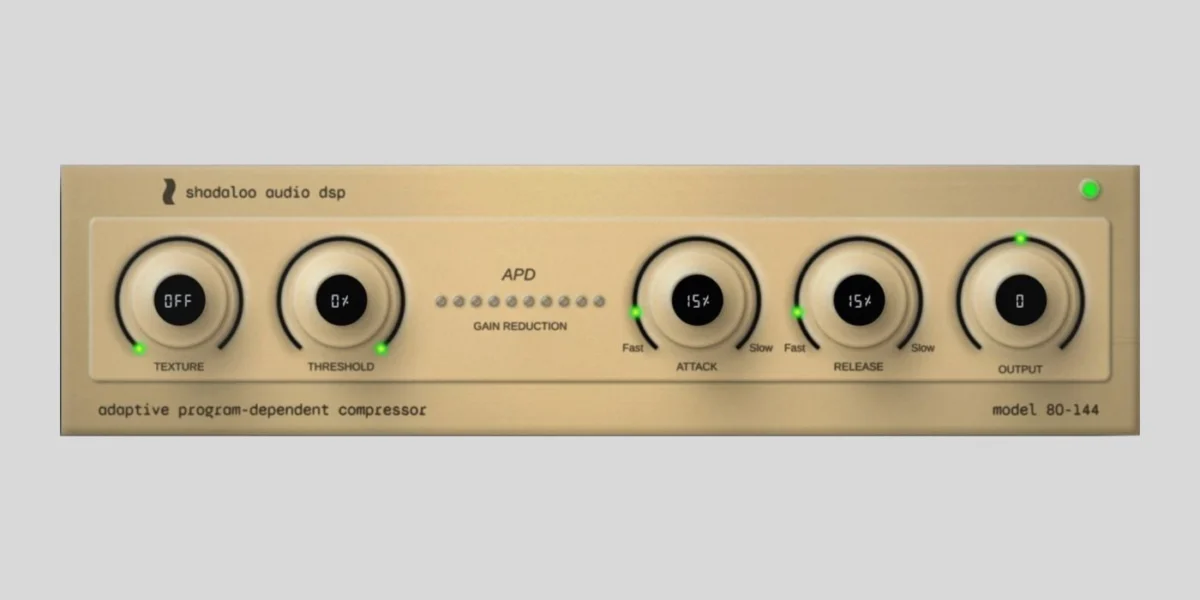
Shadaloo Audio DSP has officially launched the APD Compressor, a meticulously engineered vocal compressor plugin now available for macOS and Windows, adopting a flexible free/pay-what-you-want (PWYW) distribution model. This release marks another significant contribution from developer Fabio "Shadaloo" Caterino to the audio production community, building upon his growing reputation for delivering high-quality, accessible tools. The plugin, designed from the ground up and fine-tuned specifically for vocal processing, promises to streamline mixing workflows and enhance sonic clarity for producers at all levels.
A New Standard in Vocal Dynamics Control
The APD Compressor enters a competitive market with a clear mission: to provide a focused, intelligent solution for one of the most critical aspects of audio mixing—vocal dynamics. At its core, a compressor is an essential tool for evening out the volume of an audio signal, making quiet parts louder and loud parts quieter, thereby ensuring a vocal performance sits consistently within a mix. However, the complexities of compression, particularly for beginners, often present a steep learning curve. Shadaloo Audio DSP’s latest offering seeks to demystify this process through an intuitive interface and a design philosophy centered around specialized application.
Fabio Caterino, the driving force behind Shadaloo Audio DSP, has revealed that the APD Compressor is the result of extensive development, having been personally integrated into his own mixing regimen over several months. This hands-on, practical application by the developer himself underscores a commitment to real-world utility and performance. The explicit tuning for vocals is a deliberate choice, acknowledging that while general-purpose compressors exist, a tool optimized for the nuances of the human voice can yield superior results and a more efficient workflow. Vocal tracks often present unique challenges, such as wide dynamic ranges, transient sibilance, and subtle expressive variations that require precise and often transparent dynamic control. The APD Compressor aims to address these specific needs with precision.
Shadaloo Audio DSP: A Trajectory of Innovation and Accessibility
The release of the APD Compressor is not an isolated event but rather the latest chapter in Shadaloo Audio DSP’s burgeoning narrative of innovation and community engagement. Over the past year, Fabio Caterino has steadily garnered attention for a series of impactful plugin releases, each characterized by a blend of technical prowess and user-centric design.
Chronology of Key Releases:
- March 28, 2026: Shadaloo Audio DSP introduced the H tone and loudness enhancer. This free plugin quickly gained traction for its ability to add perceived loudness and tonal character without excessive processing, becoming a staple for many producers seeking quick and effective mastering chain additions.
- April 24, 2026: Following the success of ‘H,’ the developer launched Wide, a spatial enhancement plugin designed to broaden the stereo image of audio signals. ‘Wide’ was praised for its ability to create depth and width without introducing phase issues, a common pitfall in stereo manipulation.
- June 16, 2026: Shadaloo Audio DSP unveiled Vinland Drive, a free tape emulator plugin. This release was particularly well-received, lauded for its authentic emulation of analog tape saturation, warmth, and subtle dynamic characteristics. ‘Vinland Drive’ offered an accessible way for producers to inject vintage character into their digital recordings, further cementing Fabio Caterino’s reputation for delivering high-value tools.
- August 2, 2026 (Latest Update): The APD Compressor’s official release and subsequent updates reinforce this trajectory, offering a specialized solution that aligns with the developer’s philosophy of accessible, high-quality audio processing.
This rapid succession of releases, often accompanied by the PWYW model, has allowed Shadaloo Audio DSP to cultivate a loyal user base. The strategy emphasizes building trust and providing tangible value before requesting monetary compensation, fostering a symbiotic relationship between developer and user. This approach aligns with a growing trend in the independent audio software market where quality and community support often outweigh traditional marketing budgets.
Architectural Insight: Controls and Adaptive Intelligence
The APD Compressor’s interface features a concise yet powerful array of five primary controls: Texture, Threshold, Attack, Release, and Output, complemented by a clear 10-LED gain reduction meter. This streamlined layout is indicative of its vocal-focused design, prioritizing usability without sacrificing depth.
Central to its operation is an intelligent, adaptive processing engine. Unlike many conventional compressors where Threshold, Attack, and Release are treated as entirely static and isolated parameters, the APD Compressor exhibits dynamic responsiveness. It actively "reacts to the incoming material," meaning that as the amount of compression varies, the envelope behavior (how quickly the compressor engages and disengages) adapts accordingly. This "signal-adaptive" attack and "program-dependent" release mechanism significantly reduces the need for constant micro-adjustments, allowing the compressor to maintain a more natural and transparent sound across diverse vocal performances. For users, this translates to fewer artifacts and a more musical response, even with aggressive settings.
The Nuance of Texture: Integrated Harmonic Saturation
A standout feature of the APD Compressor is its "Texture" control. This unique parameter goes beyond simple compression, integrating a pre-compression, level-dependent harmonic saturation stage. When set to ‘Off,’ this stage is completely bypassed, offering pure compression. However, from 1% upwards, it introduces a subtle yet powerful character enhancement.
The saturation engine operates with 4x oversampling, a crucial detail that ensures high-fidelity processing by reducing aliasing artifacts, particularly with harmonic generation. According to Shadaloo Audio DSP, the Texture control primarily introduces 2nd, 3rd, and 4th harmonic content while carefully restraining higher-order harmonics. This specific harmonic profile is vital for vocal processing:
- 2nd Harmonics: Often associated with warmth, fullness, and a subtle thickening of the sound, making vocals feel more present and grounded.
- 3rd Harmonics: Contribute to a sense of clarity, aggression, and a more pronounced edge, helping vocals cut through a dense mix without becoming harsh.
- 4th Harmonics: Can add further richness and a sense of "air" or sparkle, enhancing the perceived detail and presence.
The strategic integration of this saturation stage before the compression circuit offers a distinct advantage. By subtly enriching the vocal’s harmonic content pre-compression, the compressor then acts upon a more harmonically dense signal, often resulting in a richer, more vibrant compressed sound. This eliminates the need for users to insert a separate saturation plugin before the compressor, streamlining the signal chain and reducing CPU load—a practical benefit for producers operating within tight system constraints.
Detailed Control Ranges and Precision
The APD Compressor provides a practical range of control for its core parameters:
- Threshold: Spanning approximately 0 dB to -40 dB, this range allows for precise setting of the compression activation point, from very subtle gain reduction to more aggressive leveling.
- Attack: With a range of about 0.1 ms to 100 ms and a signal-adaptive response, users can dictate how quickly the compressor reacts to incoming peaks. A fast attack can tame sharp transients, while a slower attack allows initial transients to pass through, preserving punch. The adaptive nature ensures this response remains musical.
- Release: Ranging from approximately 10 ms to 2000 ms, coupled with program-dependent behavior, the release control determines how quickly the compressor returns to its idle state after the signal drops below the threshold. A short release can create a more "pumped" sound, while a longer release can be more transparent and natural. The program dependency helps prevent pumping or breathing artifacts.
- Output: Offering a robust -24 dB to +24 dB of gain, this control is essential for make-up gain after compression, ensuring the processed vocal maintains an appropriate level within the overall mix. The gain reduction meter provides crucial visual feedback on the compressor’s activity, allowing users to monitor precisely how much gain is being reduced at any given moment.
The Pay-What-You-Want Model: A Disruptive Force in Audio Software
The decision by Shadaloo Audio DSP to employ a pay-what-you-want (PWYW) model for the APD Compressor is more than just a pricing strategy; it represents a philosophical stance on software distribution and community engagement. Available via Gumroad, users have the option to enter "zero" and download the plugin completely free of charge. This allows for a risk-free trial and immediate accessibility for anyone, regardless of their budget.
Implications of PWYW:
- Democratization of Tools: By removing financial barriers, high-quality audio tools become accessible to a broader audience, including aspiring producers, students, and those in regions with limited purchasing power. This fosters creativity and lowers the entry barrier into professional music production.
- Trust and Loyalty: The model builds trust by allowing users to experience the full functionality of the product before committing financially. If the plugin proves valuable and earns a permanent spot in their workflow, users are encouraged to return and support the developer, fostering a stronger sense of community and loyalty.
- Developer Sustainability: While seemingly counter-intuitive, PWYW can lead to sustainable revenue. A smaller percentage of users paying, even modest amounts, can collectively generate significant income, especially when coupled with a large user base. It also allows developers to focus on product quality and user satisfaction, knowing that direct support is a direct reflection of perceived value.
- Market Disruption: This model challenges traditional pricing structures in the audio plugin industry, pushing established companies to innovate and reconsider their own pricing strategies in response to the rising quality and accessibility of independent developer offerings.
Technical Specifications and Installation Notes
The APD Compressor is designed for modern production environments, ensuring broad compatibility. It is available as a macOS Universal build, meaning it natively supports both Intel-based Macs and the newer Apple Silicon (M1/M2/M3) architecture. On macOS, it supports both AU (Audio Unit) and VST3 formats, covering the vast majority of digital audio workstations (DAWs) like Logic Pro, Ableton Live, Cubase, and Studio One.
For Windows users, the plugin is provided as a 64-bit VST3 plugin, which is the current industry standard for stability and performance. It is important to note, however, that the current Windows build of the APD Compressor is not yet digitally signed. This means that upon installation or first launch, Windows users may encounter a security warning from their operating system. This is a common occurrence with software from independent developers who may not have yet acquired the necessary digital certificates. While it can be disconcerting, users can typically proceed by confirming they trust the source (Shadaloo Audio DSP) and allowing the installation to complete. It is always recommended to download software directly from the developer’s official channels to ensure authenticity.
Broader Impact and Future Outlook
The release of the APD Compressor, alongside Shadaloo Audio DSP’s preceding plugins, underscores several key trends within the music technology landscape. The increasing sophistication of independent developers is making professional-grade tools more accessible than ever before. This empowers home studio enthusiasts and independent artists to achieve results that were once exclusive to high-end studios.
The specialized nature of the APD Compressor also highlights a shift towards more focused tools. While "Swiss Army knife" plugins have their place, many producers are increasingly seeking plugins designed for specific tasks, believing they offer superior results and a more intuitive workflow for those particular applications. For beginners, a vocal-specific compressor can serve as an excellent educational tool, allowing them to grasp the fundamentals of compression within a clearly defined context before tackling more complex, general-purpose units.
Looking ahead, Shadaloo Audio DSP’s consistent output and innovative distribution model position it as a developer to watch. The community-driven approach, coupled with a demonstrated ability to create high-quality, practical tools, suggests a sustained presence and continued impact on how producers approach mixing and mastering. The APD Compressor is not merely a new plugin; it is a testament to the evolving dynamics of the audio software industry, where quality, accessibility, and direct developer-user relationships are increasingly at the forefront. As the landscape continues to evolve, tools like the APD Compressor will undoubtedly play a crucial role in shaping the sound of future productions.
