

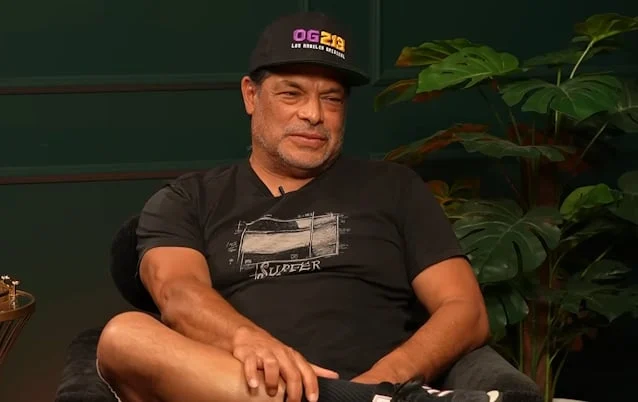
In a recent episode of the bi-weekly video podcast "Trying Not To Die," hosted by Jack Osbourne and Ryan Drexler, veteran bassist Robert Trujillo offered a candid and comprehensive look into his illustrious career. The conversation, broadcast on the popular platform, delved into Trujillo’s multifaceted journey through some of the most influential bands in rock music, including his foundational years with Suicidal Tendencies, his tenure with Ozzy Osbourne, and his ultimate arrival in the monumental ensemble, Metallica. The discussion provided an intimate glimpse into the behind-the-scenes realities of these significant career milestones, offering listeners a rich tapestry of anecdotes and insights.
Trujillo’s presence on "Trying Not To Die" served as a platform to revisit pivotal moments that shaped his trajectory. He spoke at length about the serendipitous nature of his entry into Metallica, a process that, much like his initial engagement with Ozzy Osbourne’s band, was characterized by a period of waiting and uncertainty. "Well, [me joining Metallica] was similar [to how I landed the gig with Ozzy] in that it took a while before I knew what was going on," Trujillo explained. "And in these situations, decisions like that, they don’t always just sort of happen overnight. There might be like three months and you’re, like, ‘What’s going on?’ And I know it took some time with your dad [Ozzy]. I don’t know why, but it took a minute, and then it took a minute again with Metallica. And that could’ve been because they were working on records and just life, business, and all that."
This period of transition, from 2003 onwards, was famously documented in the 2004 Metallica film "Some Kind Of Monster," which captured the internal dynamics of the band as they navigated the search for a new bassist following Jason Newsted’s departure. Trujillo’s account of this pivotal time highlights the swift and unexpected confluence of opportunities that presented themselves. He recounted a crucial 48-hour window that saw him fielding calls from two of hard rock’s most powerful figures. "But your dad had called and said… Maybe he knew something I didn’t know, because he called and said that he was gonna go on the road and do Ozzfest and, ‘Let’s go.’ And I was, like, ‘Yeah, let’s go.’ And then like the next day Lars [Ulrich, Metallica drummer] called and said, ‘Hey, we want you to come up to San Francisco. We gotta talk to you.’ So it’s just kind of weird how in those sort of 48 hours, there was two of the most powerful individuals in hard rock looking for me."
The Audition Gauntlet: A Test of Endurance and Resilience
Trujillo’s recollection of his Metallica audition, previously shared on the "WTF With Marc Maron" podcast in 2016, painted a vivid picture of a surreal and demanding experience. The audition process, which spanned two days, was not a straightforward showcase of musical prowess but rather an immersive and, at times, disorienting trial by fire. "It was a very surreal day for me," Trujillo stated. "But when you get a gig like that, it’s so… strange. Really, strange is the word. Because I remember going up there. I was late. I was always late back then."
The initial day of the audition was characterized by a sense of being an observer rather than an active participant. With the bass tracks for Metallica’s "St. Anger" album already laid down by producer Bob Rock, Trujillo found himself in a passive role. "The first day of the audition, I was kind of just there to be a fly on the wall," he recalled. "Bob Rock’s there. The bass for ‘St. Anger’ had already been recorded; Bob Rock recorded the bass. So I’m just hanging around. And Lars and James [Hetfield, Metallica frontman] and Kirk [Hammett, Metallica guitarist] kind of live in this bubble. They were just, like, ‘Yeah, make yourself at home. Just hang out.’"
This period of waiting and uncertainty extended into the late hours, culminating in an extended evening that would test Trujillo’s mettle. "Eleven o’clock rolls around at night, and Lars… We’re in the parking lot. We’re the last ones leaving. And Lars says, ‘Hey, man, let’s go get a drink. Let’s go get a nightcap.’ So I’m, like, ‘All right.’ And we go to the first bar, have a couple of cocktails, we go to the second bar, have a few more, go to the third bar. Then we end up at his house for more cocktails. By this time, it’s five in the morning." The consequences of this marathon session were immediate and profound. "I can’t even drive to where I’m staying; it’s impossible. And he even says, ‘Here, crash out in my guest room.’ So, at nine in the morning, four hours later, he’s on the treadmill, this guy, and it’s like he doesn’t know me anymore. He’s already sobered up. And he’s on the treadmill. And I’ve got this crazy headache. And then he’s, like, ‘All right. Let’s go. Let’s go to the studio.’ And I’m driving behind him. I couldn’t even keep my eyes open. I get to the studio."
The second day of the audition presented a unique set of challenges, compounded by Trujillo’s severe hangover and the band’s ongoing therapeutic sessions with life coach Phil Towle. This environment, characterized by introspection and emotional processing, was a stark contrast to the typical rock and roll milieu Trujillo was accustomed to. "This is when [the members of Metallica] were going through this sort of therapy thing, [with] this guy Phil Towle, who was… what do they call it? Kind of a life coach, kind of a motivator, which was, at the time, I guess, good for the band, but I wasn’t used to that," he explained. "Here I am with a pounding headache. James has just gone through this whole thing where, of course, he’s sober, and the last person he wants to see anywhere near his band is a drunk Mexican. That would be me. So I’m sitting at the table, and I’ve got the worst headache, [I’m] completely hung over. And I’m thinking, ‘Lars did this to me, ’cause he was checking me out, to see if I could hang with him.’ It was [a test]; it had to have been."
Despite the overwhelming physical discomfort, Trujillo found a way to navigate the situation, drawing on his prior connections and resourcefulness. "I stuck it out. I knew the tech, the bass tech, from back when Suicidal Tendencies was touring with Metallica, which would have been in 1993 on the ‘Black Album.’ So, Zach Harmon, who is now still my bass tech. I didn’t have a bass, so [I went], ‘Let’s go grab a bass. Let’s choose the amp setup.’ So I kind of used that as my way to get out of this hangover situation."
Musical Legacy and Evolving Performance Styles
Even in a compromised state, Trujillo’s performance during the audition was deemed successful, notably during their rendition of "Battery." "We played ‘Battery,’ and I think it helped me not be nervous," he remarked. "And that’s what you see in the film, and everybody seems to think it was pretty slamming. But other than that, I was brain dead. If I could play, I was fine. But in communicating with Hetfield, ’cause he would come over to me and ask me questions, and I would come up with really stupid answers, because, literally, I was not all there."
A humorous anecdote emerged regarding the attire provided for the audition. "When I watch ‘Some Kind Of Monster,’ I see myself wearing this brown Armani t-shirt, which I would never own in my life. You know why? ‘Cause it’s not mine. It’s Lars’s. His wife at the time, Skylar, gave me that shirt, because the one I’d been wearing, which was probably pretty funky, was not happening."
Trujillo also addressed the nuanced differences in approaching Metallica’s extensive catalog, particularly the distinct stylistic demands of the material originally recorded by former bassists Cliff Burton and Jason Newsted. Speaking to the "Talk Is Jericho" podcast, he elaborated on these distinctions. "A lot of the stuff that Bob Rock produced was a bit more… Obviously, groove is very, very important on those songs, like ‘Black Album’ songs. But then just really keeping it fairly simple in that style. With Cliff, we’re talking about a little bit more aggro, but tight. So they are different styles. I still play with my fingers, even on the ‘Black Album’ material."
His tenure in Metallica has also provided him with the opportunity to resurrect and perform songs that had long been absent from the band’s live setlists. "But the great thing about… What I can say I’m pretty proud of being in Metallica these years is being able to play, like, the ‘Black Album’ in its entirety – songs that were never played live: ‘The Struggle Within.’ There was about three songs on that album [that had never been played live]," he stated. "And even ‘Orion’… We play ‘Orion’ a lot now; it’s kind of an active song in the set. And that was a song that hadn’t really been played years before. And ‘Dyers Eve,’ off the ‘…And Justice For All’ album, that was a song that had never been played live as well. So the fact that, here we were, age 50, and we’re attacking songs that hadn’t been attacked… And in a lot of ways, I feel that that challenges us, and it actually makes this unit a better band."
A Journey Forged Through Iconic Bands
Robert Trujillo, born on October 23, 1964, in Santa Monica, California, has carved a distinguished path through the annals of rock music. His early career saw him gain significant recognition as the bassist for Suicidal Tendencies, a band known for its energetic and socially conscious punk-metal sound. Following his time with Suicidal Tendencies, Trujillo joined the band of metal icon Ozzy Osbourne, a move that further solidified his reputation as a formidable and versatile bassist. It was in 2003 that he achieved his most prominent role, successfully auditioning to replace Jason Newsted in Metallica, a position he has held with distinction ever since.
The legacy of Metallica’s bassist before Trujillo, Cliff Burton, remains a profound influence on the band and its fans. Burton tragically passed away in 1986 in a tour bus accident while the band was on the "Damage Inc. Tour" supporting their seminal album "Master Of Puppets." The memory of Burton’s innovative playing style and his impact on the band’s early sound continues to resonate within Metallica’s musical identity.
In a humorous revelation from a 2021 interview, Trujillo shared an amusing detail about the early days of his interaction with Metallica. He recounted how, during a joint tour in 1993 with Suicidal Tendencies, his band would often scavenge leftover dinners from Metallica’s catering. This lighthearted anecdote underscores the long-standing, albeit informal, connection between Trujillo and the members of Metallica, who, despite respecting his talent, harbored doubts about his willingness to join them. James Hetfield, in particular, admitted to thinking, "there’s no way he’s going to join us. He’s too amazing, he’s too spectacular."
Trujillo’s narrative, as presented on "Trying Not To Die," offers more than just a series of career highlights. It provides a compelling account of dedication, adaptability, and the sheer resilience required to navigate the demanding landscape of the global music industry. His journey from the vibrant Los Angeles scene to the pinnacle of heavy metal with Metallica is a testament to his enduring talent and his ability to forge meaningful connections, both musically and personally, across different eras and legendary lineups. The podcast episode serves as a valuable chronicle of a musician who has not only contributed significantly to the sonic tapestry of modern rock but has also embraced the complexities and unexpected turns that define a truly remarkable career.
