

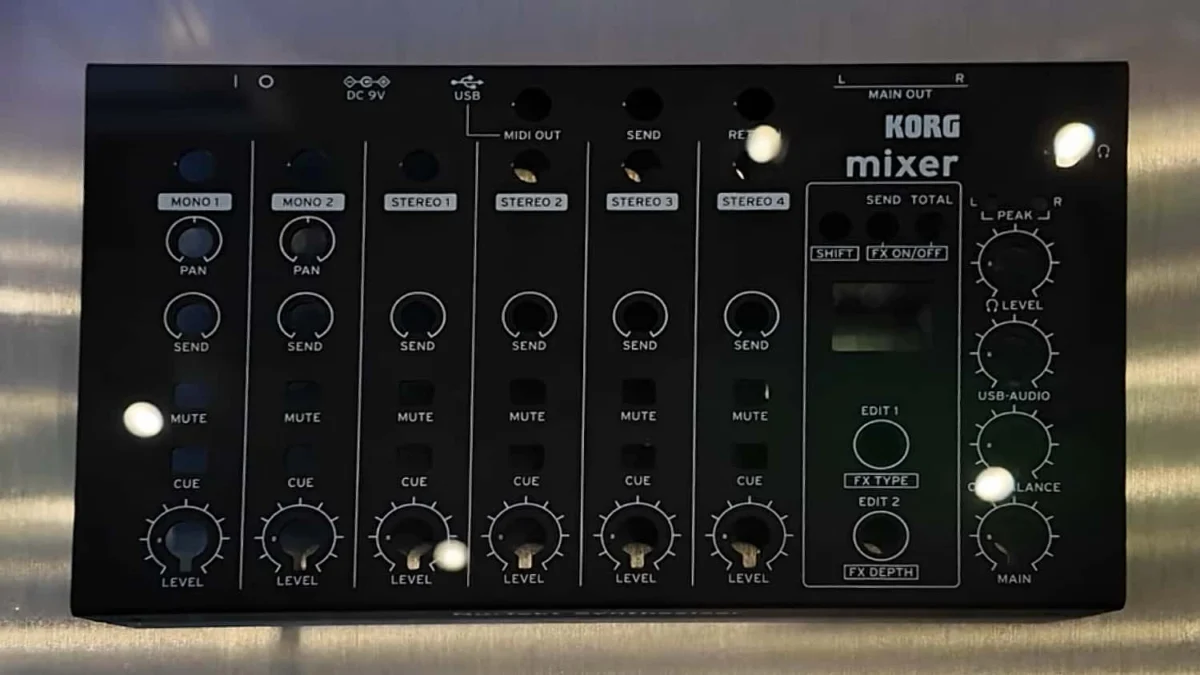
The release of the Korg NTS-4 Performance Mixer marks a significant expansion of the company’s Nu:Tekt line, a series of build-it-yourself hardware kits designed to offer high-quality synthesis and processing in a portable, accessible format. Priced at $249.99, the NTS-4 is positioned as a central hub for electronic musicians who utilize compact setups, such as the Korg Volca series, Teenage Engineering Pocket Operators, or various modular configurations. The device integrates a multi-channel mixer with a dual-engine effects processor and a high-resolution USB audio interface, providing a comprehensive solution for both live performance and studio recording.
The NTS-4 follows in the footsteps of the NTS-1 Digital Kit, the NTS-2 Oscilloscope, and the NTS-3 Kaoss Pad, maintaining the solderless assembly philosophy that has made the Nu:Tekt series popular among hobbyists and professional musicians alike. By offering a 24-bit/48kHz audio interface alongside physical performance controls, Korg aims to bridge the gap between traditional analog mixing and modern digital workflows.
Technical Specifications and Connectivity
The architecture of the Korg NTS-4 is centered around its versatile input-output configuration. The mixer features two dedicated mono inputs and four stereo inputs, allowing for the simultaneous management of up to six distinct sound sources. This configuration is particularly suited for desktop performers who often juggle multiple small-format synthesizers and drum machines.
Beyond standard mixing, the NTS-4 includes a dedicated stereo send and return loop. This allows users to integrate external hardware processors or pedals into their signal chain without sacrificing internal channels. For monitoring, the device provides a dedicated headphone output and a sophisticated cue monitoring system. The cue mix feature—rare in mixers of this size—enables performers to monitor a channel via headphones before introducing it to the main mix, a critical function for seamless live transitions.
The internal digital processing is handled at a 24-bit depth and a 48kHz sampling rate. This ensures that the audio quality remains high enough for professional recording environments. The inclusion of a two-channel USB audio interface allows the NTS-4 to function as a direct link to a Digital Audio Workstation (DAW) or a mobile device. This functionality is further enhanced by a dedicated USB return level control, which manages the volume of audio coming back from a computer or smartphone, facilitating "loopback" recording or playing along with backing tracks.
The Evolution of the Nu:Tekt Series
To understand the significance of the NTS-4, one must look at the chronology of Korg’s DIY initiatives. The Nu:Tekt brand was established to provide musicians with a more intimate understanding of their hardware. The series began with the NTS-1, a monophonic synthesizer that gained a cult following due to its support for the Logue SDK (Software Development Kit), allowing users to load custom oscillators and effects.
In the years following the NTS-1, Korg released the NTS-2, which focused on visualization and education through its four-channel oscilloscope and tuner functions. This was followed by the NTS-3, which adapted the famous Kaoss Pad touch-interface into the DIY format. The NTS-4 represents the most utilitarian entry in the series to date. While previous models were focused on sound generation or manipulation, the NTS-4 focuses on the structural necessity of signal management.
However, a notable departure from the NTS-1 and NTS-3 is the lack of support for the Logue SDK in the NTS-4. Korg has confirmed that the mixer’s effects are fixed and cannot be customized by user-written code. While this may disappoint the developer community, the decision was likely made to prioritize the stability and low-latency performance required for a multi-channel mixer and audio interface.
Dual Effects Engines and Performance Controls
A primary selling point of the NTS-4 is its integrated dual effects section. The device splits its processing power into two distinct categories: Send Effects and Master Effects.
The Send Effects engine is designed for spatial and modulation processing. It includes a variety of delays, reverbs, and choruses. Because these are on a send/return bus, the user can dial in the amount of effect applied to each individual channel, allowing for a depth of mix that is often impossible on small-format mixers.
The Master Effects engine acts on the summed output of the mixer. This section is designed for "end-of-chain" processing and includes:
- Filters: High-pass and low-pass options for tonal shaping.
- Phaser: For rhythmic movement and texture.
- Decimator: For lo-fi and bit-crushing textures.
- Drive and Distortion: To add harmonic warmth or aggressive grit.
- Compression and Limiting: Essential tools for controlling dynamic range and ensuring the final output is "radio-ready" or safe for PA systems.
The layout of the NTS-4 emphasizes hands-on control. Despite its small footprint, the mixer includes dedicated knobs and buttons for volume, mutes, and effect parameters. This tactile feedback is essential for the "performance" aspect of the mixer’s name, allowing for expressive changes during a set.
Sonic Lab Review and Performance Insights
In a detailed technical review by Sonic Lab, host Nick Batt explored the practicalities of the NTS-4 build and its sonic performance. The assembly process remains consistent with the Nu:Tekt brand: a solderless experience that takes approximately 20 to 40 minutes. The kit includes the necessary tools and a transparent protective case, though some users may find the exposed PCB (Printed Circuit Board) design requires careful handling in dusty or humid environments.
Batt highlighted the "Cue Mix" and pre-fade monitoring as standout features for the price point. In the context of a live performance, being able to check if a synthesizer is in tune or if a sequence is running correctly before the audience hears it is a professional-grade luxury.
The review also addressed potential challenges regarding USB power. Like many small USB-powered devices, the NTS-4 can be susceptible to ground loop noise when connected to multiple powered instruments and a computer simultaneously. Batt noted that while the audio quality is generally clean, users might need to employ USB isolators or high-quality power banks to ensure a silent noise floor in complex setups.
The integration with mobile devices was another point of praise. The NTS-4 was tested with smartphones and the BandLab application, proving to be a capable "on-the-go" recording interface. This makes it a viable tool for content creators and field recordists who need to mix multiple inputs into a single stereo stream for mobile broadcast or recording.
Market Context and Competitive Landscape
The NTS-4 enters a market that has seen a surge in interest for "DAWless" and compact performance gear. Historically, musicians had to choose between large, bulky analog mixers or expensive, high-end digital solutions.
The NTS-4 competes directly with several notable products:
- Teenage Engineering TX-6: While the TX-6 offers more features (including a synthesizer and drum machine), it is priced significantly higher at nearly $1,200. The NTS-4 offers a similar "tiny mixer" philosophy at a fraction of the cost.
- 1010music Bluebox: A touchscreen-based digital mixer and recorder. The Bluebox offers more recording capabilities (multi-track to SD card) but lacks the immediate physical knobs and the DIY appeal of the Korg unit.
- Korg Volca Mix: Korg’s own entry-level analog mixer. The Volca Mix is cheaper but far more limited, offering only three channels and basic analog effects.
At $249.99, the NTS-4 sits in a "sweet spot" for hobbyists who have outgrown basic mixers but are not yet ready to invest in high-end studio consoles. Its 24-bit interface provides a clear upgrade path for those looking to record their performances with higher fidelity.
Implications for the Electronic Music Community
The introduction of the NTS-4 suggests a continuing trend toward modularity and portability in the music industry. As more musicians move away from traditional computer-centric setups toward "tabletop" configurations, the need for intelligent, compact routing becomes paramount.
The NTS-4 also reinforces the value of the DIY market. By allowing the user to build the device, Korg fosters a sense of ownership and technical literacy. While the lack of SDK support might be seen as a limitation, the inclusion of master-bus compression and limiting shows that Korg is focusing on the practical needs of the performing musician—ensuring that their final sound is polished and professional.
Furthermore, the NTS-4’s ability to act as a bridge between mobile devices and hardware synthesizers aligns with the growth of mobile music production. As iPads and smartphones become more powerful as recording platforms, hardware like the NTS-4 becomes the essential "glue" that holds a hybrid setup together.
Conclusion
The Korg NTS-4 Performance Mixer Kit is a multifaceted tool that addresses several needs within the modern electronic music landscape. By combining a multi-channel mixer, a dual-engine processor, and a high-quality USB interface into a $250 DIY kit, Korg has provided a high-value entry point for musicians seeking to organize and enhance their compact setups. While it sacrifices the customizability of the Logue SDK, it gains professional utility through its cue monitoring, master effects, and high-resolution audio conversion. As the Nu:Tekt line continues to evolve, the NTS-4 stands as a testament to the brand’s ability to turn complex audio engineering into an accessible, hands-on experience.
